Wicca
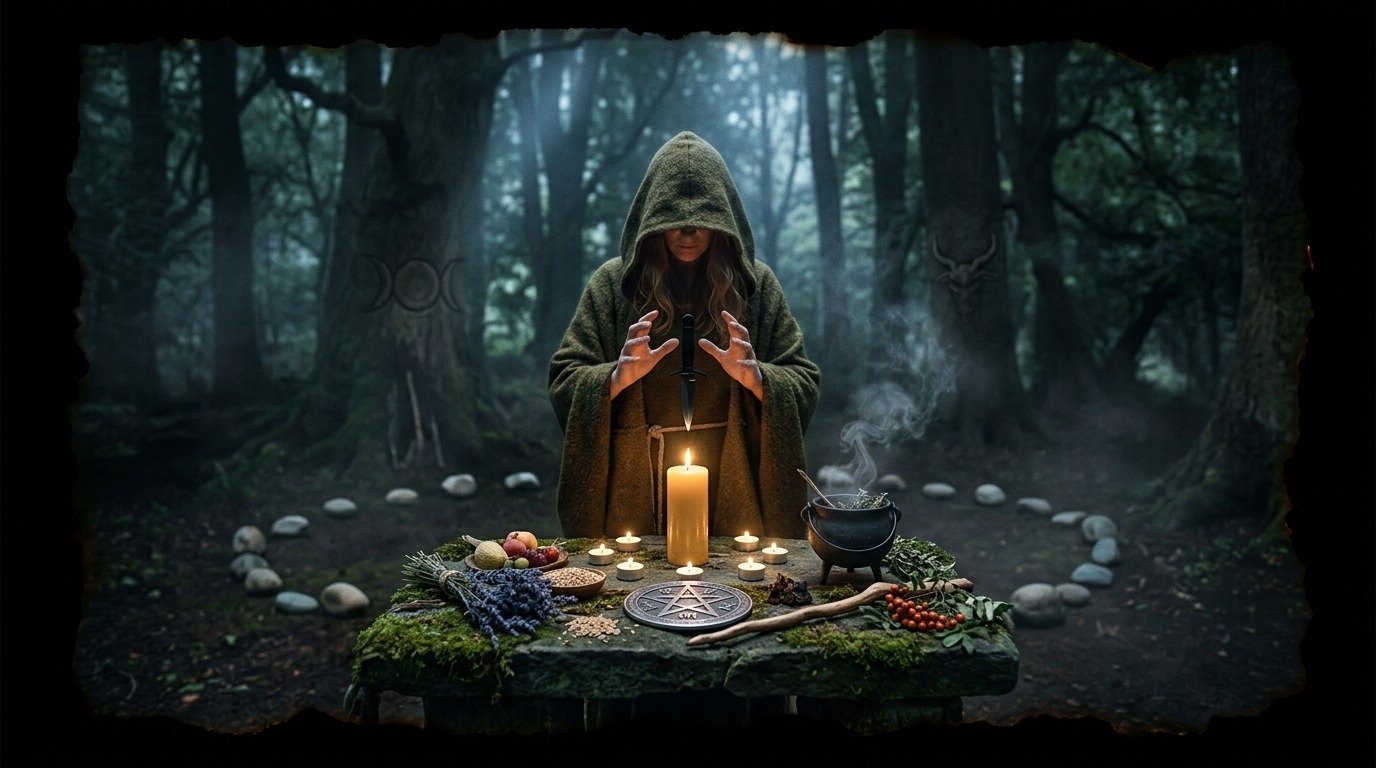
Wicca: The Rebirth of Modern Witchcraft
Definition and Essence
Wicca is a Neo-Pagan, duotheistic, and nature-oriented religion, structured in the mid-20th century in the United Kingdom. Its doctrine is based on the veneration of the creative force polarized into two main deities: the Mother Goddess and the Horned God. It is defined as an initiatory tradition of mysteries and practical witchcraft, where followers practice sympathetic magic and attunement with the seasonal cycles of the Earth to achieve spiritual and personal growth.
Origin and History
Wicca was founded and made public by British civil servant Gerald Gardner in the early 1950s, following the repeal of the witchcraft laws in England in 1951. Gardner claimed to have been initiated in the 1930s into a secret coven of surviving witches in the New Forest, Hampshire, which was the repository of an ancient pre-Christian fertility cult. To codify the Wiccan system, Gardner supplemented folkloric knowledge with elements drawn from the Hermetic Order of the Golden Dawn, the writings of Aleister Crowley, Margaret Murray's witch-cult hypothesis, and classical European folklore. From the original Gardnerian line, various branches emerged: * **Alexandrian Wicca:** founded by Alex Sanders, with a greater emphasis on high ceremonial magic. * **Dianic Wicca:** an exclusively feminist branch centered solely on the worship of the Goddess and female empowerment. * **Solitary or Eclectic Wicca:** individual practitioners who freely adapt rituals, popularized by authors like Scott Cunningham in the 1980s.
Cosmology and Deities
Divinity in Wicca manifests through the complementary duality of the cosmos: * **The Triple Goddess:** represents the Moon and its three visible phases: the Maiden (birth, renewal, growth), the Mother (maturity, creation, love, fulfillment), and the Crone (wisdom, death, transmutation, and winter). * **The Horned God:** represents the Sun, wildlife, the hunt, male sexuality, and the cycle of vegetation that dies and is reborn annually. He is associated with historical and mythological figures such as Cernunnos, Pan, or Herne the Hunter. Wiccan morality is guided by the **Wiccan Rede**, whose maxim is: *"An it harm none, do what ye will"*. This guideline of individual responsibility is reinforced by the **Threefold Law**, a metaphysical postulate holding that all energy—beneficial or harmful—sent out into the world will return to its original sender multiplied threefold.
Practice, Liturgy, and Rituals
Practitioners traditionally organize themselves into small circles called *covens* (often limited to a symbolic number of thirteen people), led by a High Priestess and a High Priest. There is also a vast community of solitary practitioners. The liturgical calendar of Wicca follows the **Wheel of the Year**, which commemorates the relationship of the God and the Goddess through the cycle of the Earth's seasons. It consists of eight festivals or *Sabbats*: four major (Samhain, Imbolc, Beltane, Lughnasadh) and four minor (Yule, Ostara, Litha, Mabon). In parallel, *Esbats* are celebrated, corresponding to the phases of the full moon, dedicated to meditation, practical magic, and communion with the Goddess. Rituals involve the consecration of a temporary sacred space by casting a magic circle. Within this circle, traditional tools of elemental and symbolic correspondence are used: * The **Athame:** a black-handled ceremonial dagger used to direct will and magical energy (air or fire element). * The **Wand:** an instrument for channeling energy and invoking subtle beings (fire or air element). * The **Pentacle:** a metal or wooden plate inscribed with a five-pointed star, used to consecrate objects or food (earth element). * The **Chalice:** a consecrated cup for ritual wine that symbolizes the womb of the Goddess (water element).
Current Presence and Myths
Wicca is a global religion, legally recognized in countries such as the United States and the United Kingdom. It has no centralized hierarchy, which fosters broad freedom of interpretation. The most widespread myth claims that Wiccans worship Satan or perform demonic-style malevolent practices. Wiccan theology lacks the concept of an entity of absolute evil or the biblical devil, notions that belong exclusively to the conceptual framework of Abrahamic religions.
Esoteric Connections
Wicca is closely related to contemporary Neo-Paganism, modern Druidry, nineteenth-century Hermeticism, and the English Hermetic Qabalah, systems from which it adopted its conception of the microcosm and planetary correspondences.
Comments
Share information, an experience, or a source to help enrich this entry. They are automatically reviewed before being published.
Loading comments...