Magic circle
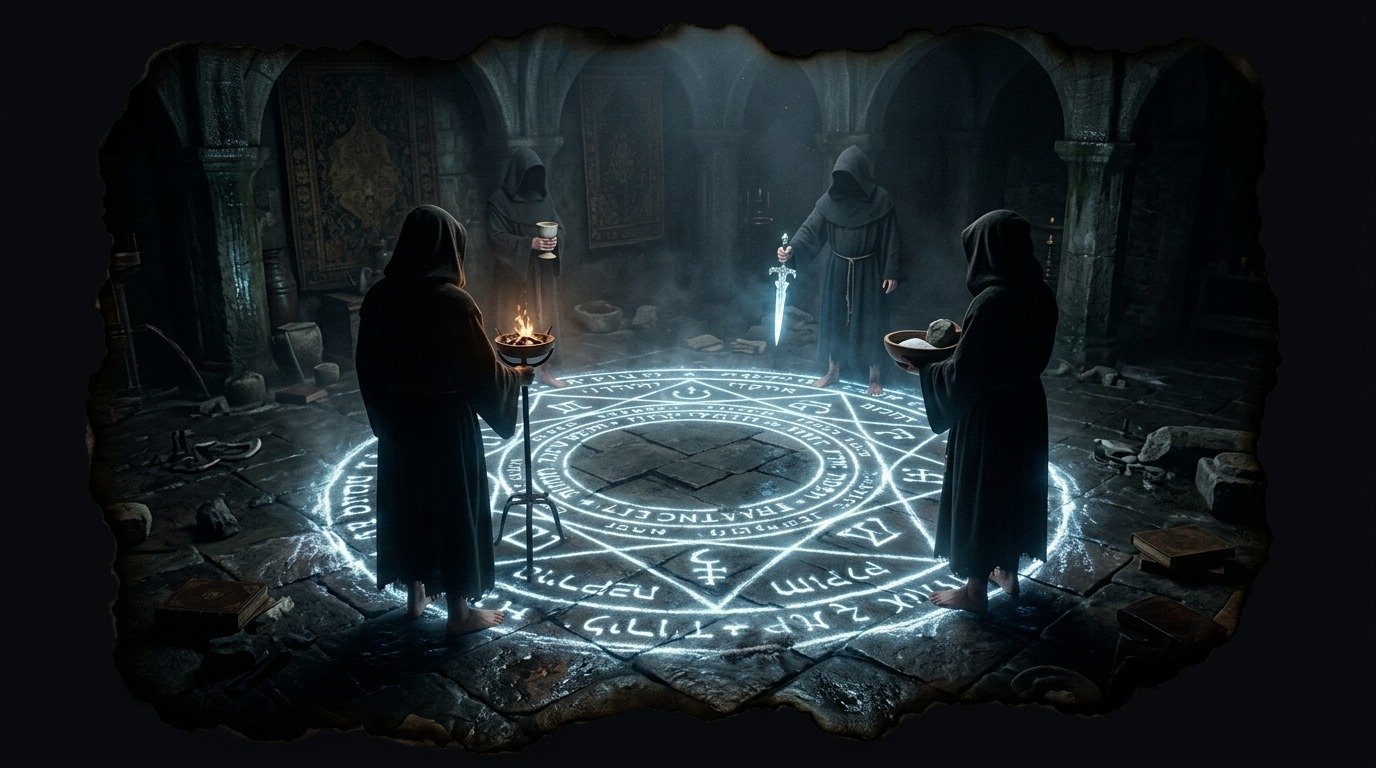
Magic circle: the consecration of sacred space and the protective boundary
What it is and what it is like
The magic circle is a boundary demarcated on the ground or in three-dimensional space that separates the ritual environment from the everyday, profane world. Physically, it is drawn as a continuous line using chalk, salt, charcoal, paint, or by projecting it mentally with consecrated tools. Traditionally, it includes inscriptions on its outer perimeter: names of divine power, astrological symbols, and words of protection in Hebrew, Latin, or Greek. Its diameter varies according to the number of participants, with the classic standard being nine feet (approximately 2.7 meters).
Origin and history
The use of protective circles dates back to the apotropaic rituals of ancient Babylonia, where priests drew perimeters of flour and water to defend the sick from the demons of disease. In the medieval magic of Europe, the drawing of the circle was systematized in texts such as the *Grand Grimoire* and the *Clavicula Salomonis*, becoming an indispensable step before any operation involving the invocation of spirits of a hostile nature.
In the 20th century, Gerald Gardner integrated the magic circle into modern Wicca, redefining it not only as a defensive shield against dangerous entities, but as a three-dimensional container of concentrated beneficial energy and a meeting point between the human and spiritual worlds.
Meanings in each tradition
In ceremonial magic and Goetia, the circle represents an impregnable fortress. The magician operates strictly from within the circle, which remains sealed against the spirits that are summoned *outside* of it, typically confined to a separate triangle of manifestation. Any physical or mental breach of the circle during the invocation exposes the magician to direct attack from the entities.
In Wicca and Neopaganism, the circle is considered a non-physical portable temple, a space that is situated "outside of ordinary time and space." It represents the totality of Creation and the wheel of the year.
Magical or ritual use
The casting of the circle follows a strict protocol. The magician physically cleanses the ritual space. Using a ceremonial sword, an athame, or a wand, the magician projects energy in a clockwise direction (deosil or clockwise), starting in the East. The four cardinal points of the circle are consecrated, associating them with their corresponding elements (East-Air, South-Fire, West-Water, North-Earth).
Once the circle is closed, no participant can cross its physical boundary without performing a temporary ritual opening of the casting through a specific gesture to prevent the dissipation of energy or the entry of unwanted external influences. At the end of the ritual, the circle is dissolved by tracing it in a counterclockwise direction (widdershins).
Presence in popular culture and connections
The magic circle is one of the most recognizable visual elements of witchcraft in cinema, anime, fantasy literature, and role-playing video games, where it often lights up with glowing runes to indicate the activation of a spell. It connects with the use of the athame and the ceremonial sword, with classical ceremonial magic, Wicca, and the invocation of Goetic spirits.
Comments
Share information, an experience, or a source to help enrich this entry. They are automatically reviewed before being published.
Loading comments...