Ouroboros
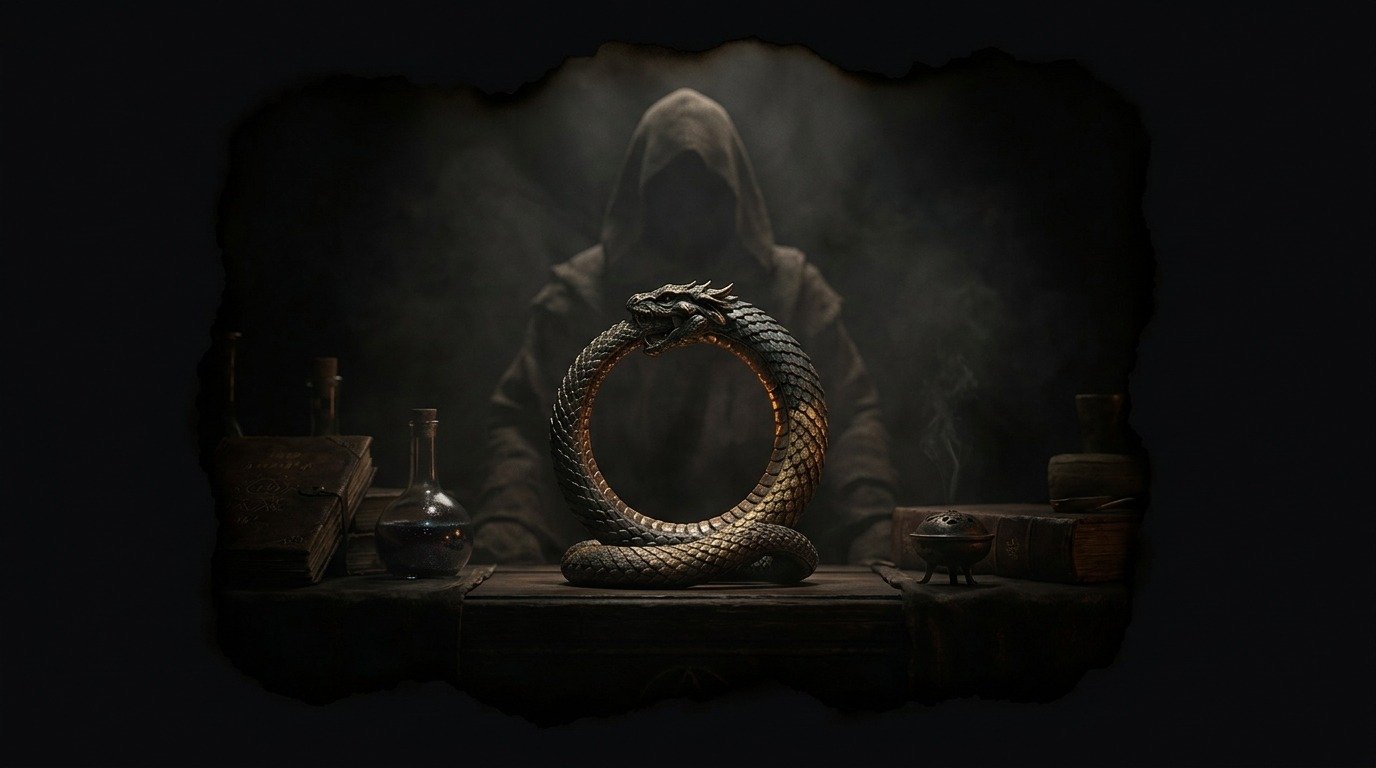
Ouroboros: Eternity and the Infinite Cycle of Transmutation
What It Is and What It Looks Like
The Ouroboros is the iconographic representation of a serpent or a dragon biting and swallowing its own tail, forming a perfect circle with its body. Its design combines the stillness of the circular shape with the dynamism of the perpetual motion of the animal feeding on itself. In some medieval and Renaissance representations, the reptile is shown divided into two halves, one light and one dark, marking a complementary duality within unity.
Origin and History
The oldest surviving representation of the Ouroboros is found in the *Enigmatic Book of the Netherworld*, an Ancient Egyptian funerary text discovered in the tomb of Tutankhamun (14th century BC). There, it surrounds the feet and head of the sun god on his nightly journey, symbolizing the cycle of solar rebirth.
The symbol passed to Hellenistic Greece and became a key piece of Alexandrian alchemy. In the manuscript *The Chrysopoeia of Cleopatra* (3rd century AD), the drawing of the Ouroboros appears accompanied by the Greek inscription "Hen to Pan" ("The All is One"). The Gnostics adopted the symbol in works such as the *Pistis Sophia*, where it describes the outer boundary of the physical world before the celestial dimensions.
Meanings in Each Tradition
In alchemy, the Ouroboros represents the cyclic process of matter: the repeated dissolution and coagulation inside the flask. It is the symbol of philosophical mercury and the self-sufficient nature of prime matter, which needs nothing external to transmute.
In Gnosticism, it embodies the nature of linear time consuming its own creation, trapping souls in the cycle of rebirth and dense matter.
In the analytical psychology of Carl Jung, the Ouroboros represents the primordial psychic state of the human being: the archaic unconscious, where individual opposites have not yet differentiated and the ego resides in a state of protective latency.
Magical or Ritual Use
Unlike other symbols, the Ouroboros is not commonly used as an active drawing tool in ritual space, but rather as an object of contemplation and a seal of hermetic consecration.
It is engraved on alchemical vessels, journals of operations, and ritual tools to seal their purpose within the laws of eternal nature. Its visual presence serves to remind the magician of the great hermetic law that all destruction precedes creation, and that the matter of the universe is constant and indestructible.
Presence in Popular Culture and Connections
The Ouroboros is a common visual element in contemporary tattoo design, album covers, and mystery and science fiction television series. Its concept of circular time connects directly with Friedrich Nietzsche's theory of eternal return, with the figure of the dragon in Norse mythology (Jörmungandr), and with the concepts of transmutation in Alchemy.
Comments
Share information, an experience, or a source to help enrich this entry. They are automatically reviewed before being published.
Loading comments...