Philosopher's Stone
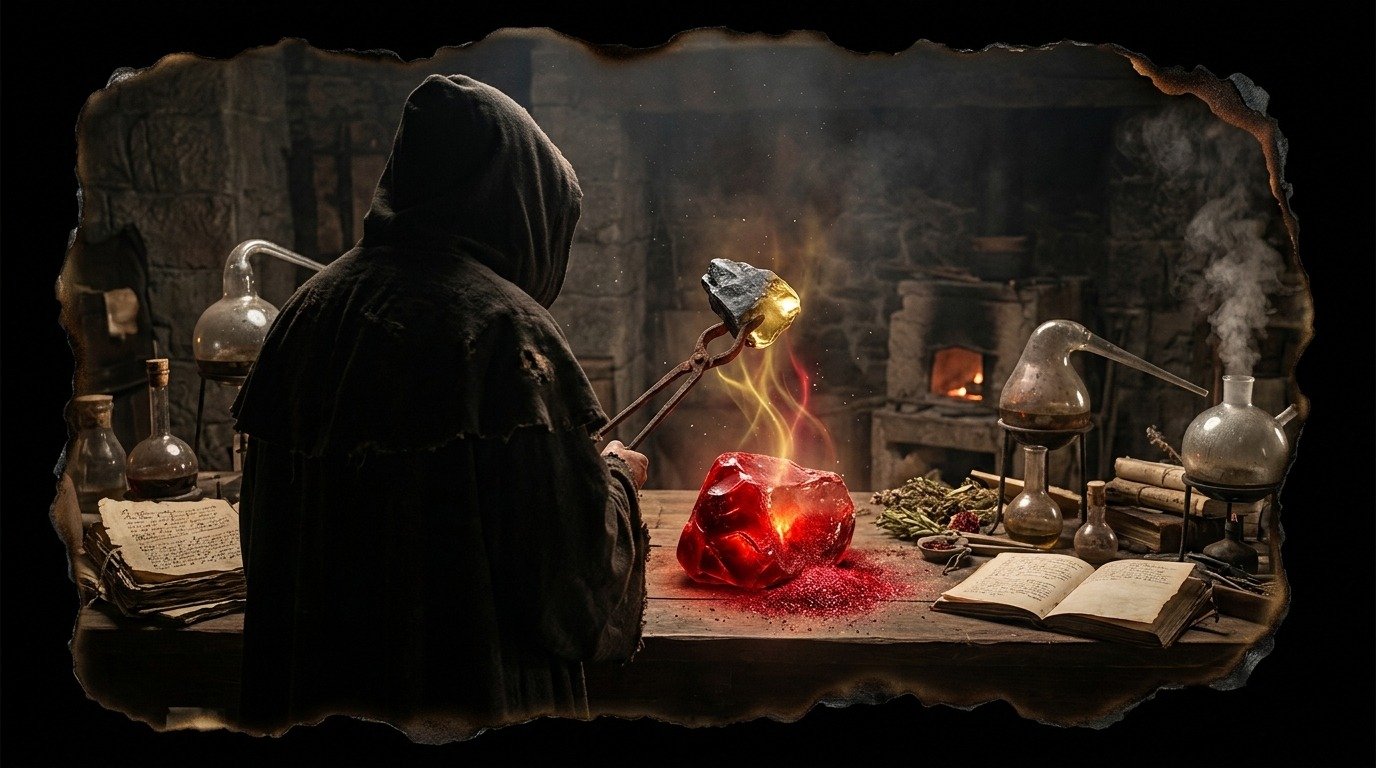
Philosopher's Stone: the agent of absolute transmutation
What it is and what it is like
The philosopher's stone is the mystical and material substance that constitutes the supreme goal of alchemy. It is not a stone in the strict mineral sense. Hermetic texts describe it as a dense, brilliant, and heavy powder, or as a solid material of an intense red color, translucent and malleable like wax. Two fundamental properties are attributed to it: the transmutation of base metals (such as lead, tin, or mercury) into perfect metals (gold and silver), and the creation of the Elixir of Life, a universal medicine capable of curing any disease, rejuvenating the body, and granting physical immortality.
Origin and history of the symbol
The concept of a transmuting agent arose in Hellenistic Egypt, in the first centuries of the Common Era, from the fusion of practical metallurgy, Greek philosophy, and Eastern mysticism. The alchemist Zosimos of Panopolis, in the 4th century, already mentioned the existence of a "tincture" or substance capable of perfecting metals. With the expansion of Islam, this knowledge transferred to the Arab world. The polymath Jabir ibn Hayyan (known in the West as Geber) developed in the 8th century the theory of sulfur and mercury as components of all metals. According to his system, the philosopher's stone—which the Arabs called *al-iksir*, the origin of the word elixir—is the necessary catalyst to perfectly balance these two principles in a base metal and elevate it to the state of gold. The idea of the stone reached medieval Europe in the 12th century through translations from Arabic to Latin. During the Middle Ages and the Renaissance, philosophers and theologians such as Albertus Magnus, Roger Bacon, and Paracelsus dedicated treatises to its study. The figure of Nicolas Flamel, a 14th-century Parisian scribe, became the symbol of the alchemist who achieves success, although the chronicles of his physical transmutation are legendary additions from the 17th century.
Meanings in each tradition
In operative alchemy, the philosopher's stone is a real physical substance obtained in the laboratory after a long process of purification and cooking of the prima materia in the crucible. In spiritual alchemy and Hermeticism, the stone is a symbol of the perfected human soul. The transmutation of lead into gold represents the elevation of mundane and corruptible consciousness toward spiritual enlightenment and the immortality of being. Obtaining the stone is equivalent to the union of opposites: the masculine and the feminine, the spiritual and the material. In Rosicrucianism and the esoteric currents of the 17th century, the stone represents the restoration of man's original state before the Fall, and access to direct knowledge of divine laws and nature.
Magical and ritual use
In alchemical laboratory practice, the philosopher's stone acts through two ritualized processes: projection and multiplication. Projection consists of throwing a small amount of the stone (usually wrapped in wax) onto a crucible containing molten base metal to transform it into gold. Multiplication is the process by which the stone increases its own strength and quantity through repeated cycles of dissolution and coagulation in the hermetic vessel. In contemporary ritual magic, the philosopher's stone is not sought in a chemical laboratory, but is constructed on the astral or meditative plane. It is used as a talisman of centrality and power absolute. The magician visualizes the stone in their energy center to purify their subtle body, align their intentions, and effectively project their will onto material reality.
Presence in popular culture and connections
The philosopher's stone is the driving force behind numerous literary and artistic works. It appears in the novel *Harry Potter and the Sorcerer's Stone* by J.K. Rowling, where its properties of immortality and wealth are highlighted, and in the manga *Fullmetal Alchemist*, where it is presented as an object that bypasses the laws of equivalent exchange at the cost of human lives. It connects directly with symbols such as the Ouroboros (the serpent biting its own tail, symbol of the eternal cycle of the Great Work), the Rebis (the alchemical hermaphrodite representing the perfection of matter before obtaining the stone), and the historical figure of Nicolas Flamel.
Comments
Share information, an experience, or a source to help enrich this entry. They are automatically reviewed before being published.
Loading comments...