Nicolas Flamel
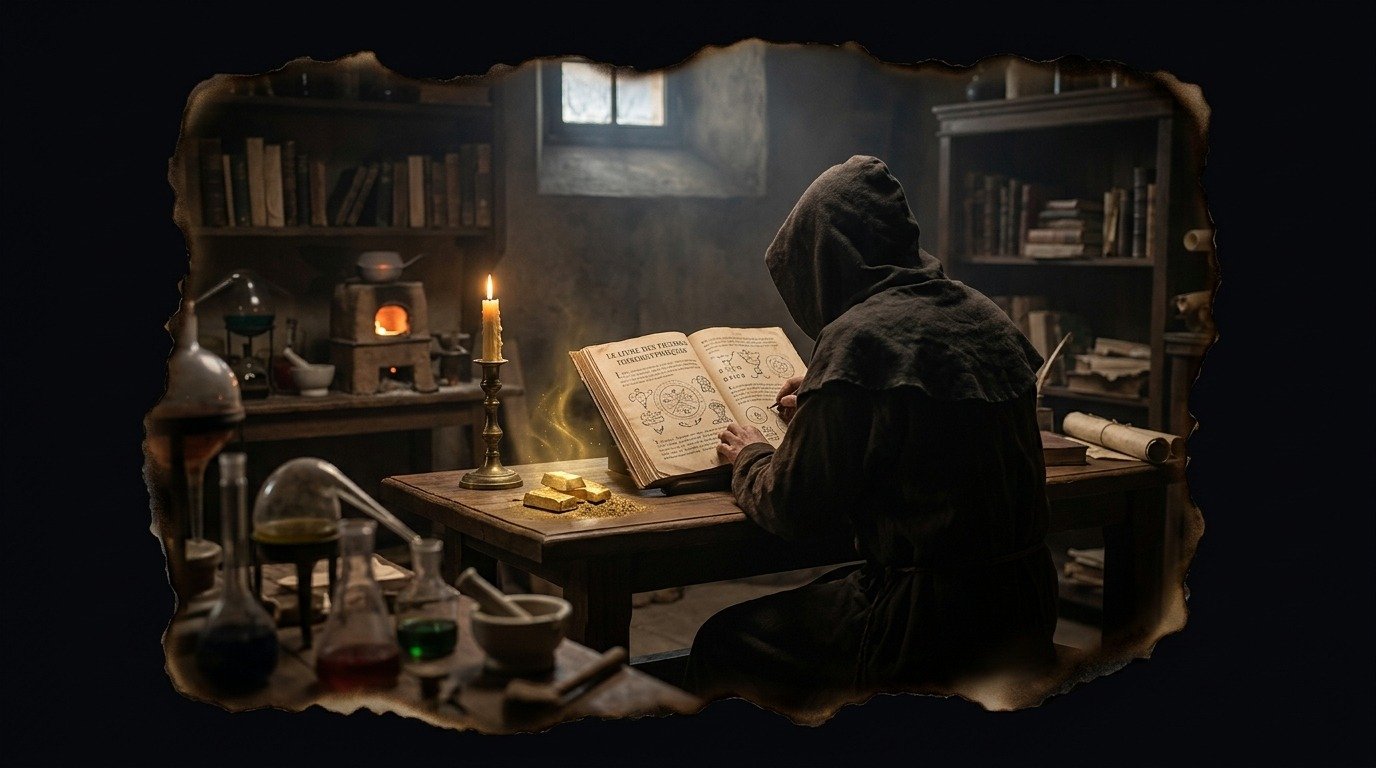
Nicolas Flamel: The Parisian Scribe and the Legend of the Philosopher's Stone
Who He Was
Nicolas Flamel was a bourgeois, copyist, bookseller, and sworn scribe who lived in fourteenth- and fifteenth-century Paris. While the historical Flamel was a wealthy businessman known for his generosity and charitable works, the legendary Flamel became the most celebrated French alchemist in history, credited with discovering the Philosopher's Stone, transmuting lead into gold, and achieving physical immortality.
Historical Life
He was born around 1330, probably in Pontoise, and died in Paris on March 22, 1418. He established himself in Paris as a copyist and bookseller, a lucrative profession at a time when all books were copied by hand. In 1368, he married Perenelle, a widow who brought a substantial dowry to the marriage. Through prudent financial management of his income and Perenelle's assets, the couple accumulated a remarkable fortune. Flamel devoted part of this wealth to pious and charitable works: documents of the period record donations to churches such as Saint-Jacques-de-la-Boucherie and the Holy Innocents' Cemetery, as well as houses intended to provide free lodging for the poor of Paris, on the condition that they pray for the souls of the deceased. Later alchemical tradition magnified this generosity, even attributing the founding of fourteen hospitals to him. Flamel's original tomb was located in the church of Saint-Jacques-de-la-Boucherie, of which only the Saint-Jacques Tower remains today. His tombstone, which he designed himself with religious and allegorical reliefs in 1410, is preserved and currently on display at the Cluny Museum in Paris.
Alchemical Doctrine and Legend
The legend of Flamel as an alchemist began to take shape at the end of the fifteenth century and was definitively consolidated in 1612 with the publication in Paris of *Le Livre des figures hiéroglyphiques* (*The Book of Hieroglyphical Figures*), an alchemical treatise published under his name. According to this account, in 1357 Flamel acquired for two florins an ancient book very different from standard manuscripts. It was a gilded manuscript written on sheets of tree bark, signed by "Abraham the Jew, prince, priest, levite, astrologer, and philosopher." The text contained illustrated instructions for performing the transmutation of metals, but the images were incomprehensible to the scribe. The legend describes the process of searching for and decoding the text: 1. **The Pilgrimage to Santiago de Compostela:** After twenty-one years of fruitless study, Flamel undertook a pilgrimage to Spain to seek out a wise kabbalist who could translate the manuscript. In León, he met Master Canches, a Jewish convert and physician who identified the book's figures as keys to the alchemical Great Work. Canches died of an illness during the return journey, but he had already provided Flamel with the keys to interpreting the symbolic images. 2. **The Great Work:** Flamel returned to Paris and, applying the interpreted instructions from the book of Abraham, successfully performed the first transmutation. According to the legend, on January 17, 1382, he transmuted half a pound of mercury into pure silver and, on April 25 of that same year, at five in the afternoon, transmuted mercury into pure gold in the presence of his wife Perenelle.
Historical Controversies
Contemporary historians and bibliophiles agree that the historical Nicolas Flamel did not practice alchemy: no document from his lifetime links him to it, and the first alchemical attribution appears decades after his death. Studies of the texts attributed to him reveal that they were written at the end of the sixteenth century by anonymous authors who used Flamel's name to lend authority to their alchemical treatises, taking advantage of the fame of his inexplicable wealth and philanthropic generosity. Another legend surrounding his figure claims that Flamel and Perenelle faked their deaths (hers in 1397 and his in 1418) and that the empty graves were ransacked by people looking for gold or the secret of the elixir of life. Various literary accounts from the seventeenth and eighteenth centuries claim to have seen the couple traveling through India, residing in Turkey, or attending the Paris Opera centuries after their official burials.
Legacy and Influence
Nicolas Flamel represents the triumph of the alchemical ideal: the attainment of material wealth put at the service of charity and the pursuit of spiritual regeneration through the Great Work. His Parisian house on the Rue de Montmorency, built in 1407 to house the needy, still stands and is one of the oldest stone houses in Paris. His name remains in the collective imagination and popular culture as the ultimate symbol of physical and spiritual immortality through the Philosopher's Stone.
Comments
Share information, an experience, or a source to help enrich this entry. They are automatically reviewed before being published.
Loading comments...