Hermes Trismegistus
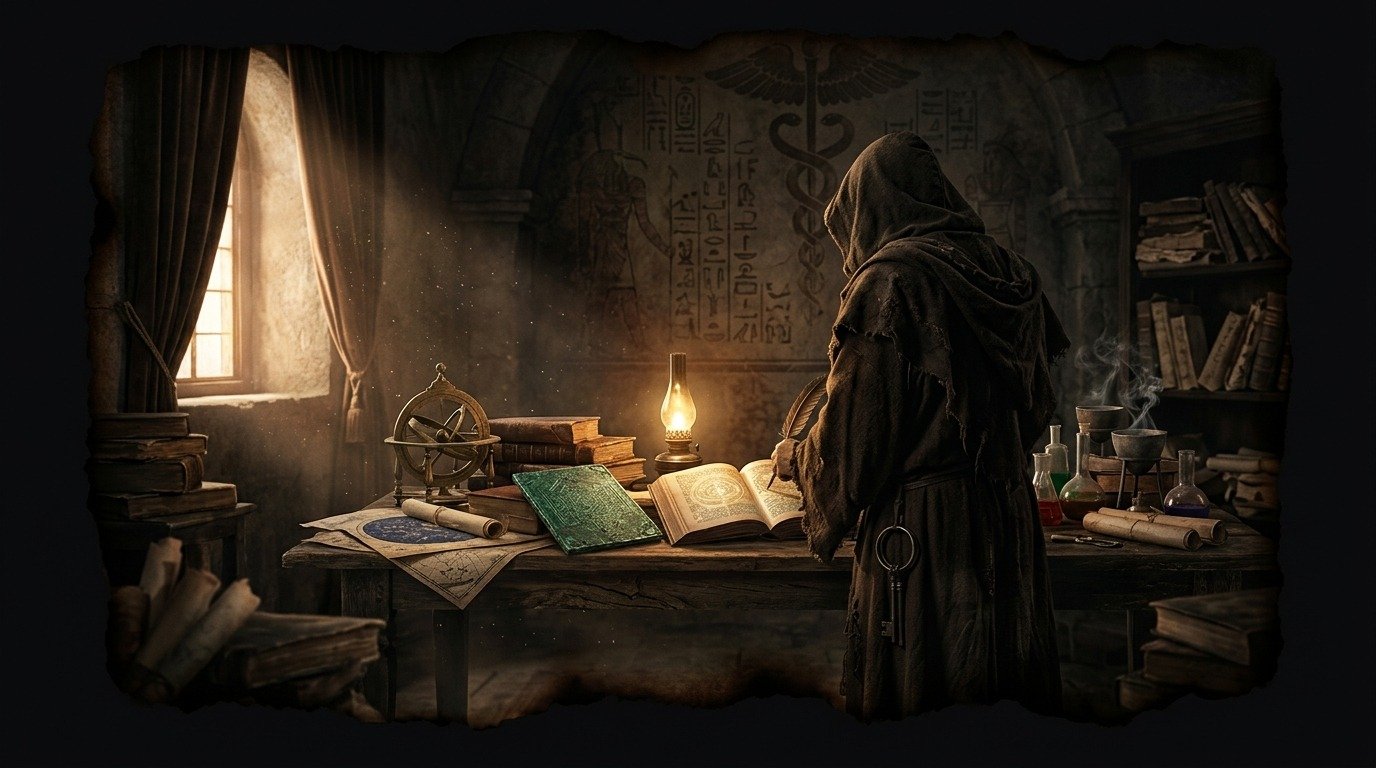
Hermes Trismegistus: The Founding Father of the Hermetic Current
Who He Was
Hermes Trismegistus, the "Thrice-Greatest," is the foundational figure of Hermeticism. He is a syncretic deity who unifies Thoth, the Egyptian god of wisdom, writing, and magic, with Hermes, the divine messenger of Greek mythology. For Western occultism, he is the spiritual lawgiver, the first alchemist, and the repository of the primordial wisdom of ancient Egypt.
History of the Myth and Origin of the Texts
The origin of this figure lies in Ptolemaic and Roman Egypt, between the 1st and 3rd centuries AD. In this environment of cultural fusion, the *Corpus Hermeticum* was written, a collection of seventeen philosophical and theological treatises written in Greek. These texts take the form of dialogues where Hermes Trismegistus instructs his disciples, such as Tat, Asclepius, or Ammon, in the mysteries of the cosmos. During the Middle Ages, knowledge of these works diminished in the West, but was actively preserved in the Islamic world. In 1460, the monk Leonardo of Pistoia brought a Byzantine manuscript of the *Corpus Hermeticum* to Florence. Cosimo de' Medici immediately ordered the philosopher Marsilio Ficino to halt his translation of Plato to translate these Hermetic texts into Latin, sparking the revival of ceremonial magic in Europe.
Doctrine and Magical Work
Hermetic teaching is divided into two complementary currents: philosophical Hermeticism and technical or practical Hermeticism. The pillar of the technical branch is the *Emerald Tablet* (*Tabula Smaragdina*), a brief text of Arabic origin (first attributed in the 8th century in the *Book of the Secret of Creation* by Balinas the Wise). Its most famous maxim defines the law of correspondence: "That which is below is like that which is above, and that which is above is like that which is below, to perform the miracles of the one thing." This principle establishes that the microcosm (the human being) exactly reflects the macrocosm (the universe), allowing one to act upon the environment through the manipulation of sympathetic correspondences. The technical Hermeticism encompasses three specific disciplines called the "three parts of the wisdom of the whole cosmos": 1. **Astrology:** The study of stellar forces and their influence on Earth, not as mere destiny, but as a structure of forces that the magician can channel. 2. **Alchemy:** The art of the transmutation of matter, understood as a physical and spiritual process of purification. 3. **Theurgy or Magic:** Ritual contact with celestial and divine entities to elevate human consciousness.
Legend and Controversies
During the Renaissance, scholars like Ficino, Giordano Bruno, and Giovanni Pico della Mirandola considered Hermes Trismegistus to be a real historical figure, an Egyptian priest and king contemporary with Moses who had prophesied Christianity. In 1614, the Swiss philologist Isaac Casaubon published a rigorous linguistic analysis of the *Corpus Hermeticum*. He demonstrated that the texts did not belong to ancient dynastic Egypt, but were written in the Hellenistic period by authors influenced by Platonism and Gnosticism. This historical discovery stripped the myth of its chronological antiquity, but did not diminish the coherence or operational value of its philosophy for practitioners of the occult.
Legacy and Influence
Hermeticism is the backbone of Western esotericism. Its concepts structure medieval and Renaissance alchemy, Christian Kabbalah, and ceremonial magic. In the 19th century, it directly influenced the founding of the Hermetic Order of the Golden Dawn. In 1908, the publication of *The Kybalion* by an anonymous group under the pseudonym of the "Three Initiates" adapted Hermetic principles to the language of 20th-century New Thought, consolidating the seven Hermetic principles (mentalism, correspondence, vibration, polarity, rhythm, cause and effect, and gender) in contemporary esoteric culture.
Comments
Share information, an experience, or a source to help enrich this entry. They are automatically reviewed before being published.
Loading comments...