Astrology
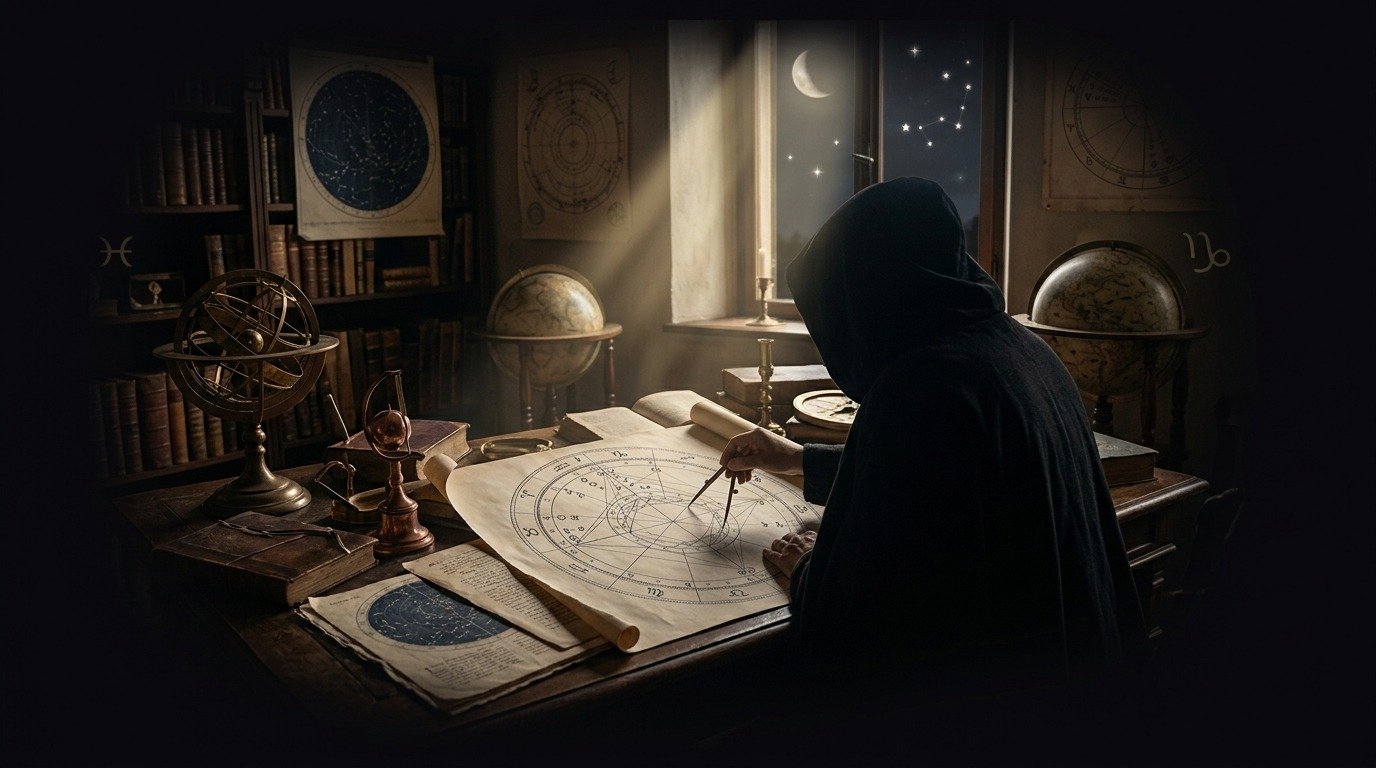
Astrology: The Language of the Stars and Time
What It Is
Astrology is a discipline and an interpretive art that studies the positions and movements of celestial bodies to understand their influence and correlation with life on Earth, human destiny, and the fluctuations of nature. It operates under the postulate that the celestial order reflects the terrestrial order.
How It Works
The astrological system is based on the astrological chart or birth chart. This is a mathematical representation of the geocentric sky at an exact moment, calculated for a specific location on Earth. The astrological chart is composed of four fundamental elements: - **The Zodiac**: A celestial band divided into twelve equal sectors of 30 degrees, called signs (Aries, Taurus, Gemini, Cancer, Leo, Virgo, Libra, Scorpio, Sagittarius, Capricorn, Aquarius, Pisces). Each sign represents an energetic quality and is associated with one of the four classical elements (Fire, Earth, Air, Water). - **The Planets**: The luminaries (the Sun and the Moon) and the celestial bodies (Mercury, Venus, Mars, Jupiter, Saturn, Uranus, Neptune, Pluto). They act as the active forces or psychological functions within the system. - **The Houses**: Twelve divisions of the chart representing sectors of human experience (the self, possessions, communication, home, creativity, health, partnerships, transformation, philosophy, career, groups, spirituality). - **The Aspects**: The specific geometric angles formed between the planets as seen from Earth (conjunction, sextile, square, trine, opposition). They determine how energy flows between the different planetary forces.
Origin and History
Astrology began in Mesopotamia during the third millennium BCE, where Babylonian priests observed the sky to predict state, weather, and dynastic events. This rudimentary astrology met Greek geometry and philosophy in Hellenistic Egypt (2nd century BCE), giving birth to horoscopic astrology, which introduced the use of the ascendant and the individualized interpretation of birth charts. In the 2nd century CE, Claudius Ptolemy wrote the *Tetrabiblos*, a work that systematized astrology under the laws of Aristotelian natural physics of the time. During the Middle Ages, astrological knowledge was preserved and expanded by scholars of the Islamic world, such as Abu Ma'shar. This knowledge returned to Western Europe through Spain and Italy in the 12th and 13th centuries. During the Renaissance, renowned astronomers such as Tycho Brahe, Johannes Kepler, and Galileo Galilei calculated astrological charts for monarchs and royal courts. With the rise of heliocentric astronomy and Isaac Newton's physics, astrology gradually separated from academic science in the late 17th century.
Key Figures
- **Claudius Ptolemy (c. 100–170 CE)**: Greek astronomer, geographer, and astrologer, author of the *Tetrabiblos*, the foundational text of classical astrology. - **Abu Ma'shar (787–886)**: Persian astrologer whose writings introduced Aristotelian astrology to medieval Europe. - **William Lilly (1602–1681)**: English astrologer who published *Christian Astrology*, the first comprehensive treatise on horary astrology in English. - **Alan Leo (1860–1917)**: Considered the father of modern astrology for simplifying the technical system and focusing it on personality analysis. - **Carl Gustav Jung (1875–1961)**: Swiss psychiatrist who integrated astrology into his theory of synchronicity.
How It Is Understood Today
In modern esotericism, astrology is practiced under two main currents: traditional astrology (focused on prediction and event analysis) and psychological or humanistic astrology (focused on self-knowledge). Although the modern scientific community classifies it as a pseudoscience due to its lack of a verifiable causal mechanism of action, contemporary historians value astrology as one of the great cultural forces of antiquity.
Connections
Astrology is intimately connected with Hermeticism (by virtue of the law of correspondence), Alchemy (the association of metals with planets), Kabbalah (the association of planets with the Sephirot), and Tarot (where the arcana represent planets and signs).
Comments
Share information, an experience, or a source to help enrich this entry. They are automatically reviewed before being published.
Loading comments...