Venus
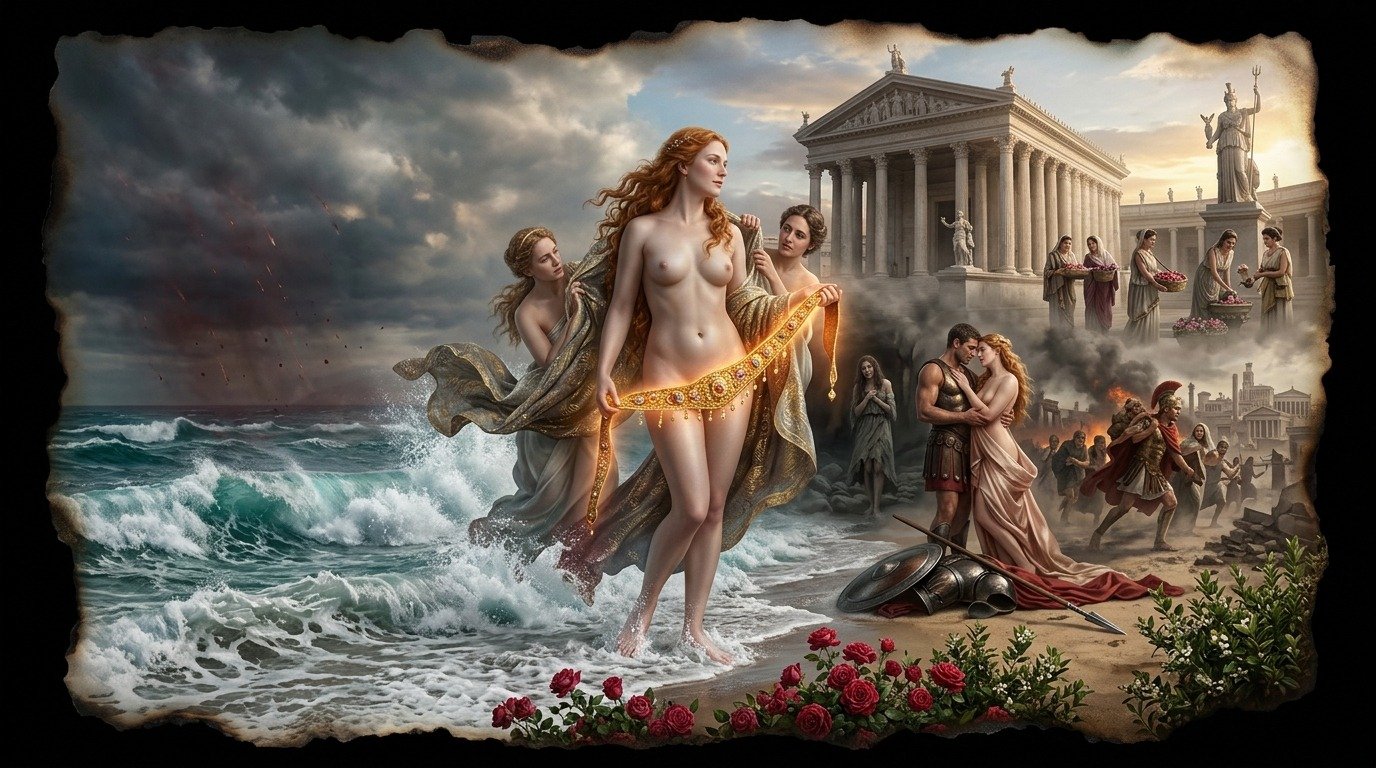
Venus: The Tide of Desire and the Mother of an Empire
The Rise of Foam and Blood
In the beginning of beauty, there was violence. Venus knew no childhood; she emerged already fully formed, perfect, and dazzling from the waves of the Cypriot sea, fertilized by the seed of heaven that fell after a great divine rebellion. When her mother-of-pearl feet touched the sand of the beach, the dry earth bloomed instantly, carpeting itself with red roses and fragrant myrtles. The Hours rushed to cover her celestial nakedness with cloaks of golden thread and led her before the court of the immortals, who were left speechless in the presence of the very embodiment of desire. For the Roman people, Venus was much more than the deity of physical attraction and passionate romance. She was the cosmic force that united opposing elements, the invisible gravity that maintained the order of the universe, and the biological mother of her own people. Through her mortal son, the Trojan hero Aeneas, Venus founded the lineage that centuries later would give rise to the dynasty of the Caesars. She was *Venus Genetrix*, the great mother of the Roman homeland, who watched from on high over the flourishing of her descendants and the success of their conquests.
The Force That Bends All
Venus's power was not exerted through the violence of swords, but through a sweet and inevitable submission. Her magic girdle possessed the gift of captivating anyone who looked upon it, disarming wills and bending even the hardest hearts. Not even Mars himself, the god of war who terrified mortals and immortals alike, could resist her charm. Venus would envelop him in her silken arms, and under the influence of her voice, the god of iron would forget his battles, drop his spear, and surrender completely to the repose of love. This sacred union between Venus and Mars represented for Rome the perfect balance of the cosmos: the tempering of strength by beauty, the peace that arises after the din of combat. However, her power could also manifest in a terrible way for those who dared to despise love or compete with her beauty. The myth of Psyche, a mortal princess so beautiful that men began to worship her instead of the goddess, unleashed the celestial wrath of Venus. She did not stop until she subjected the young woman to a series of impossible trials in the underworld, proving that mortal beauty is nothing but a passing shadow before the eternal splendor of divinity.
The Temple of the Mother of the People
Roman emperors, especially Julius Caesar, claimed direct descent from her blood. Majestic temples were erected in her honor in the Forum, where she was worshipped not only as the patroness of lovers, but as *Venus Victrix*, the goddess who granted victory on the battlefield by instilling irresistible courage in the breasts of her soldiers and demoralizing enemies with the despair of defeat. Each spring, during the festival of the Veneralia, the women of Rome washed her statue and crowned it with fresh flowers, asking for her guidance to maintain harmony in their homes and fertility in their wombs. Venus remained as the warm current flowing through the veins of the world, ensuring that, as long as desire existed, life would continue to make its way upon the earth and the glory of Rome would never cease to flourish. ***
Comments
Share information, an experience, or a source to help enrich this entry. They are automatically reviewed before being published.
Loading comments...