Vulcan
Vulcan: The Devouring Fire and the Secret of Metal
The God of the Roaring Depths
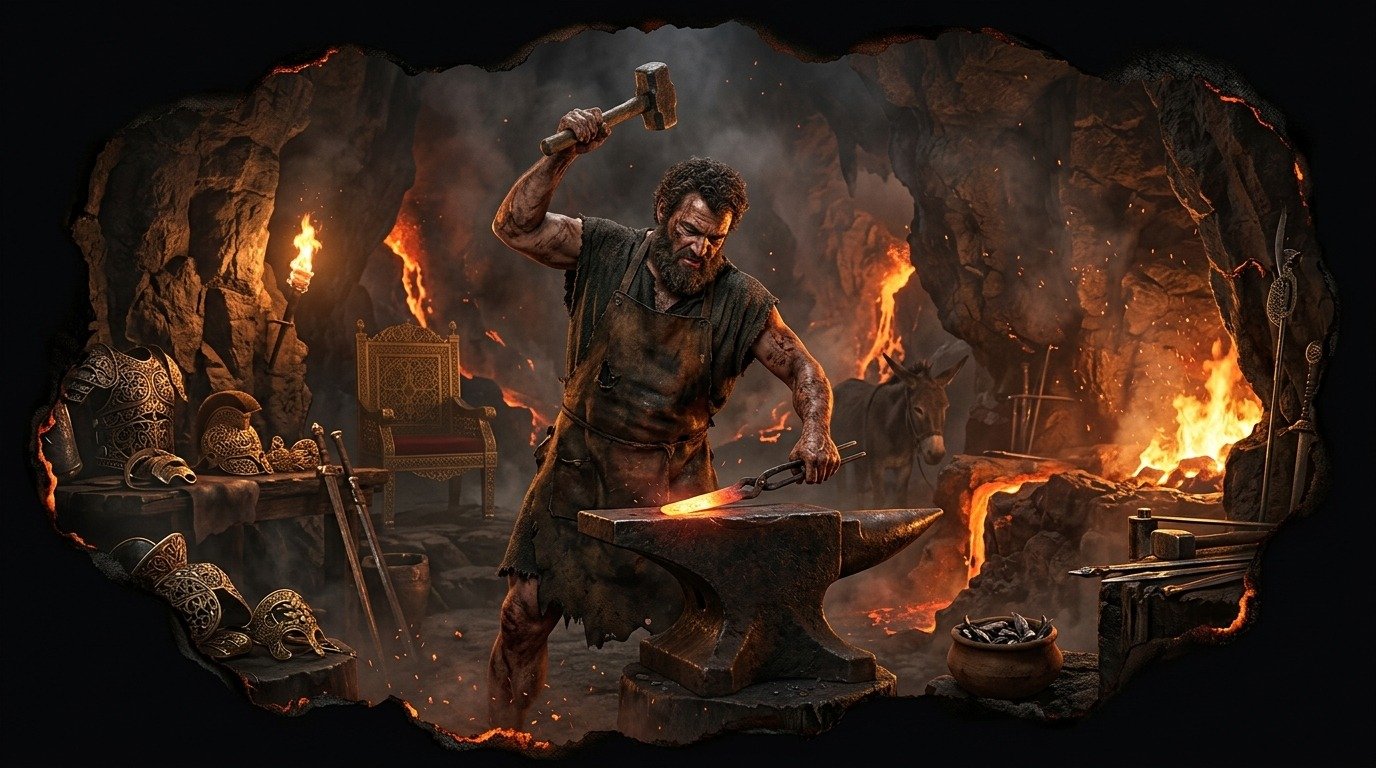
Beneath the roots of the mountains and the burning abysses of the islands of Sicily and Lipari, where the earth roars and spits ash and molten rock, lies the workshop of the blacksmith of the gods. Vulcan was born marked by physical imperfection. The story goes that his mother, Juno, seeing that her son had been born deformed and lame in both legs, felt such shame that she cast him down from the heights of Olympus to rid herself of him. The little god fell into the ocean for an entire day, saving his life thanks to the sea nymphs, who hid him in an underwater grotto. Far from consuming himself in the bitterness of his abandonment, Vulcan discovered in the depths of the earth the secret of fire and the malleability of metals. With only an anvil, a hammer, and tongs, he learned to master the flames that devoured everything in their path, turning the destructive force of fire into an art of divine precision. His rough yet wise hands were capable of forging the most delicate works and the most complex devices that had ever existed, earning the respect and fear of the rest of the gods who had once rejected him.
The Strike of the Sacred Hammer
Vulcan did not forget his mother's offense. To exact his revenge, he forged on his underground anvil a golden throne of unparalleled beauty, decorated with perfect filigree, and sent it to Olympus as a gift for Juno. Flattered by the gift, the queen of the gods sat upon it, but at that very instant, invisible cords of indestructible metal sprouted from the arms of the throne, imprisoning her without any god being able to free her. Jupiter sent several emissaries to beg Vulcan to return to Olympus and free his mother, but the blacksmith flatly refused to listen to their pleas. Only Bacchus, the god of wine, managed to soften his resolve by numbing his senses with a sweet and intoxicating liquor. Led back to Olympus on the back of a donkey, Vulcan agreed to free Juno in exchange for a legitimate place on the council of the gods and the hand of Venus, the most beautiful goddess, as his wife. Although the marriage was marked by her infidelity with Mars, Vulcan demonstrated his technical superiority by forging a bronze net as fine as a spiderweb yet so strong that it trapped the lovers in their own bed, exposing them to the mockery of the entire pantheon.
The Appeased Ashes
In ancient Rome, the worship of Vulcan was marked by a deep fear of his destructive power. Great conflagrations were a constant threat to the city's wooden dwellings, which is why the god's temple was built outside the sacred walls, on the boundary of the Forum. The Romans knew that Vulcan was the fire that devours crops and reduces empires to ashes if he was not kept appeased. During the festival of the Vulcanalia, celebrated in the stifling heat of August, citizens lit bonfires in his honor and threw small live fish into the flames, offering those tiny lives to the god to implore him to spare their homes and grain storehouses from the fury of the fire. Vulcan was the indomitable force that dwelt in the heart of matter; the god who, with every strike of his hammer upon the cosmic anvil, forged the thunderbolts of Jupiter, the armor of heroes, and the fiery destiny of the earth.
Comments
Share information, an experience, or a source to help enrich this entry. They are automatically reviewed before being published.
Loading comments...