Terminus
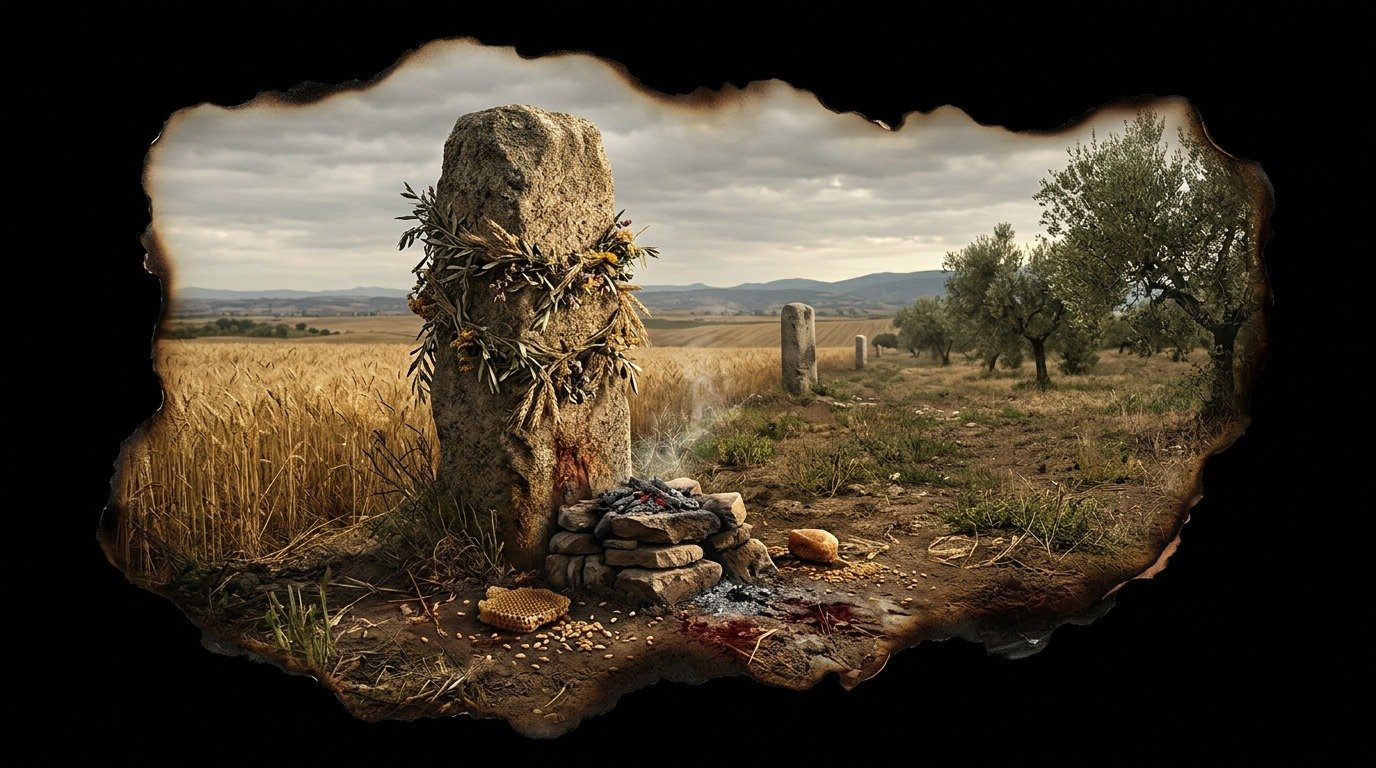
Terminus: The Stone That Does Not Retreat
The God Without Face or Movement
In the plowed fields of the Italian peninsula, where the wheat meets the fallow land and one man's olive trees stop before those of his neighbor, dwells a god who has no hands to strike nor feet to march. Terminus is the god of boundaries, frontiers, and the stone boundary markers that separate properties. Unlike deities who fly in chariots of fire or shapeshift to seduce mortals, Terminus manifests in the physical world as a simple pillar, a rough stone, or a carved oak trunk driven deep into the ground. He is absolute stillness made divinity, the guardian of property law, and the invisible wall that prevents human greed from unleashing civil war at every boundary line.
The Challenge on the Capitoline
The legend of his immutability was burned into Rome's memory during the reign of Tarquin the Proud. The king wished to consecrate a monumental temple to Jupiter Optimus Maximus on the summit of the Capitoline Hill, but the space was already occupied by the altars of numerous ancient gods. The augurs performed the rites of *exauguratio* to ask permission from the local deities to move their altars to other parts of the city. All the gods agreed to withdraw before the arrival of the sovereign of Olympus, except Terminus. The god of boundaries flatly refused to move from the spot where his stones had been planted. The priests, fearing they would unleash a curse, decided to incorporate his altar into the very structure of the new temple of Jupiter. An opening was left in the roof of gilded tiles so that the stone god could gaze upon the open sky, proving that even the king of thunder had to share his dwelling with the immovable boundary of the earth.
The Rite of the Shared Fields
Each year, during the Terminalia, neighbors who shared a boundary gathered around the sacred marker of Terminus. The rite was a feast of reconciliation and mutual recognition. The landowners crowned the stone with garlands of fresh flowers, built a rustic altar at its base, and lit a fire fed with noble woods. Each of them threw grain, honey, and wine into the fire, while a young ewe or a young sow was sacrificed to drench the stone with its blood. By sharing this sacred feast over the line that divided them, the men sealed an alliance of peace watched over by the god himself. Anyone who dared to uproot a boundary stone of Terminus or move it in the darkness of the night to widen his field was declared accursed; he became an outcast whom anyone could kill without fear of human justice, for the very earth he walked upon would claim his blood.
The Invisible Wall of the Empire
Terminus was the moral foundation upon which Roman law and the order of the empire were built. While the legions marched, expanding the borders, the god advanced behind them to secure the conquered land, transforming the chaos of barbarian territories into organized provinces measured by land surveyors. He taught the Romans that true greatness does not consist in infinite and disorderly expansion, but in the ability to clearly define where one's own sovereignty ends and the law of the outside world begins, firmly maintaining that the stone defining the boundary will never retreat.
Comments
Share information, an experience, or a source to help enrich this entry. They are automatically reviewed before being published.
Loading comments...