Saturn
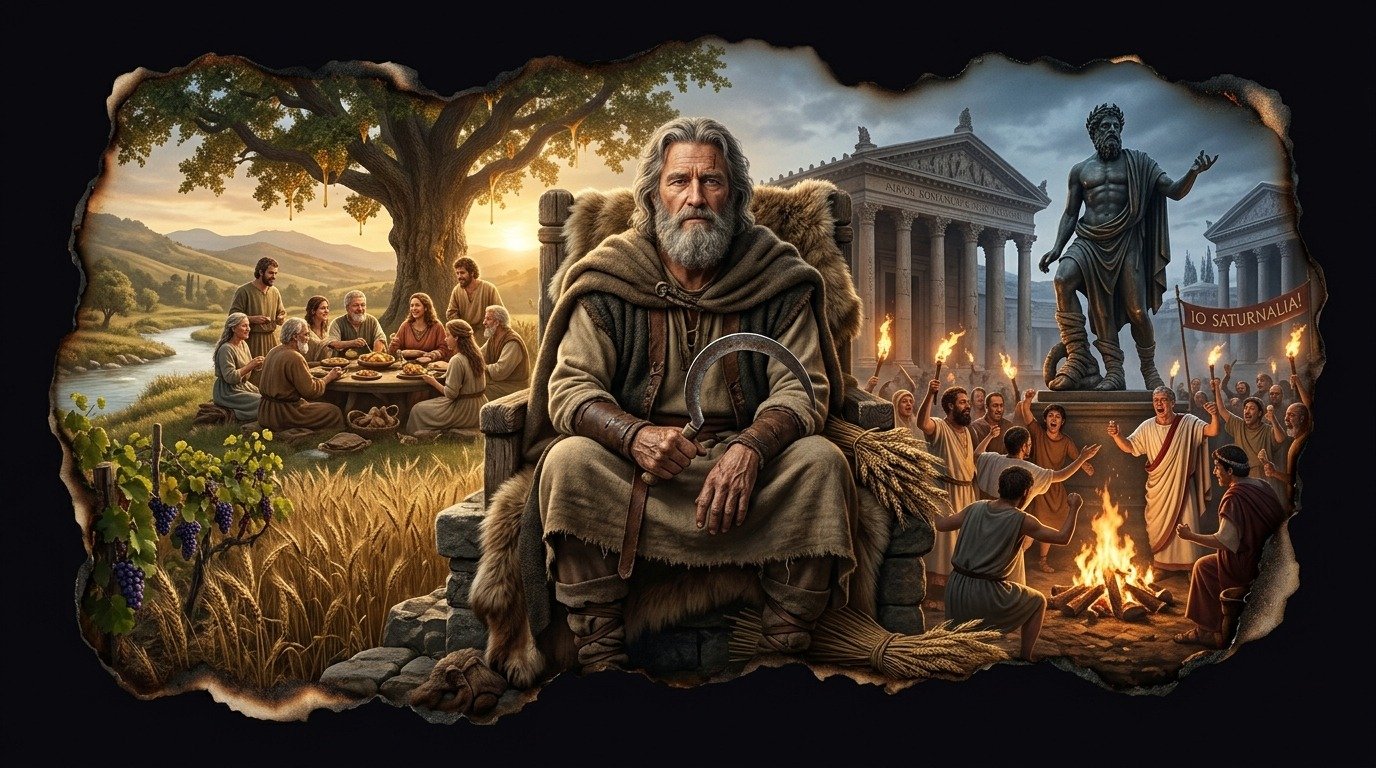
Saturn: The Sovereign of Time and the Golden Age
The Exiled King on the Hills
Saturn was once the absolute monarch of the heavens, the Titan who ruled the cosmos with a flint sickle. However, his reign was marked by the fear of a prophecy announcing that one of his children would overthrow him. To avoid his fate, he devoured his offspring as they were born to his wife Ops, until he was tricked with a stone wrapped in swaddling clothes and his son Jupiter grew up to banish him from the celestial throne after a war that shook creation. But the fall of Saturn was not the end of his story, but rather the beginning of his true legend among mortals. Stripped of his crown of thunder, the defeated god fled across the sea and found refuge in the hills of Italy, in the region that would later be called Latium, the "place of concealment." There, the god Janus welcomed him with hospitality and shared the rule of the land with him. In that fertile exile, Saturn left behind the cruelty of his divine past and became the great teacher of humanity, teaching primitive peoples to plow the earth, sow wheat, and prune the vines that grew wild on the hillsides.
The Golden Age of Latium
Under the wise rule of Saturn, Latium flourished in an era of peace and abundance that poets would remember as the Golden Age. Under his scepter, there were no bronze laws or courts of justice, because there was no crime or greed; the earth, grateful to the god of agriculture, yielded its fruits spontaneously, without the need for hoes or toil under the sun. Rivers flowed with milk and honey, and oaks dripped sweet dew to nourish mankind. The most extraordinary aspect of this kingdom was the absence of social hierarchies. In the Golden Age, there were no masters or slaves; all men lived in perfect equality, sharing the goods of the earth in a brotherhood that the world would never know again. The sickle of Saturn, which in heaven had been a weapon of mutilation and tyranny, was transformed on earth into the sacred tool of the harvest, a symbol of the abundance that arises from working the fields and respecting the cycles of nature.
The King of Winter and the Inversion of Order
Although Saturn's reign ended when the god withdrew from the sight of men, his memory was celebrated every year at the winter solstice during the festival of Saturnalia. During these days of joy and revelry, the social order established by the Empire was completely suspended in honor of the Golden Age. Courts closed, schools suspended classes, and no war was allowed to be declared. The deepest aspect of the festival was the role reversal: masters served their slaves at the table, and the slaves could speak and act with total freedom without fear of any punishment. The streets were filled with torches, public banquets, and games of chance, while the cry of *"Io Saturnalia!"* echoed through every corner of the stone city. With the feet of his statue in the temple of the Forum unbound from the woolen bands that bound them the rest of the year, Saturn walked free among men once more, reminding them that time devours all, but also that beneath the cold harshness of winter sleeps the golden promise of a new harvest.
Comments
Share information, an experience, or a source to help enrich this entry. They are automatically reviewed before being published.
Loading comments...