Janus
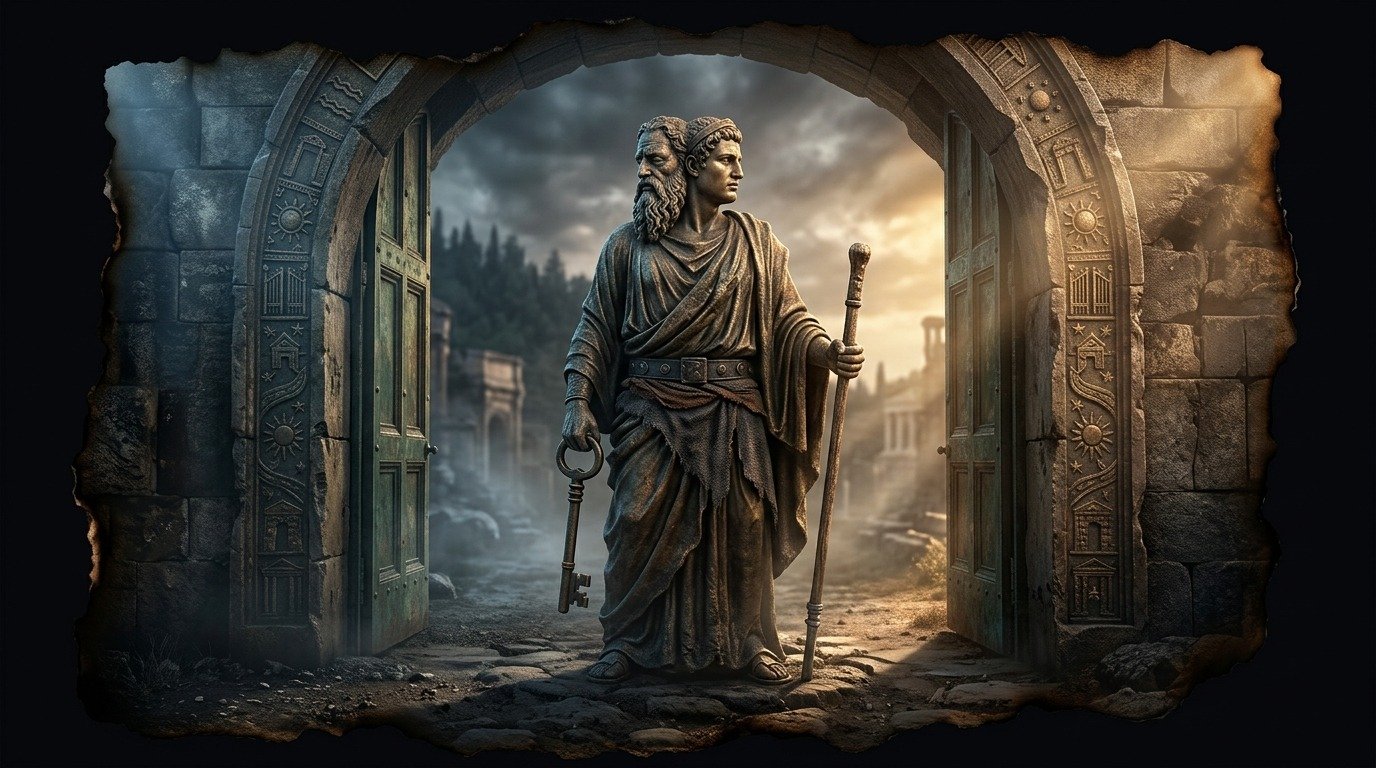
Janus: The Guardian of the Two Faces and the Threshold of Time
The God of the Absolute Origin
Long before the gods of Olympus divided the universe among themselves, even before the earth and the sky had different names, Janus existed. He is the deity of beginnings, the primordial Chaos that took form and order to allow the cosmos to come into being. He has no divine parents or complex genealogies to explain his origin; Janus is the initiator of all things, the one who opened the first gate so that the sunlight could cross space, and the one who established the laws of time that govern the lives of both mortals and immortals.
His presence is defined by a unique physiognomy that fills those who gaze upon him with awe: he possesses two opposing faces on a single head. With one, he observes the past, the paths already traveled, the memories of what was, and the lessons carved in time; with the other, he contemplates the future, the paths that have not yet opened, the promises of tomorrow, and the mysteries that sleep in uncertainty. Janus dwells in the exact instant in which the present divides both eternities.
The Keys of Heaven and the Thresholds of Men
Janus is the lord of doors (*ianuae*), passages, archways, and all physical and spiritual transitions. He carries in his hands a bronze key and a staff, the tools of the guardian who decides who enters and who exits. He opens the gates of heaven in the morning for the sun's chariot to pass, and closes them at night to make way for the stars. No prayer to the other gods can be heard if Janus is not invoked first, for he is the one who guards the threshold that connects the world of mortals with the abode of the immortals.
In the lives of men, his presence is constant. Every new year bears his name in the month of January (*Ianuarius*), the month that looks back at the year that is leaving and forward to the one that is beginning. He presides over the birth of every child, who crosses the threshold of existence; the beginning of every sowing; and the departure of armies heading to foreign lands. On the Janiculum Hill, his temple watched over the crossing of the Tiber River, marking the boundary of the city and the beginning of the peninsula's territories.
The Gates of War and Peace
In the Forum stood the most unique sanctuary dedicated to his cult: a bronze passage with two opposing gates that contained the statue of the two-faced god. This place was not a common temple, but a sacred indicator of the state of the nation. In times of war, the heavy bronze gates were opened wide, allowing the protective influence of the god to accompany the soldiers departing for battle and ensuring that the gates of return remained clear. In times of peace, the gates were locked and bolted, containing the force of war within the temple so that it would not disturb the peace of the homeland.
Legend has it that during a Sabine invasion, when the enemies were attempting to scale the Capitoline Hill, Janus caused a spring of boiling water and sulfur to gush from the temple floor, blocking the attackers' path and saving the city. That fiery spring was proof that the god of the threshold does not only watch over peaceful passages, but knows how to defend the boundaries of his empire with relentless violence. Janus remains, unalterable in his double gaze, reminding men that every ending is but the prelude to a new beginning.
Comments
Share information, an experience, or a source to help enrich this entry. They are automatically reviewed before being published.
Loading comments...