Fortuna
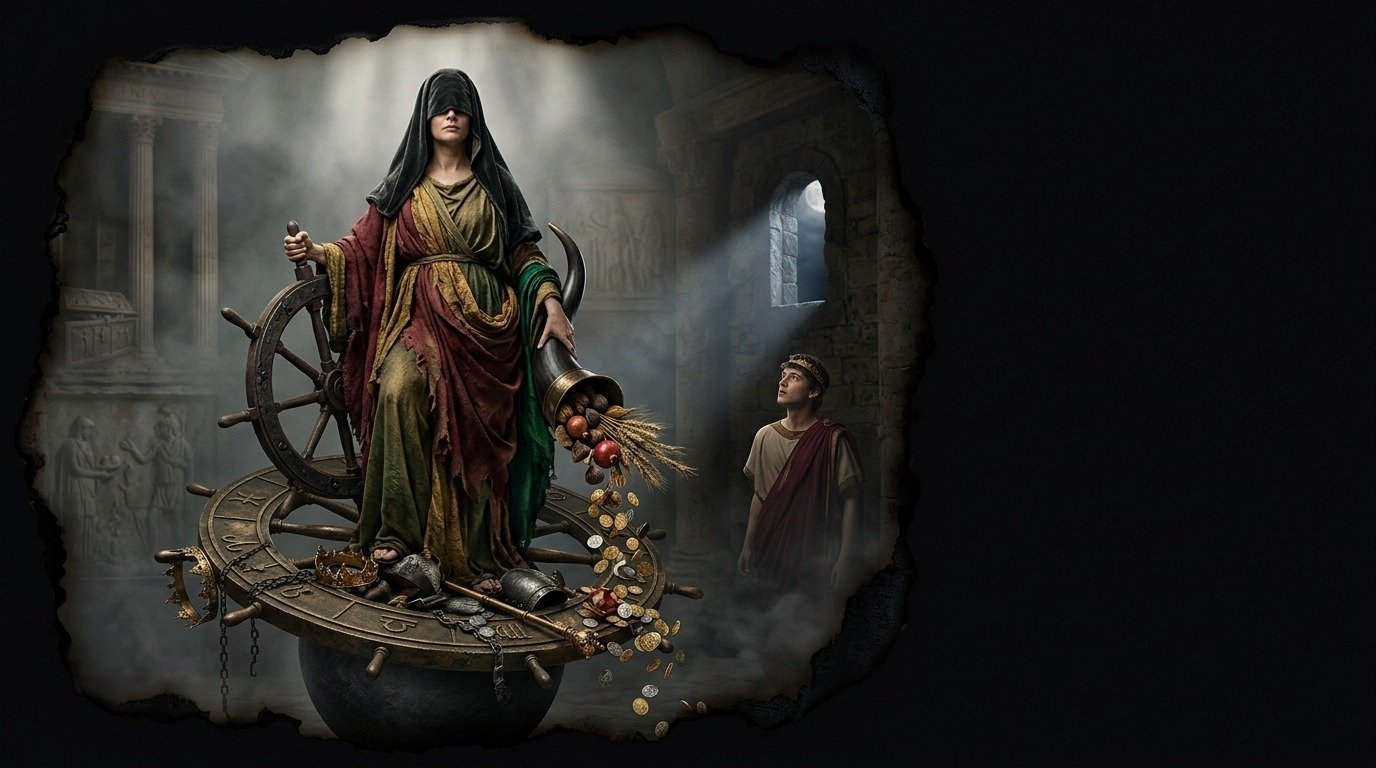
Fortuna: the Rudder and the Wheel of Destiny
The Firstborn of Chance
Before temples were raised and laws were carved in bronze, there existed a force that did not answer the prayers of the righteous nor the punishment of the wicked. Men called her Fortuna, the firstborn of the creative forces, a divinity whose origin is lost in the mists preceding the rise of the Olympian gods. She was not a simple personification of luck, but the invisible engine that made the world turn. She presented herself to mortals as a woman of imposing presence and veiled eyes, not out of blindness, but out of a sovereign indifference to human distinctions of rank, merit, or birth. Her breath could elevate a slave to the throne or drag an emperor into the mud in the span of a single heartbeat.
The Movement of Her Attributes
The presence of Fortuna manifested through three objects that defined her sovereignty over existence. In one hand she held the rudder, the instrument of wood and iron that guides ships through the darkest storms, demonstrating that she governed the course of human lives and entire nations. In the other hand she carried the *cornucopia*, the horn of the goat Amalthea overflowing with figs, ears of wheat, and gold coins, a symbol of the abundance she could bestow as suddenly as it was inexplicable. Beneath her feet rested a perfect sphere or a great bronze wheel that spun without ceasing. The movement of this wheel was the heartbeat of destiny: what was at the summit today, tomorrow would lie crushed under the weight of its rim, reminding the proud that stability is but an illusion granted by her temporary whim.
The Lover at the Window
No mortal knew the favor of the goddess more intimately than Servius Tullius, the sixth king of Rome. Born to a slave in the royal palace, the boy was marked by the goddess when flames surrounded his head while he slept, without burning a single hair of his forehead. Fortuna adopted him as her protégé and, according to the whispers of the court, became his secret lover. It was said that the goddess entered his chamber every night through a small window in the palace to advise him on the government of the city and secure his crown. Grateful for this divine love, Servius Tullius filled Rome with sanctuaries in her honor, notably the temple of *Fortuna Primigenia* and that of *Fortuna Virilis*, teaching the citizens that human effort is sterile if the goddess decides to withdraw her gaze from the battlefields or the forums of law.
The Thousand Faces of the Wheel
To the Romans, Fortuna was not a single deity, but a tide that took the form of each devotee's need. There was *Fortuna Redux*, whom soldiers implored to ensure a safe return home; *Fortuna Huiusce Die*, the force of the present day that granted daily bread and safety; and *Fortuna Balnearis*, who protected undressed citizens in the public baths from thefts and the evil eye. In her great sanctuary of Praeneste, men sought her oracles written on tablets of ancient oak that a child drew from a sacred chest. The cult of Fortuna was an act of humble realism: the acceptance that, above the legions, the consuls, and the stone walls, the uncontrollable wind of change will always govern.
Comments
Share information, an experience, or a source to help enrich this entry. They are automatically reviewed before being published.
Loading comments...