Vesta
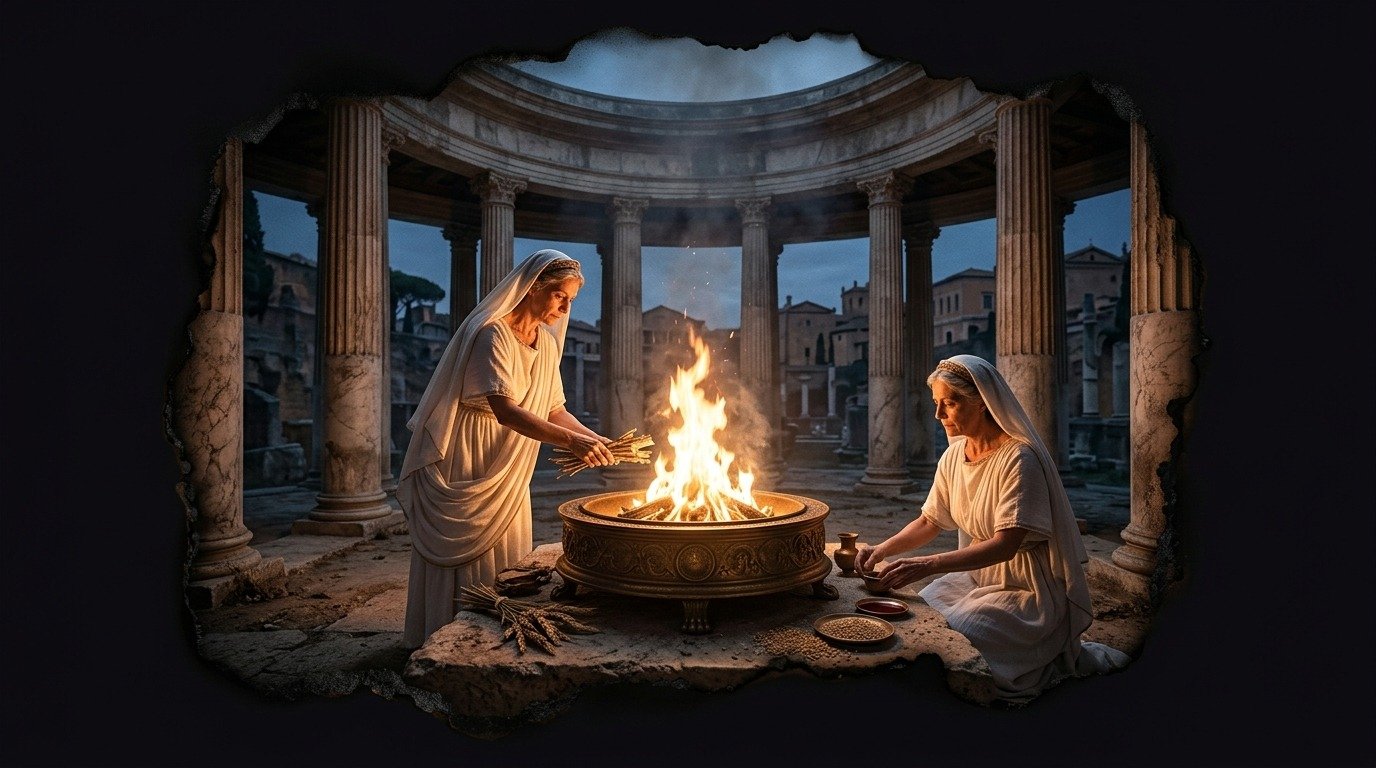
Vesta: the eternal flame that sustains the Empire
The invisible presence
Vesta is the oldest and most mysterious of the great deities. Firstborn daughter of Saturn and Ops, she was the first to be devoured by her father and the last to be freed, a sacred captivity that distanced her from the intrigues and ambitions that divided the rest of the Olympians. While her siblings divided the heavens, the seas, and the underworld among themselves, Vesta rejected the marriage proposals of the most powerful gods and obtained from Jupiter the gift of remaining eternally virgin, consecrating her existence to a single purpose: to be the motionless center around which the existence of men revolves.
Unlike other divinities who claim colossal statues with faces sculpted in marble, Vesta does not possess a defined human form at the heart of her sanctuary. Her only true image is the sacred fire that burns in her circular temple. She is the flame itself, a living and pure force that is not consumed and does not tolerate the slightest impurity. She is the warmth of the hearth that gathers the family and the sacred light that gives cohesion and life to the entire community.
The heartbeat of the stone city
In the Forum, the temple of Vesta stood as the spiritual heart of the State. That building of circular columns imitated the primitive huts of the founders, linking the mythical past with the present glory of the city. Keeping that flame lit was not a simple ritual task, but a matter of life or death for the Empire: it was believed that if Vesta's fire were to go out, the protection of the gods would vanish and the city would fall into ruin and darkness.
To guard this flame, the State consecrated the Vestals, a group of priestesses chosen in their childhood who swore to maintain absolute purity for thirty years. These women enjoyed unique privileges, free from the guardianship of their fathers and with the power to grant pardon to those condemned to death if they crossed paths with them on the road. However, their destiny was inextricably linked to the flame: if they allowed the fire to go out, they were punished with whipping; and if they broke their vow of chastity, the punishment was being buried alive in a dark crypt, for the blood of a Vestal could not be spilled upon the earth that sustained the Empire.
The refuge of the domestic fire
The power of Vesta extends from the great public temple to the humblest corner of every home. In every house, the hearth —the *focus*— is her altar. Before every meal, she is offered a portion of food and a libation of wine, recognizing that without her warmth the house is nothing more than a cold structure of stone and wood. She is the one who transforms a physical space into a home, protecting the intimacy of the family, fidelity, and domestic peace.
In a pantheon dominated by warrior gods and capricious transformations, Vesta represents absolute constancy, silent order, and the sanctity of the everyday. She does not descend to earth to fight battles, nor does she intervene in the passions of mortals, but her warmth is the invisible fabric that holds the living together with their ancestors, guaranteeing that, as long as the flame continues to shine in the twilight of the temple, the order of the world shall not be broken.
Comments
Share information, an experience, or a source to help enrich this entry. They are automatically reviewed before being published.
Loading comments...