Nymphs
Nymphs: The Wild Heartbeat of the Ancient World
The Three Strands of Untamed Life
Long before iron and dogma compartmentalized the forests and named the stars, the Mediterranean world beat to the rhythm of the nymphs. These beings are not the languid, decorative figures that Neoclassical painting portrayed centuries later; they are the generative force of nature in its purest, wildest, and often most relentless state. They are minor yet primordial divinities, the link between the pulse of the cosmos and the organic matter of the earth.
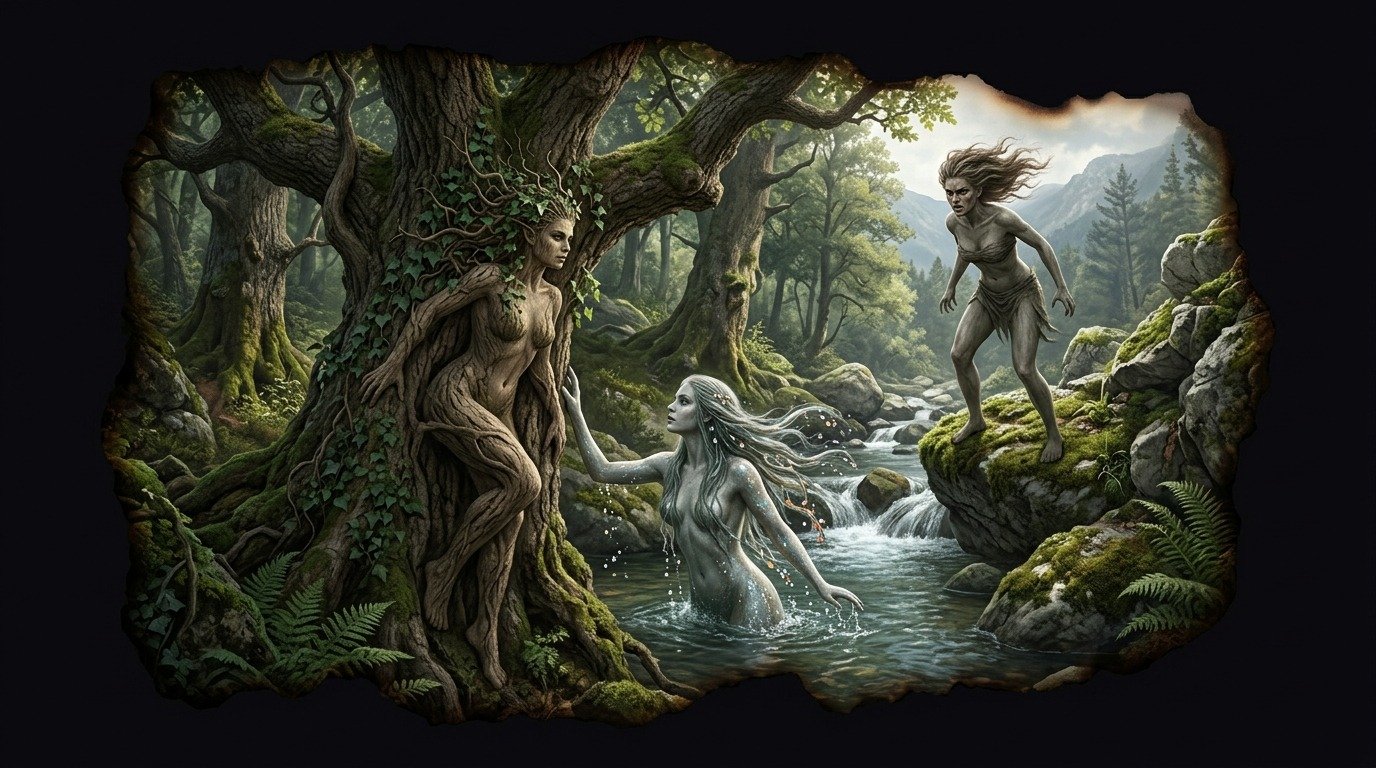
Their lineage is divided according to the realm they sustain with their very existence. Dryads and hamadryads inhabit the trees; the latter in such a way that their life is inextricably linked to that of their bark: when the axe cuts the trunk or lightning splits it, the nymph screams in pain and dies at that very instant, her invisible blood dissolving with the sap. Naiads rule over fresh waters, healing springs, and babbling brooks; they are the ones who grant fertility to the fields and poetic inspiration to men, but also those who drag beautiful youths to the bottom when they dare to profane their sacred pools. Finally, oreads inhabit the solitude of mountain peaks, limestone caves, and ravines where the wind roars; harsh and elusive spirits, companions of the night hunt and the silence of the heights.
The Whisper of the Bark and the Spring
To encounter a nymph is to experience beauty in its most dangerous dimension. They do not wear complex garments; their skin bears the tone of wet clay, the green of tender leaves, or the silver gleam of river pebbles. Their hair seems to be made of threads of water or wild vines that move even when there is no breeze. Their eyes, deep and unblinking, reflect nature's total indifference to human morality: they can heal a wound with the water of their spring or drive a shepherd mad with love simply for the pleasure of hearing him weep.
The presence of a naiad is recognized by the scent of water mint and fresh earth, and by a sound of singing laughter that blends with the murmur of the current. Dryads, more elusive, make themselves known when the forest seems to whisper without wind; a brush against your back, the snap of a branch bending to make way, or the sudden glimpse of a slender figure that blends into the trunk of an ancient olive tree as you turn your head. They are not immortal in the strict sense of the Olympian gods, but their longevity is incalculable, living as long as the forests they protect and the rivers they nourish.
The Midday Rapture
There is a phenomenon that the ancients feared above the wild beasts of the forest: *nympholepsy*. It occurred almost always at the hour of midday, when the sun stands still at its zenith, shadows disappear, and the countryside is plunged into a dense and suffocating silence, the so-called "silence of Pan." Any mortal who ventured into a forest clearing or beside a lonely spring at that sacred hour ran the risk of seeing the nymphs dancing in their natural state.
The punishment for this vision was not always physical death, but mystical possession. The unfortunate soul was left "raptured by the nymphs," plunged into a state of wild ecstasy, a poetic and prophetic madness that distanced him forever from human society. His eyes would no longer see the real world, but rather the underground current of life flowing through the roots and veins of the earth. Nymphs are a reminder that nature is not a resource to be exploited, but a living mystery that demands reverence, fear, and, at times, the tribute of our own sanity.
Comments
Share information, an experience, or a source to help enrich this entry. They are automatically reviewed before being published.
Loading comments...