Peri
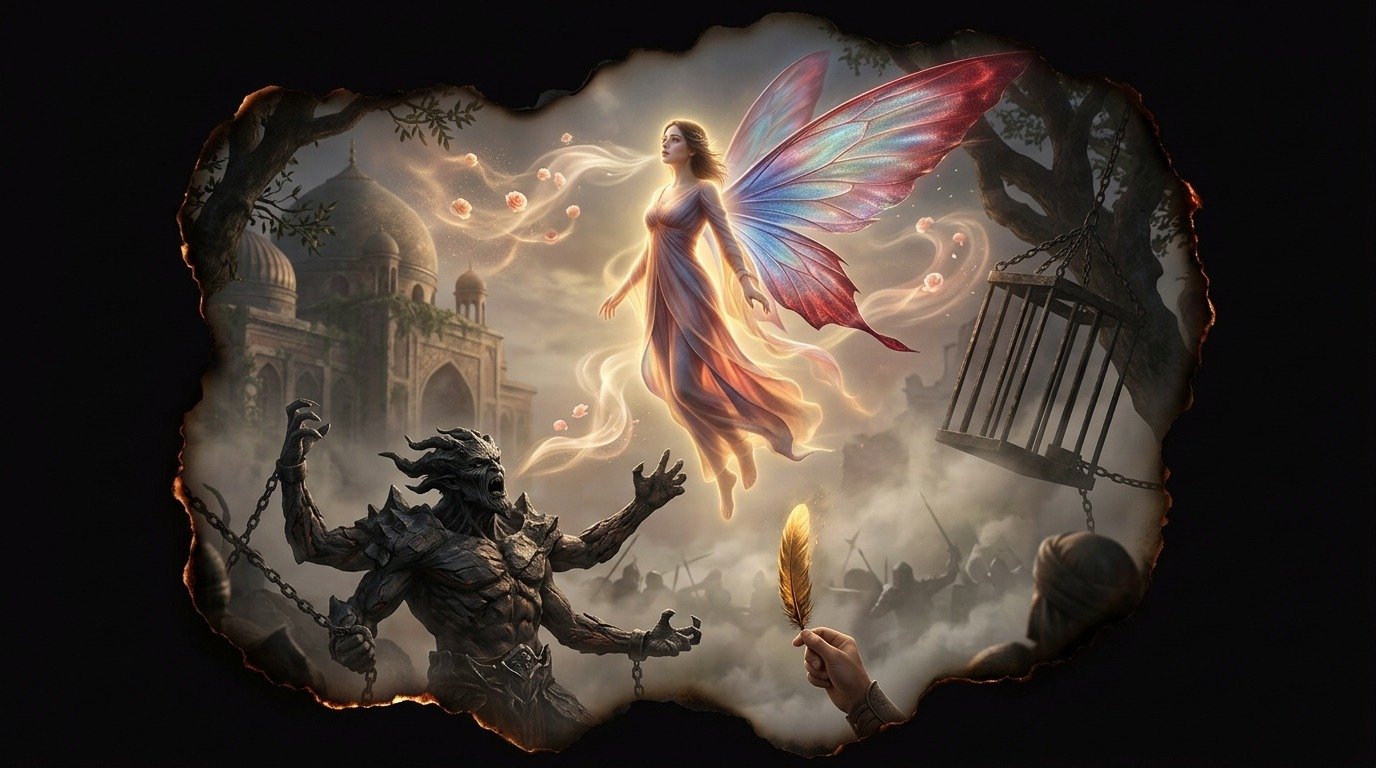
Peri: The Exiled Beauty That Feeds on Perfumes
The Scent of the Lost Eden
There are creatures whose very existence is a sigh of nostalgia. The peri is one of them: a being of such dazzling grace that the human eye can rarely hold her gaze without tears welling up. They are not angels, though they were at the dawn of time, nor are they demons, though they aligned themselves with the rebel hosts in a hesitation they are still repenting. This indecision left them stranded in the space between, banished from the celestial spheres but too pure for the coarseness of the inhabited earth.
Physically, they are described as figures of unbearable delicacy, enveloped in a golden glow or wearing robes woven from the light of twilight. Their wings, which beat noiselessly, change hue according to their mood, shifting from the blue of evening to the carmine of dying fire. But the most unique thing about the peri is not her appearance, but her sustenance. Lacking a dense body, they know no hunger for flesh or bread; they feed exclusively on fragrances. The scent of sandalwood, the exhalation of Persian roses opening in the morning, or the perfume of musk are their true manna. A neglected garden or a withered land is, for a peri, the equivalent of a devastating famine.
The Invisible War Against the Shadows
The destiny of the peri is linked to an eternal and silent war against the deevs, the gigantic and brutal demons of Eastern mythology. The deevs hate them with the viciousness typical of ugliness confronting harmony. When they manage to capture a peri, they do not kill her—for her nature is almost incorporeal—but lock her in iron cages that hang from the tops of the tallest trees in the Caucasus. There, they expose them to the freezing wind and deprive them of their food, preventing the scents of the valleys from rising up to them.
To defend themselves, the peris resort to illusion and the cunning of the winds. They can deflect their enemies' arrows with a breath, disorient armies by covering mountain passes with aromatic mists that dull the senses, or seek alliances with pure-hearted human heroes. When a mortal earns the gratitude of a peri, they receive in return a favor that defies the laws of the physical world: the ability to cross deserts without feeling thirst, or a golden feather that, when burned, summons her in the moment of greatest danger, bringing with it the freshness of an instant spring in the midst of battle.
The Longing for the Closed Door
The entire existence of the peri is dominated by a deep melancholy: the desire to return to Paradise. Every good deed they perform on earth, every aid offered to a lost traveler, or every defeated deev is a drop of penance they accumulate in the hope that the gates of heaven will open for them once more.
It is said that they wander along the banks of sacred rivers and the domes of abandoned temples, listening to the prayers of men to learn the language of devotion. Anyone who has ever heard a sweet whistling in a nighttime garden, a sound that seems like a cross between a reed flute and the rustle of silk, has not heard the wind; they have heard the lament of a peri who, hidden among the branches of a pomegranate tree, gazes at the stars and calculates how many centuries of exile she still has left to serve.
Comments
Share information, an experience, or a source to help enrich this entry. They are automatically reviewed before being published.
Loading comments...