Murmur
The Count of the Immortal Echo and the Necromancy of Memory
Origin and Legend
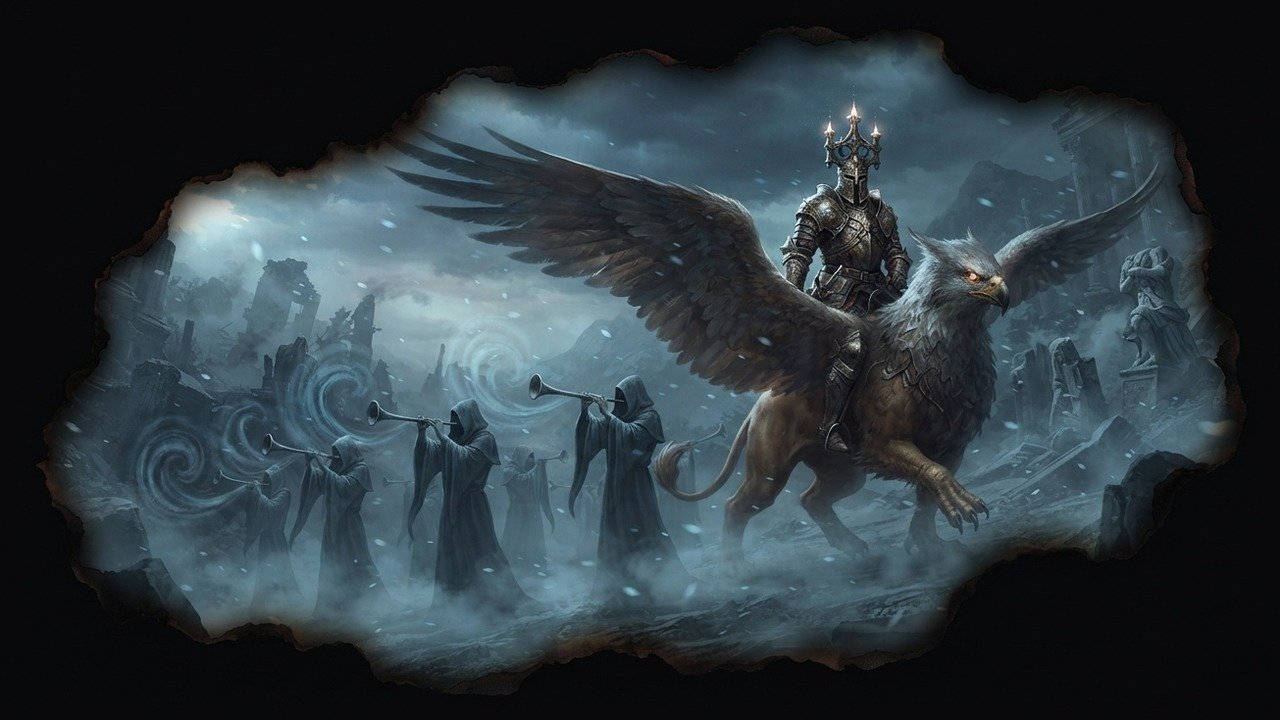
Murmur (also mentioned as Murmux) is cataloged in the traditions of the Goetia as a Great Count and Duke who rules over thirty legions of spirits. His name comes directly from the Latin *murmur*, which evokes a whisper, a distant rumble, or the murmur of a crowd speaking in the shadows. His iconography is imposing and somber: he appears as a warrior wearing the attire of a duke, crowned with a trinitarian crown, riding upon a vulture or a griffin. Before him walk his ministers, sounding brass trumpets from whose bells issues no festive music, but rather a low, vibrating, and mournful sound that shakes the air. The presence of the vulture—the bird that feeds on what has perished to transform it into life—marks his absolute dominion over remains, history, and the dead.
Historical Evolution
In the inquisitorial context of the sixteenth and seventeenth centuries, Murmur was considered the demon par excellence of profane necromancy. The Church furiously persecuted his invocation because it promised to summon the souls of the deceased to force them to answer the operator's questions. However, in the high magical tradition and late esoteric philosophy, Murmur went from being a specter that conjures graves to embodying the principle of Primordial Memory. It was understood that the "dead" whom Murmur commands are not only biological corpses, but forgotten knowledge, extinct civilizations, repressed traumas, and the echoes of human history. He became the patron of historians of the occult, philosophers of mortality, and initiates into the mysteries of the transmigration of the soul.
Esoteric Significance
On the plane of initiatory philosophy and the occult structure of the mind, Murmur represents Psychological Necromancy and the Resurrection of Knowledge. He is the archetype of the Immortal Echo. Nothing that has existed is truly lost; it remains engraved in the deep layers of the collective consciousness (the akashic record or ancestral memory). Murmur is the force that allows the initiate to descend into their own personal underworld—their past, their ancestors, their dead experiences—to retrieve the lessons and energy trapped in decay. In alchemy, he rules over *Putrefactio*: the necessary decomposition of the old so that the immortal essence can be released and understood.
Practice and Manifestation
The vibration of Murmur is perceived as a solemn heaviness, a low and deep resonance that seems to come from the bowels of the earth or the depths of memory.
Manifestation in the individual: It manifests in moments of deep introspection regarding mortality, legacy, and the past. It is the force that allows one to analyze their own history without nostalgia or regret, extracting the hard wisdom of past mistakes and losses.
Interaction and Sovereignty: To work with the vector of Murmur, the operator must face death—both literal and symbolic—without fear. The answers this energy grants are direct, stripped of embellishments. Interaction demands absolute respect toward the memory of those who went before and a posture of sovereignty: the dead are not sought to pay them servile worship, but to integrate them as teachers in the chain of experience.
Protection and Balance: The greatest risk when tuning into the current of Murmur is becoming trapped in melancholy, fixation on the past, or obsession with death and decay. Protection against this stagnation is the act of future creation. The initiate must remember that the memory of the dead is honored in the present, using the knowledge rescued from the graves to build a stronger and more luminous life.
Comments
Share information, an experience, or a source to help enrich this entry. They are automatically reviewed before being published.
Loading comments...