Goetia
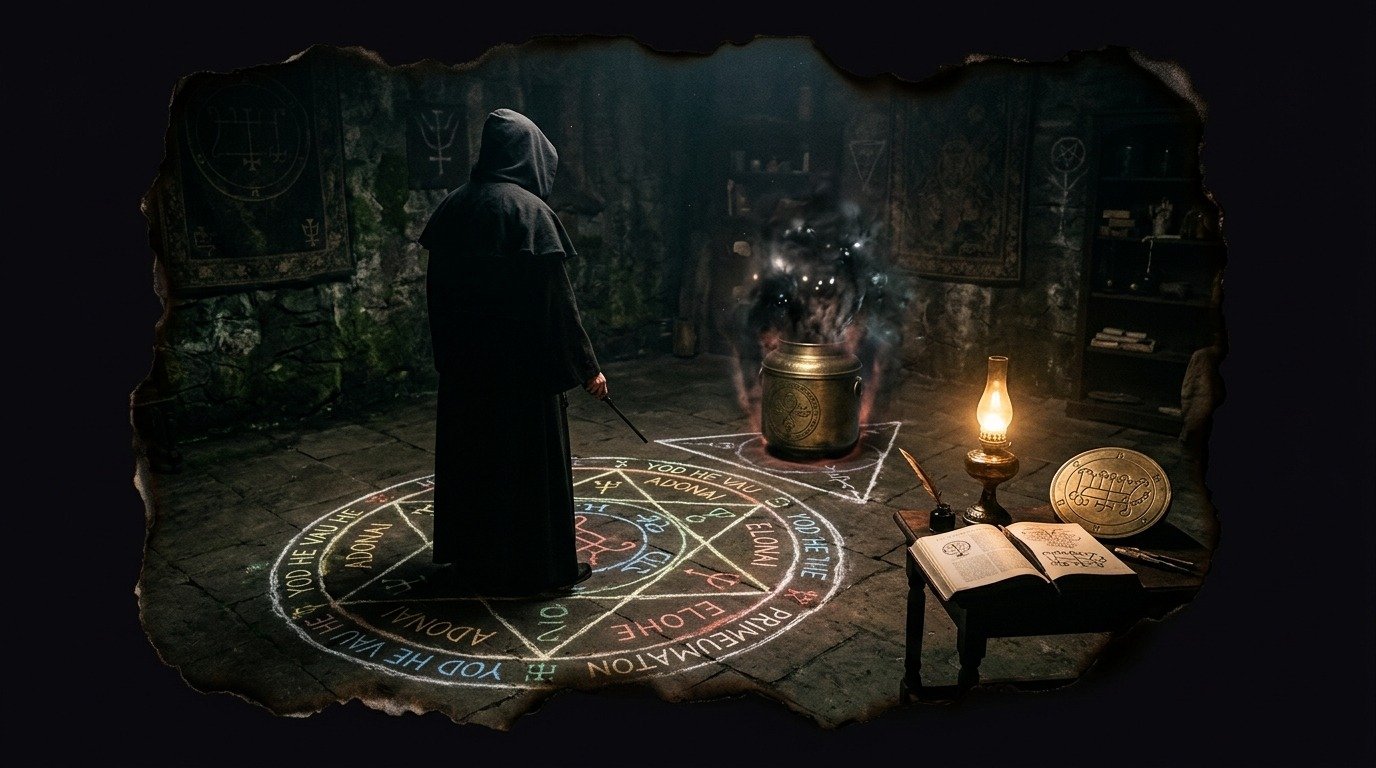
Goetia: The Evocation and Control of the Spirits of the Ars Goetia
The Dominion of the Underworld
Goetia, from the Greek term *goeteia* (sorcery or wailing), is a branch of ceremonial magic dedicated to the evocation and control of seventy-two spirits traditionally classified as demons or low astral entities. Unlike theurgy, which seeks union with the divine, Goetia is an eminently practical and utilitarian discipline: the magician subdues these entities to obtain specific favors, occult knowledge, protection, or mastery over mundane situations.
The Method of Ritual Coercion
Goetia operates under a hierarchical and authoritarian structure. The magician does not worship the entities of Goetia; they summon them and compel them to obey their commands using the authority of divine names. The basic tools of this practice are highly specific: * **The magic circle:** Drawn on the ground, decorated with divine names of power that protect the magician from any retaliation by the evoked entity. * **The triangle of manifestation:** Placed outside the circle of protection. It is the only space where the spirit can manifest and be contained. * **The seal or sigil:** A geometric glyph exclusive to each of the 72 spirits. It acts as the demon's energetic signature and its link to physical reality. It is engraved in metal (gold, silver, bronze, or lead, depending on the planetary rank of the spirit) or drawn on virgin parchment. * **The brass vessel:** A container that emulates the vessel in which King Solomon enclosed the rebellious spirits, used symbolically to contain or seal the force of the summoned entity.
The rite demands that the practitioner display an unwavering will. If the magician hesitates, the spirit will attempt to confuse them, evade the pact, or distort the terms of the task.
Origin and History
The practice dates back to the exorcism and invocation rituals of classical antiquity in the Eastern Mediterranean and the medieval assimilation of legends about King Solomon, to whom tradition attributes absolute control over demons through a magic ring delivered by the Archangel Michael.
The definitive manual of the system is the *Ars Goetia*, which constitutes the first section of the 17th-century grimoire titled *Lemegeton Clavicula Salomonis* (*The Lesser Key of Solomon*). This text classifies the 72 spirits with their respective ranks (kings, dukes, princes, marquises, earls, presidents, and knights), describes their monstrous appearances, and details the favors they grant.
Key Figures
* **Johann Weyer (1515-1588):** German physician whose catalog of demons, the *Pseudomonarchia Daemonum* (1577), served as the structural basis for the inventory of Goetic spirits. * **Aleister Crowley (1875-1947):** Edited and published an English version of the *Ars Goetia* in 1904, introducing the system to modern magic. * **S. L. MacGregor Mathers (1854-1918):** Translated from manuscripts the version that Crowley published in 1904.
Goetia in Modern Esotericism
In contemporary occultism, Goetia has undergone a fundamental interpretative shift. The rationalist and psychological current posits that the 72 spirits on the list are not external monsters, but archetypes of the magician's deep subconscious. Evoking them is a way to project phobias, hidden desires, or repressed capacities in order to confront, master, and assimilate them under the control of waking consciousness.
Connections
It is linked to Ceremonial magic, the figure of Solomon, the Seal of Solomon, and the 72 spirits of the Ars Goetia, which have their own entry in the Demons section.
Comments
Share information, an experience, or a source to help enrich this entry. They are automatically reviewed before being published.
Loading comments...