Curses
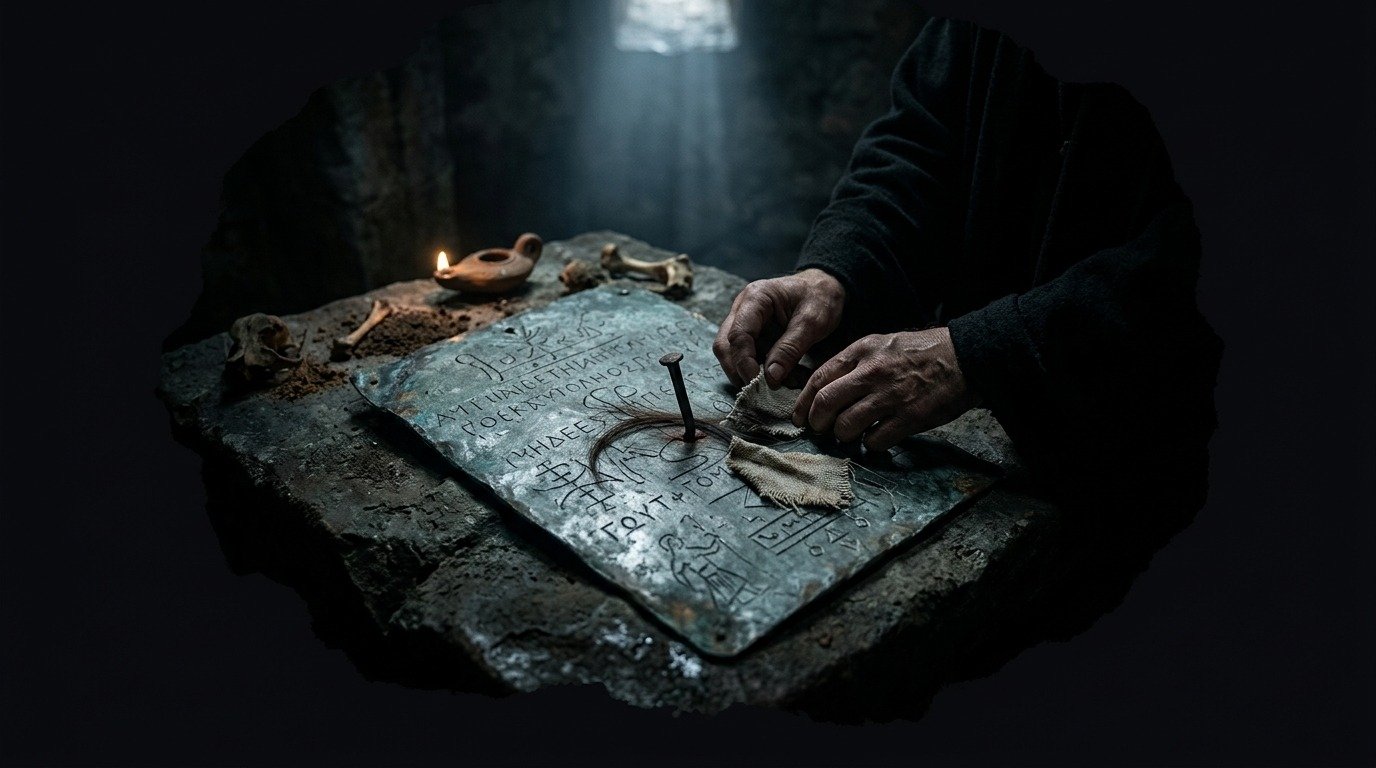
Curses: the art and history of harm from a distance
What it is
A curse is a ritual and verbal act designed to inflict harm, illness, misfortune, or death upon a specific person, family, or place. It is the manifestation of hostile magic that utilizes the power of the word, charged with intention, and the invocation of punitive forces to alter the victim's destiny.
How it works
Curses operate through specific laws of ceremonial and sympathetic magic: * **The law of contagion:** It uses elements that were in direct physical contact with the victim, such as hair, nails, clothing, or handwritten signatures. These objects serve as a conduit to direct the force of the attack. * **The law of similarity:** It employs physical representations of the victim, such as dolls made of wax, cloth, or clay (*poppets*). The harm physically inflicted on the figure is energetically projected onto the target. * **Verbal formulas:** They require the pronunciation of specific decrees at precise astronomical moments, usually during the waning moon or the hour of Saturn. * **Chthonic invocation:** The intervention of deities of justice, vengeance, or the underworld, such as Hecate or earth deities, is requested to execute the punishment.
Origin and history
The oldest and most abundant material record of this practice is the *defixiones* or curse tablets of ancient Greece and Rome (from the 6th century BC to the 4th century AD). They were sheets of lead where the victim's name, the desired harm, and the invoked gods were written. They were folded, pierced with an iron nail, and buried in graves, wells, or temples consecrated to deities of the underworld. During the Middle Ages and the Renaissance, belief in *maleficium* (magical harm) dominated civil and ecclesiastical legislation. The inquisitorial manual *Malleus Maleficarum* (1486) details how witches cast curses to cause impotence, illness, and the loss of livestock. In 17th-century Paris, the *Affaire des Poisons* (Affair of the Poisons, 1679-1682) revealed how members of the royal court of Louis XIV hired services to perform black masses and curses aimed at eliminating romantic and political rivals.
Key figures
Henrich Kramer, author of the *Malleus Maleficarum*, who systematized the judicial persecution of those who cast curses. Catherine Monvoisin, known as *La Voisin*, a 17th-century French midwife and fortune-teller who performed curses and rituals of harm for Parisian high society before being executed at the stake in 1680.
How it is understood today
In modern esotericism, curses belong to the realm of aggressive or self-defense magic. Practitioners of the Left-Hand Path and traditional witchcraft consider them legitimate tools of justice and personal retribution. Conversely, neopagan-influenced systems such as Wicca prohibit their use under the premise of karmic responsibility. Modern psychology explains the historical efficacy of curses through the nocebo effect: when a person discovers they have been cursed, their own suggestibility and anxiety trigger the expected physical and mental decline.
Connections
Curses are closely linked to the Evil Eye, Roman *defixio* tablets, the use of dolls in sympathetic magic, the figure of the goddess Hecate, and black magic grimoire texts such as the *Grand Grimoire*.
Comments
Share information, an experience, or a source to help enrich this entry. They are automatically reviewed before being published.
Loading comments...