Malleus Maleficarum
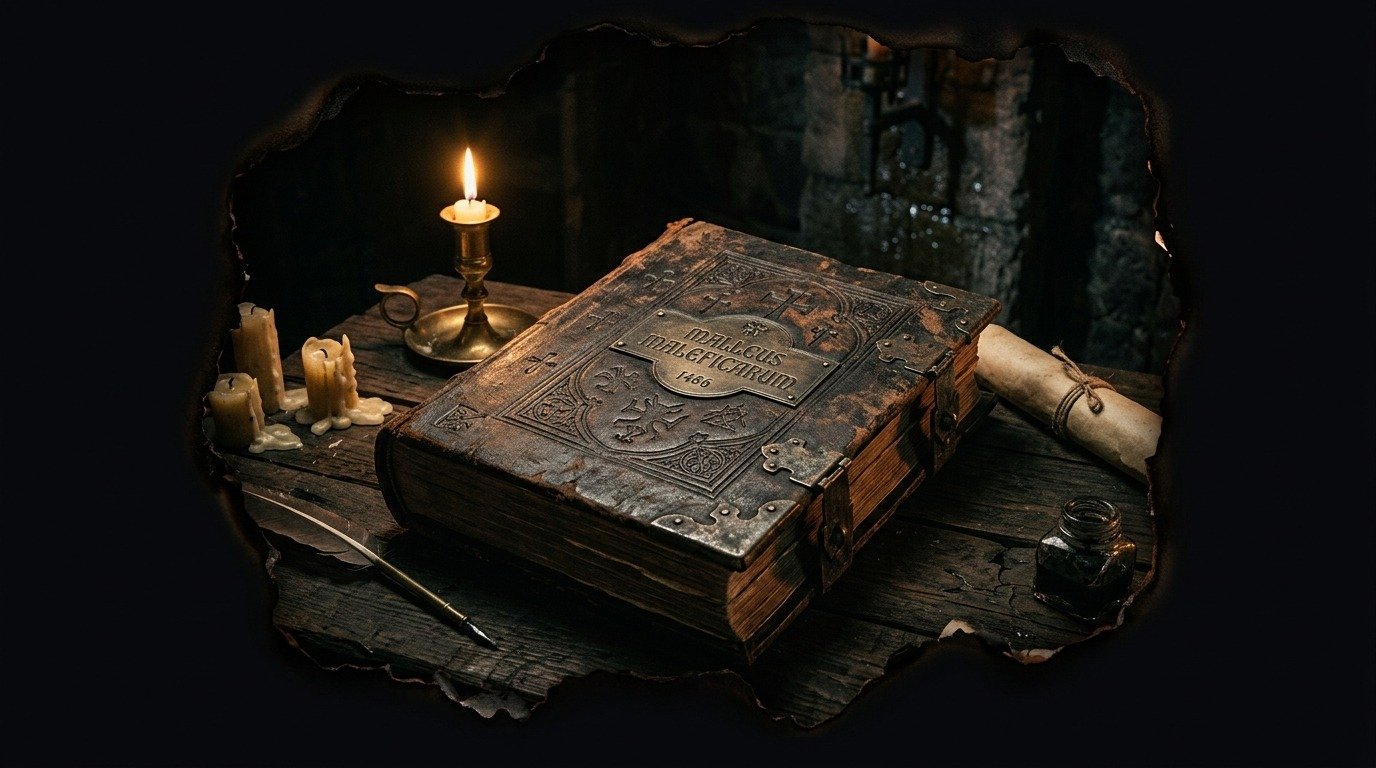
Malleus Maleficarum: The Hammer That Unleashed Terror
The Malleus Maleficarum (The Hammer of Witches) is the most influential manual for the persecution, torture, and execution of women in human history. Published in Germany in 1486 by the inquisitor Heinrich Kramer, this book codified for the first time the belief that witchcraft was not a mere superstition, but an active satanic conspiracy to destroy Christendom. Its fame and the terror it evokes are due to the fact that it served as the definitive legal and theological guide for Catholic and Protestant judges to send tens of thousands of people to the stake during more than two centuries of collective hysteria.
The Structure of Institutional Paranoia
The content of the Malleus Maleficarum is a treatise on demonology divided into three parts structured with a cold and ruthless legal logic. The first part aims to convince the reader that doubting the existence of witches is in itself an intolerable heresy. It details how the devil acts in the world through women, whom the authors describe as intellectually weaker, more credulous, and possessing an insatiable lust that inevitably drives them to seek carnal commerce with demons.
The second part describes the alleged practices of witches: infanticide, causing storms, the barrenness of livestock, the evil eye, and night flights to the Sabbat. Finally, the third part is the purely procedural section and the deadliest of all. It details the methods for interrogating suspects, the use of systematic torture to extract confessions, the validity of testimony from children and criminals in witchcraft trials, and the guidelines for handing down the death sentence at the stake without the judge risking being cursed by the accused.
The Personal Revenge of Heinrich Kramer
The authorship of the Malleus Maleficarum belongs primarily to the Dominican inquisitor Heinrich Kramer (under his Latinized name Henricus Institoris). Although the book historically included the name of the theologian Jacob Sprenger as co-author to gain greater academic authority, modern research has shown that Sprenger had zero or minimal involvement and that Kramer used his name to validate his own obsession.
The book was born from a personal failure. In 1485, Kramer attempted to conduct a witchcraft trial in the city of Innsbruck, Austria. The local bishop, Georg Golser, stopped the trial, released the accused women, and expelled Kramer from the city, calling him a senile old man obsessed with women's sexual fantasies. Humiliated, Kramer retreated to Cologne and wrote the *Malleus* as a defense of his inquisitorial work and a manual so that no local judge could ever stop a witch burning in Europe again.
The Fuel of the Printing Press and European Hysteria
The success of the Malleus Maleficarum was colossal thanks to a recent technological invention: Johannes Gutenberg's movable-type printing press. Between 1487 and 1669, the book was reprinted at least thirty-six times in Latin, French, German, and English, becoming the second best-selling book of the era, surpassed only by the Bible.
Despite the fact that theologians at the University of Cologne condemned the book a few years after its publication for being unethical and contradicting official Catholic theology, civil courts adopted the Malleus as their go-to law. The work unleashed a trial fever that swept through Germany, Switzerland, France, England, and the American colonies, as occurred in the famous Salem trials in 1692. The book transformed justice into a perfect trap: once accused under the rules of the Malleus, the suspect had no legal way to prove their innocence.
The Monument to Fanaticism
Numerous original printed editions of the Malleus Maleficarum are preserved in the rare book sections of the world's major libraries, including the Library of Congress of the United States in Washington, the Bodleian Library in Oxford, and the Harvard University Library.
The Malleus Maleficarum remains in history as the most brutal example of how religious dogma, institutional misogyny, and legal precision can unite to justify the extermination of innocents. Reading it today is chilling not because of the presence of demons or spells, but because of the coldness with which the human mind was capable of drafting a rational manual to commit absolute horror in the name of God.
Comments
Share information, an experience, or a source to help enrich this entry. They are automatically reviewed before being published.
Loading comments...