Necronomicon
Necronomicon: The Literary Lie That Became a Real Nightmare
The Necronomicon is the most famous and sought-after cursed grimoire in modern history, celebrated for containing the cosmogony of the Great Old Ones—monstrous deities who ruled the Earth before the appearance of man—and the exact ritual formulas to awaken them from their cosmic slumber. This book promises access to truths so deep and terrifying that they inevitably lead anyone who attempts to decipher them to madness. Despite the fact that thousands of people around the world firmly believe it is an ancient, forbidden text that the Vatican hides in its secret archives, the Necronomicon is an absolute fiction invented by the American horror writer Howard Phillips Lovecraft in 1922.
The Secrets of the Cosmic Void
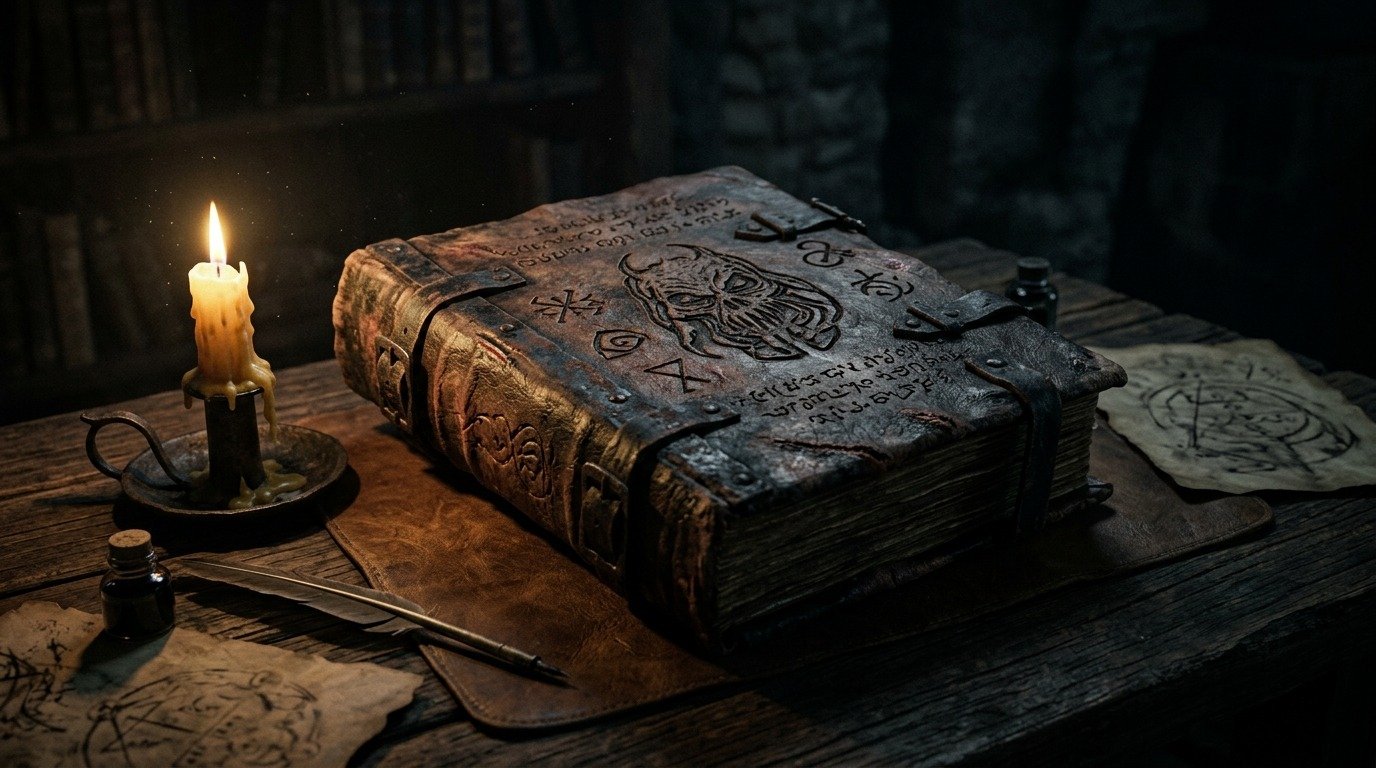
In the fiction surrounding the grimoire, the Necronomicon is a volume bound in human skin and closed with iron clasps. Its pages do not contain common spells to obtain wealth or love, but rather revelations about the insignificance of human beings in a hostile universe. Anyone who delves into its reading finds maps of interdimensional portals, physical descriptions of entities such as Cthulhu, Yog-Sothoth, and Azathoth, and the chants in forgotten tongues necessary to tear the fabric of reality.
The book warns that the Earth is but a thin layer over an abyss of horror and that the ancient owners of the planet await the moment when the stars align to reclaim their dominion. The text details summoning rites that demand terrible sacrifices and the alteration of the operator's mind, who must attune their brain to the frequencies of outer space in order to communicate with these entities.
The Genesis of a Perfect Forgery
Lovecraft invented the book to give coherence and realism to his cosmic horror stories. The original title of the grimoire is *Al Azif*, an Arabic term that the author translated as "the sound of nocturnal insects," which Middle Eastern tradition associates with the howling of demons. The creator of the myth devised an impeccable biography for its author, Abdul Alhazred, a Yemeni poet and mystic who supposedly wrote the manuscript in Damascus in the year 730, shortly before being devoured in broad daylight by an invisible monster before a terrified crowd.
To give greater credibility to the hoax, Lovecraft wrote an essay in 1927 titled *History of the Necronomicon*, where he traced the book's journey through the centuries. According to this document, the text was secretly translated into Greek in the year 950 by Theodorus Philetas, a version that adopted the name *Necronomicon* (meaning "an image of the law of the dead"). Later, in the 13th century, the scholar Olaus Wormius translated it into Latin. By mixing real historical figures and dates from the history of medieval translation with his own invention, Lovecraft created a historical trap so perfect that the boundary between reality and fiction was completely erased.
The Collective Obsession and the Real Books
The lie took on a life of its own very quickly. Lovecraft encouraged his writer friends, such as Clark Ashton Smith and Robert E. Howard, to mention the Necronomicon in their own horror stories. Seeing that different authors in various magazines of the era made reference to the same forbidden volume, readers assumed that the book truly existed.
Public demand was such that antiquarian bookstores in New York and London began receiving daily requests from wealthy clients willing to pay fortunes for a copy in Latin or Greek. Some prankster booksellers went so far as to include listing cards for the *Necronomicon* in their sales catalogs with detailed descriptions of its provenance. Even the prestigious Yale University and the University of Buenos Aires recorded pranks in their library card catalogs, where the card corresponding to the non-existent grimoire appeared.
Starting in the 1970s, the fiction materialized. Various publishers and occultists decided to write and publish real "Necronomicons" to satisfy the market. The most famous version is the *Simon Necronomicon*, published in 1977, which mixes the names of Lovecraft's monsters with Sumerian mythology and real rituals of ceremonial magic. This was followed by other versions written by authors from the chaos magic movement, who argued that the power of the human mind is capable of endowing a purely invented system with real magical efficacy.
The Grimoire That Does Not Exist, But Operates
The original Necronomicon, as Lovecraft described it, does not rest on the shelves of Miskatonic University—which is also a fictional institution—nor in the British Museum. There is no medieval manuscript in human skin containing the words of Abdul Alhazred.
However, the book exists today on the plane of belief and occult practice. Modern satanic sects, practitioners of witchcraft, and chaos magicians use the versions published in recent decades on their altars. For them, the fictional origin of the text is of no importance. The Necronomicon has achieved the greatest feat a grimoire can claim: to be born from the imagination of a writer from Providence and end up converted into a manual of real rituals, proving that literature can indeed tear reality.
Comments
Share information, an experience, or a source to help enrich this entry. They are automatically reviewed before being published.
Loading comments...