Book of Abramelin
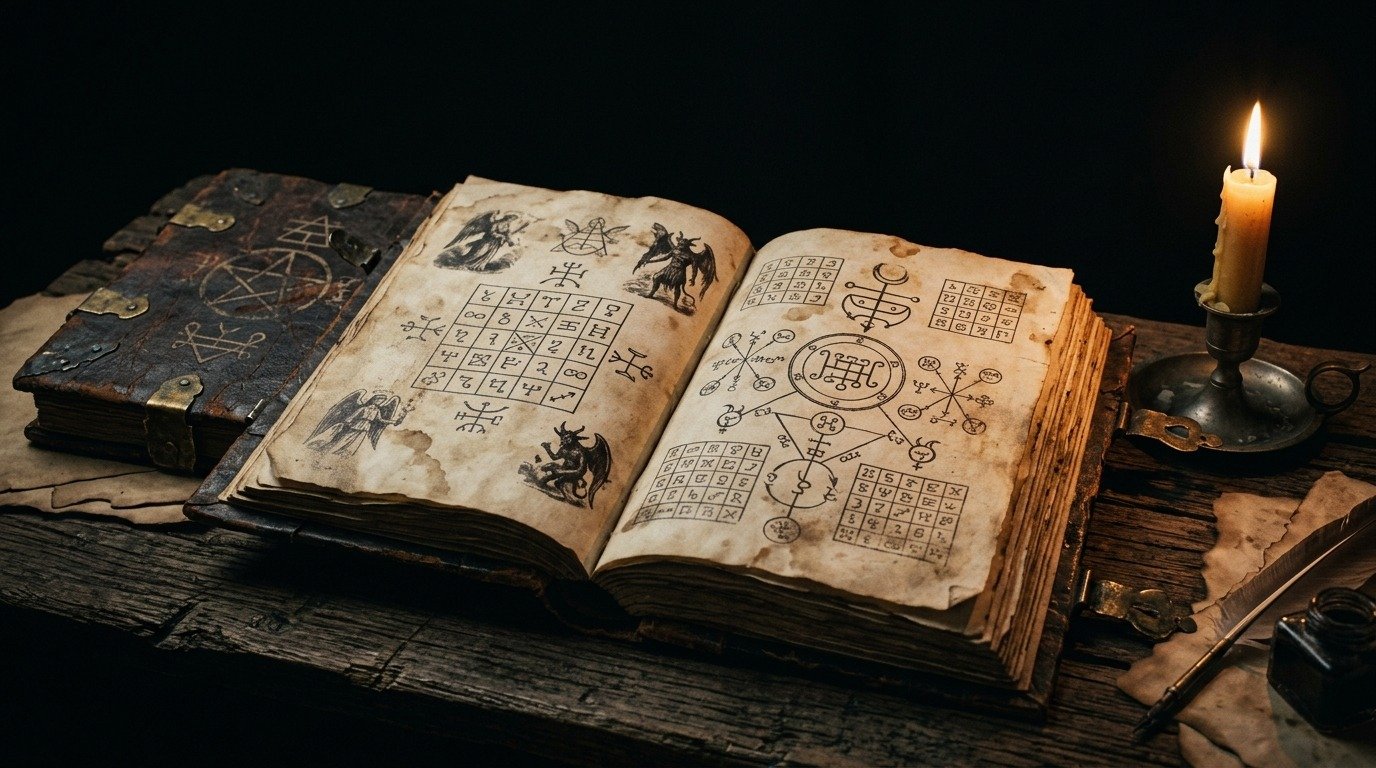
Book of Abramelin: The Extreme Formula for Subduing Demons
The *Book of Abramelin*—originally known as *The Book of the Sacred Magic of Abramelin the Mage*—is one of the most feared and coveted grimoires in history. This manuscript details a grueling process of mystical purification designed for a single purpose: to contact the Holy Guardian Angel. Once this celestial alliance is achieved, the mage obtains absolute power to subdue rebellious spirits and the most powerful demons of hell. Its reputation as a dangerous book does not stem from curses printed on its pages, but from the lethal demands of its practice: the Hermetic tradition warns that any interruption, moral weakness, or miscalculation during the months that the ritual lasts unleashes madness, ruin, and demonic persecution upon the daring soul who attempts it.
The Ordeal of Purification and the Magic Squares
Unlike other magic texts that offer quick formulas or immediate blood pacts, the *Book of Abramelin* demands a total transformation. The original process requires eighteen months of absolute isolation, divided into three strict phases. During this time, the practitioner must undergo a rigorous regimen of constant prayer, severe fasting, uncompromising chastity, and an almost complete withdrawal from human contact. Each phase elevates the operator's purity until, at the climax, the Holy Guardian Angel manifests to reveal the true nature of the universe and grant them protection.
Only after this encounter is the mage ready to descend into the abyss. Protected by their angel, they must summon the four superior princes of hell—Lucifer, Leviathan, Satan, and Belial—and their eight sub-princes. The grimoire does not seek the worship of these entities, but rather their humiliation: the mage forces them to swear obedience and to deliver an army of familiar spirits that will carry out their orders.
The practical power of the book manifests through its famous magic squares. These grids of letters are actually active talismans. By focusing on them under the guidance of the angel, the mage can activate specific effects: becoming invisible, discovering hidden treasures in the depths of the earth, flying through the air, curing diseases, or sowing discord among enemy armies. However, the grimoire warns that attempting to use these squares without having completed the purification and without the express authorization of the angel is equivalent to surrendering one's soul directly to the summoned entities.
The Legacy of Abraham of Worms
The text is presented in the form of an epistolary testament. The author identifies himself as Abraham of Worms, a Jewish scholar who lived between the 14th and 15th centuries. In the pages of the book, Abraham narrates to his second son, Lamech, how he spent his youth traveling through Europe and the Middle East in search of the true secrets of the Kabbalah and magic, finding only charlatans and false prophets.
His quest ended in Egypt, on the banks of the Nile, in a place called Araki. There lived Abramelin, a wise old hermit who possessed the science of divine magic. Abramelin taught Abraham the sacred ritual and handed over the original manuscripts. Upon returning to Europe, Abraham used this power to intervene in the high politics of his time: the grimoire claims that he helped Emperor Sigismund of Luxembourg consolidate his power and saved Pope John XXIII from the stake during the Council of Constance.
Although the work places these events in the year 1458, the oldest surviving manuscripts today are written in German and date from around 1608. Philological analysis reveals that, while the attribution to Abraham of Worms is a literary device to grant authority to the text, the actual author possessed a deep knowledge of Jewish mysticism and the life of Hebrew communities in the Holy Roman Empire.
From Paris to the Madness of Boleskine House
For centuries, the grimoire survived in jealously guarded manuscript copies. In the 18th century, a French translation reached the shelves of the Arsenal Library in Paris. It was there that, at the end of the 19th century, the British occultist Samuel Liddell MacGregor Mathers, co-founder of the Hermetic Order of the Golden Dawn, discovered the text. Mathers was fascinated by the coherence of the system and translated the manuscript into English in 1898.
This translation ignited the obsession of Aleister Crowley. In 1899, Crowley purchased Boleskine House, an isolated property on the shores of Loch Ness in Scotland, for the sole purpose of performing the Abramelin operation. The location met the isolation requirements demanded by the ritual.
Crowley began the purification process, but before reaching the final phase of summoning the angel, the Golden Dawn fell into an internal crisis and he was urgently summoned to London. Crowley abandoned Boleskine in a hurry, leaving the ritual incomplete. Tradition asserts that the entities he had already summoned remained trapped in the house without control, unleashing a dark history of tragedies, suicides, and mysterious fires that locals still attribute today to the forces unleashed by the mage.
The Original Manuscript Today
The version that Mathers translated and that Crowley attempted to perform in Scotland was incomplete. The French manuscript from the Arsenal Library contained translation errors and reduced the operation to only six months. In the early years of the 21st century, researchers of the esoteric tradition located the original German texts in the Saxon State and University Library in Dresden, and in the Herzog August Library in Wolfenbüttel.
These original copies revealed that the ritual is much longer, stricter, and more complex than Mathers assumed, and that the magic squares of the French version were full of erroneous letters that invalidated their use or made it extremely dangerous.
The Warning of the Empty Temple
The true danger of the *Book of Abramelin* does not lie in its physical pages, but in the space it opens in the mind of the practitioner. By demanding an absolute emptying of the ego so that the angel can enter, the ritual turns the human mind into a deserted temple. If the operator falters before the end, that temple does not remain empty: it is immediately filled with the princes of the abyss who wait, stalking.
Comments
Share information, an experience, or a source to help enrich this entry. They are automatically reviewed before being published.
Loading comments...