Familiar
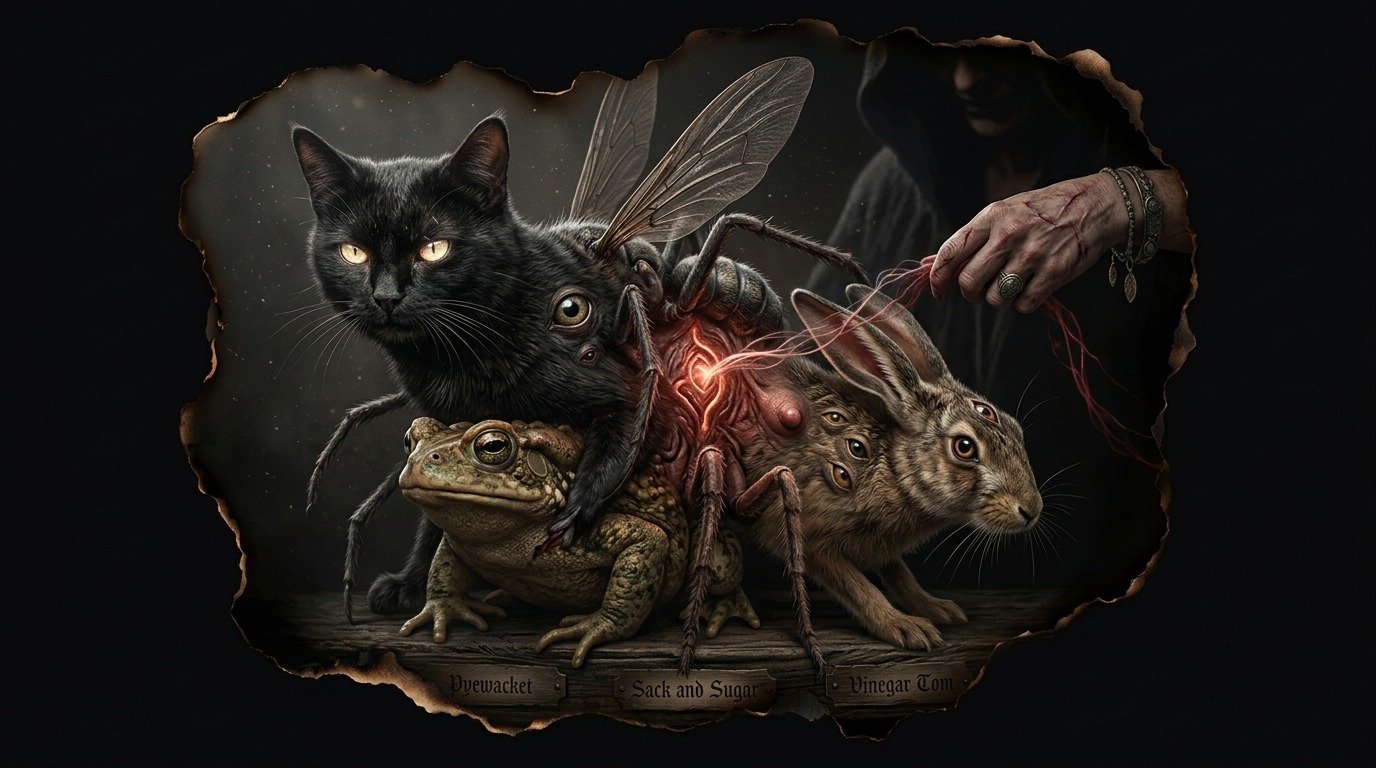
Familiar: The Covenant of the Domestic Shadow
The Spirit in the Form of the Beast
The familiar spirit, known in the Anglo-Saxon tradition as an *imp* or *animal familiar*, constitutes a central element of European demonology and witchcraft, particularly during the trials of the sixteenth and seventeenth centuries in England, Scotland, and colonial New England. Unlike the mounts of shamans or the totems of indigenous cultures, the familiar of traditional witchcraft is not a common animal with special abilities, but an incorporeal spirit—often a low-ranking demon—that inhabits a physical animal vessel or manifests under its appearance to serve as an intermediary between the practitioner of the dark arts and the powers of the abyss.
Historical records of judicial trials, such as those of the dreaded witch hunter Matthew Hopkins (the *Witchfinder General*), document with disturbing detail the names and forms of these creatures: dogs, cats (especially black ones), toads, hares, ferrets, and even insects like flies or spiders, which answered to strange names like *Pyewacket*, *Sack and Sugar*, or *Vinegar Tom*.
Theological Origins and Cultural Variations
Inquisitorial theology theorized the familiar as a gift bestowed by the Devil at the moment of sealing the covenant of witchcraft. This spirit operated as a guardian, a spy, and an executor of the hexes (*maleficia*) that the witch ordered against her neighbors or livestock. The *Malleus Maleficarum* (1487) and King James I of England's treatise *Daemonologie* (1597) explain that the demon assumes the form of a domestic animal so as not to arouse suspicion in the community and to constantly monitor the fulfillment of the witch's obligations.
In other latitudes, the concept finds equivalents that enrich its phenomenology: * **The Norse Fylgja:** A spirit from Scandinavian mythology that accompanies a person, often in the form of an animal, representing their destiny or family lineage. * **The Mesoamerican Nahual:** A spiritual alter ego that shares its life force with a human being, allowing for physical transmutation. * **The auxiliary spirits of Siberian shamanism:** Zoomorphic entities that the shaman projects to the subtle plane to engage in spiritual combat or healings.
Esoteric Anatomy: The Covenant of Blood and the Mark
In the praxis of traditional witchcraft and ceremonial magic, the familiar is not a pet, but an astral anchor. The bond between the mage and the spirit is sealed through a blood covenant. Popular belief asserted that witches possessed a "Devil's mark" or a third nipple (supernumerary nipple) through which they fed the familiar with their own blood.
Esoterically, this myth describes a real process of consensual energy vampirism: the operator yields a portion of their vital energy (*Ether* or *Prana*) to condense the spirit's astral body, allowing it to interact in a denser manner on the physical plane. In exchange for this sustenance, the familiar acts as an amplifier of the mage's power. Possessing highly acute astral senses, the familiar can cross the thresholds of others' properties, gather information on the subtle planes, deflect psychic attacks directed at its master, and act as a filter that purifies the dense energy the mage absorbs during the execution of transmutation or necromancy rituals.
Protocol for Custody and the Dissolution of Cords
Possession of a familiar requires iron discipline on the part of the operator; otherwise, the spirit can invert the power dynamic and subjugate the mage's will through obsession or energy depletion.
To establish and maintain a sovereign and secure bond, the following traditional rules must be observed: 1. **Consecration of the Vessel:** If the familiar inhabits an inanimate object (such as a fetish, a power stone, or a mirror) or is associated with a living animal, it must be consecrated by drawing clear boundaries that prevent the spirit from extending beyond its container without express authorization. 2. **Regulated Sustenance:** The spirit must never be fed with blood directly from the operator's body in an improvised manner; fluids must be offered on a dedicated altar, under strict temporal terms and associated with specific completed tasks. 3. **Banishment and License to Depart:** At the end of the operator's life, or if the spirit shows signs of insubordination, one must proceed to revoke the covenant. The physical vessel must be destroyed by fire or buried in consecrated ground under a greater banishing ritual, pronouncing the formula of the "License to Depart," freeing the spirit from its service and cutting every astral cord binding it to the practitioner's genealogy or domestic space.
Comments
Share information, an experience, or a source to help enrich this entry. They are automatically reviewed before being published.
Loading comments...