Tulpa
Tulpa: The Condensation of the Mental Current
The Mirage of the Western Mind
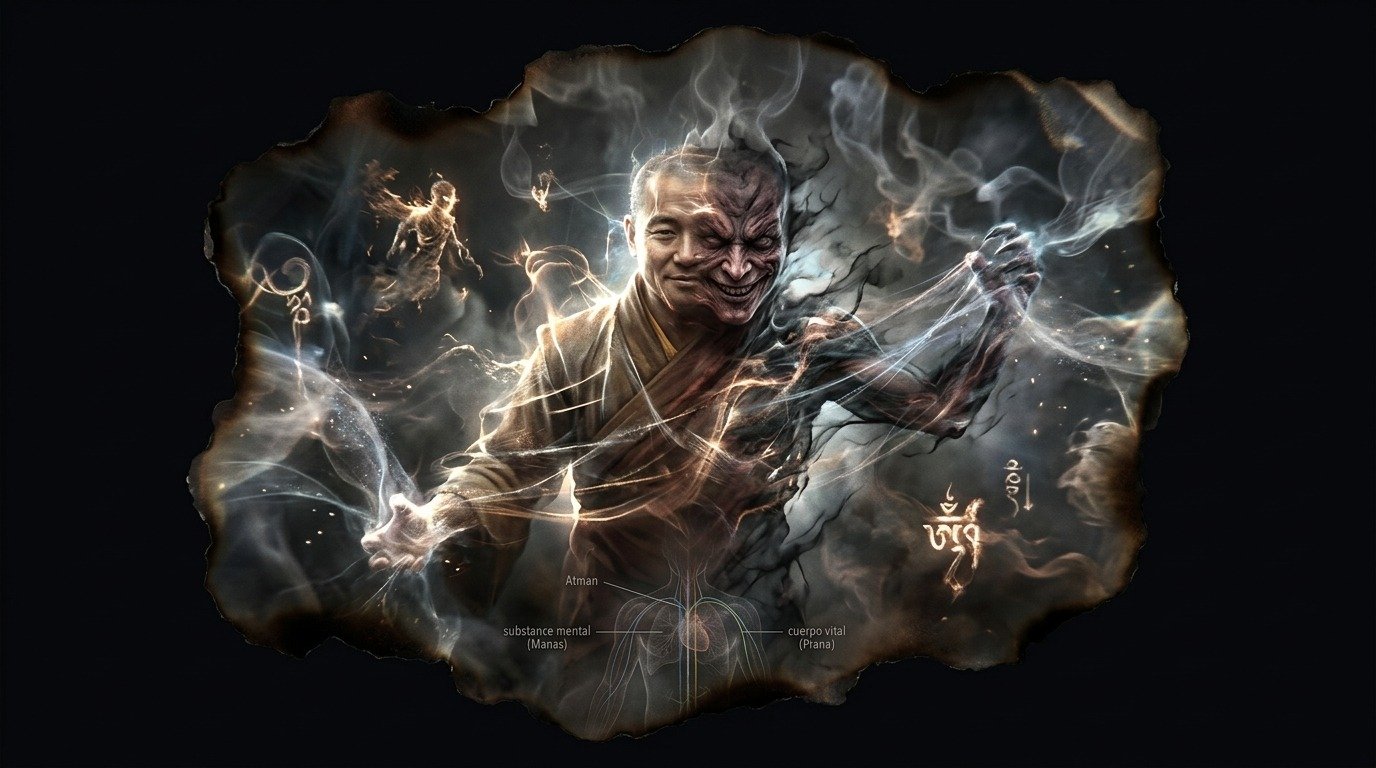
The contemporary concept of the *tulpa* represents one of the most unique phenomena of esoteric transculturation of the last century. Its roots lie in Tibet, under the term *sprul-pa* (in Sanskrit, *nirmita*), which designates a physical or mental emanation created through rigorous training of the will and yogic visualization. However, the notion that prevails in the West today—that of an entity with its own consciousness born from the mind of a solitary creator—differs considerably from the original context of Vajrayana Buddhism. It was the mystic and traveler Alexandra David-Néel who, in her 1929 work *Magic and Mystery in Tibet*, introduced the term into the European imagination by recounting how she herself had gestated a tulpa in the form of a jolly-faced monk, which, over the months, acquired a disturbing autonomy, altering its physiognomy into a malicious grin and becoming visible to third parties, forcing her into an exhausting process of mental reabsorption.
From Tibetan Sprul-pa to the Modern Egregore
In the tradition of Tibetan Buddhism, the *sprul-pa* is neither a psychological companion nor a recreational entity; it is a didactic and initiatory tool. Advanced lamas and yogis employed these projections to understand the emptiness of existence (*śūnyatā*): if an entity created by the mind can interact with the physical plane, then the physical plane itself possesses the same illusory nature (*māyā*). The process requires a state of absolute concentration (*samādhi*) and mastery of the energy flows of the subtle body (*lung*). At the end of the 19th and beginning of the 20th centuries, the Theosophical Society assimilated these practices under the concept of "thoughtforms" (*thoughtforms*), theorized by Annie Besant and C.W. Leadbeater. Within this framework, mental and emotional energy shapes "astral matter," creating semi-living structures. In the chaos magic of the late 20th century and in the internet forums of the digital age (the *tulpamancy* movement), the concept was completely stripped of its Buddhist liturgical framework to become a technique of conscious fragmentation of the psyche, where the practitioner seeks to induce a controlled schizophrenia to cohabitate with an artificially created intelligence.
Esoteric Anatomy and the Autonomy of Thought
From the perspective of operative occultism, the tulpa is classified as an advanced form of individual egregore. Unlike a specter or a pre-existing demon, the tulpa does not possess a spiritual core (*Atman* or divine spark); its metaphysical framework is composed exclusively of the mental substance (*Manas*) and the vital or astral body (*Prana* or *Linga Sharira*) of its creator. The inherent danger of this practice lies in the Law of Conservation of Psychic Energy. At first, the tulpa is a willing parasite that feeds on the sustained attention of the operator. However, if the visualization is sufficiently intense and prolonged, the entity begins to drain energy subconsciously (during states of sleep or fatigue). Upon acquiring a rudiment of self-preservation instinct, the tulpa will resist dissolution. Its autonomy manifests first through internal communication (internal audition), then through the manipulation of the creator's perceptual environment (sensory hallucinations), and, in extreme cases, through objective manifestation before unsuspecting external observers, behaving like a *poltergeist* phenomenon.
Dissolution Protocols and Psychic Dangers
For the practitioner of the arcane arts, the tulpa is a warning about the sovereignty of the will. If an operator finds themselves besieged by a mental construct that has escaped their control, the traditional containment protocol is not religious exorcism (since the tulpa lacks external demonic affiliation), but rather de-assimilation or reabsorption. The method demands the absolute withdrawal of all attention from the entity; indifference is its deadly poison. In parallel, a reverse process of visualization must be executed, imagining how the substance of the tulpa flows back toward the center of one's own chest (the *Anahata* chakra or the *spiritual heart*), dismantling the form part by part, from the extremities to the core of the face. If the tulpa has gained enough strength to resist this process, the assistance of high-vibration banishing rituals (such as the Lesser Ritual of the Pentagram) or the intervention of an external operator acting as an energetic firewall is required, isolating the creator from their own emanation.
Comments
Share information, an experience, or a source to help enrich this entry. They are automatically reviewed before being published.
Loading comments...