Leshy
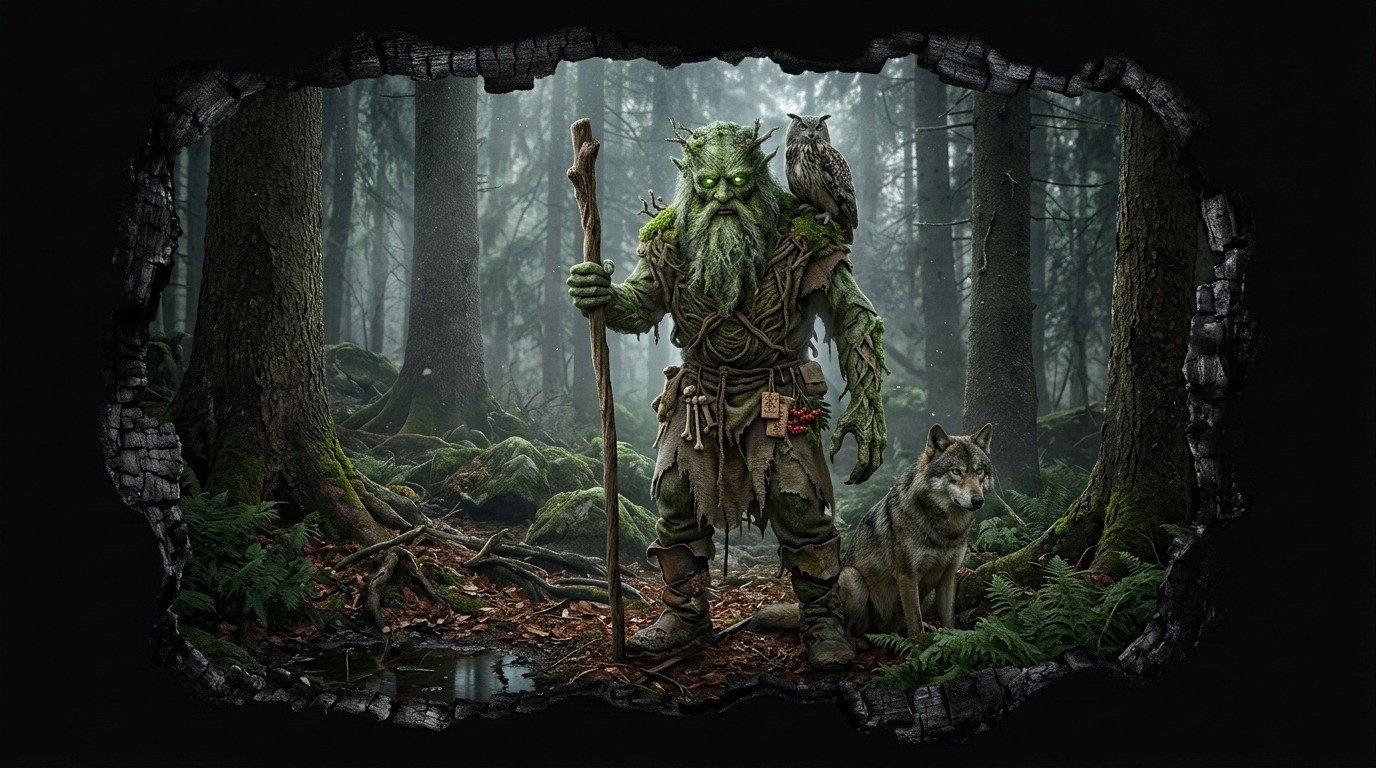
Leshy: The Arboreal Sovereign and Guardian of the Slavic Thicket
Origin and the Legend of the Taiga
In the vast and shadowy forests of Eastern Europe and Russia, where the taiga becomes impenetrable, dwells the Leshy (plural: *Leshie*; from Old Russian *lěsъ*, "forest"). More than a monster, the Leshy is the *spiritus loci*, the embodied soul of the Slavic woodland. Its origin dates back to pre-Christian animist beliefs, where nature was not conceived as an inert resource, but as a living organism ruled by lesser deities and guardian spirits under the sovereignty of the god of forests and wild beasts, Svyatobor. Physically, the Leshy is an absolute shapeshifter, whose height adapts to the environment it treads: it is as tall as the most colossal fir tree when walking through the heart of the forest, and as small as a blade of grass when slipping along the edges of the paths. Folk accounts describe it with pale or greenish skin, glowing green eyes that lack eyelashes and eyebrows, and a thick beard made of lichens and living moss. Its blood is blue and cold like winter sap, giving it a spectral paleness. An unmistakable feature to identify it in its rare human appearances is that it casts no shadow, its eyes glow with an inner fire, and it usually wears its left boot on its right foot and its clothes buttoned backward, disrupting the natural symmetry of the human body.
Deals with the Thicket and Folkloric Transformation
With the Christianization of the Slavic peoples, the Leshy underwent a process of demonization, transitioning from a respected intermediary of nature to a malicious being associated with the devil (*leshiy chort*). However, the Russian peasantry maintained a pragmatic and reverent respect for it. The Leshy is not intrinsically evil; its morality is that of nature itself: indifferent, chaotic, fair yet relentless. It rules over all the animals of the forest, especially wolves and bears, who act as its personal guard and carry out its designs. Hunters, shepherds, and lumberjacks were forced to make pacts (*dogovor*) with the Leshy to enter its domains without perishing. A shepherd had to offer it a cow or sign an agreement in blood on birch bark so that the Leshy would protect his livestock from predators. Lumberjacks had to ask permission before felling an ancient tree, under penalty of being crushed by dead branches or lost forever in spatial labyrinths created by the entity's will. The Leshy enjoys disorienting travelers: it alters the perception of paths, mimics the voices of loved ones to lure victims into the swamp, or makes them walk in endless circles.
Symbolic Anatomy and Esotericism of the Forest
From an esoteric perspective, the Leshy is the guardian of the Green Threshold, the boundary between the order of the village (civilization, daytime consciousness) and the chaos of the forest (the wild, the deep unconscious). It represents the Law of Return: everything taken from nature must be paid for in equal measure. It is the principle of ecological homeostasis personified. On the initiatory plane, encountering the Leshy is equivalent to the disintegration of the ego. Getting lost in its forest is not a geographical accident, but a dismantling of ordinary cognitive structures. Anyone who survives the night in the Leshy's forest returns transformed, having communed with the hive mind of the flora and fauna. It also symbolizes the untamed aspect of the Western "Green Man," but stripped of agricultural benevolence; it is the wilderness reclaiming the ruins of cities.
Protocols of Protection and Interaction
To interact with the Leshy or protect oneself from its tricks if one has dared to enter its territory without its approval, Slavic folklore has preserved precise methods: * **The Inversion of Garments (*Naizvorot*):** If a traveler finds themselves lost and suspects that the Leshy is playing tricks on their mind, they must stop, undress, shake out their clothes, and put them back on backward (left to right, inside out), and place their shoes on the opposite feet. This breaks the spell of disorientation by emulating the Leshy's own inverted nature. * **Threshold Offerings:** Before crossing the boundary of the forest, one must leave an offering of bread and salt (symbols of Slavic hospitality) or a cup of milk on the stump of an old tree, uttering a plea for safe passage. * **The Silence of Iron:** Under no circumstances should one whistle inside the forest (an act the Leshy considers a challenge to its voice) or shout profanities. If seen face-to-face, the safest method of warding it off is to provoke its laughter or remain absolutely still, mimicking the texture of wood. ---
Comments
Share information, an experience, or a source to help enrich this entry. They are automatically reviewed before being published.
Loading comments...