Homunculus
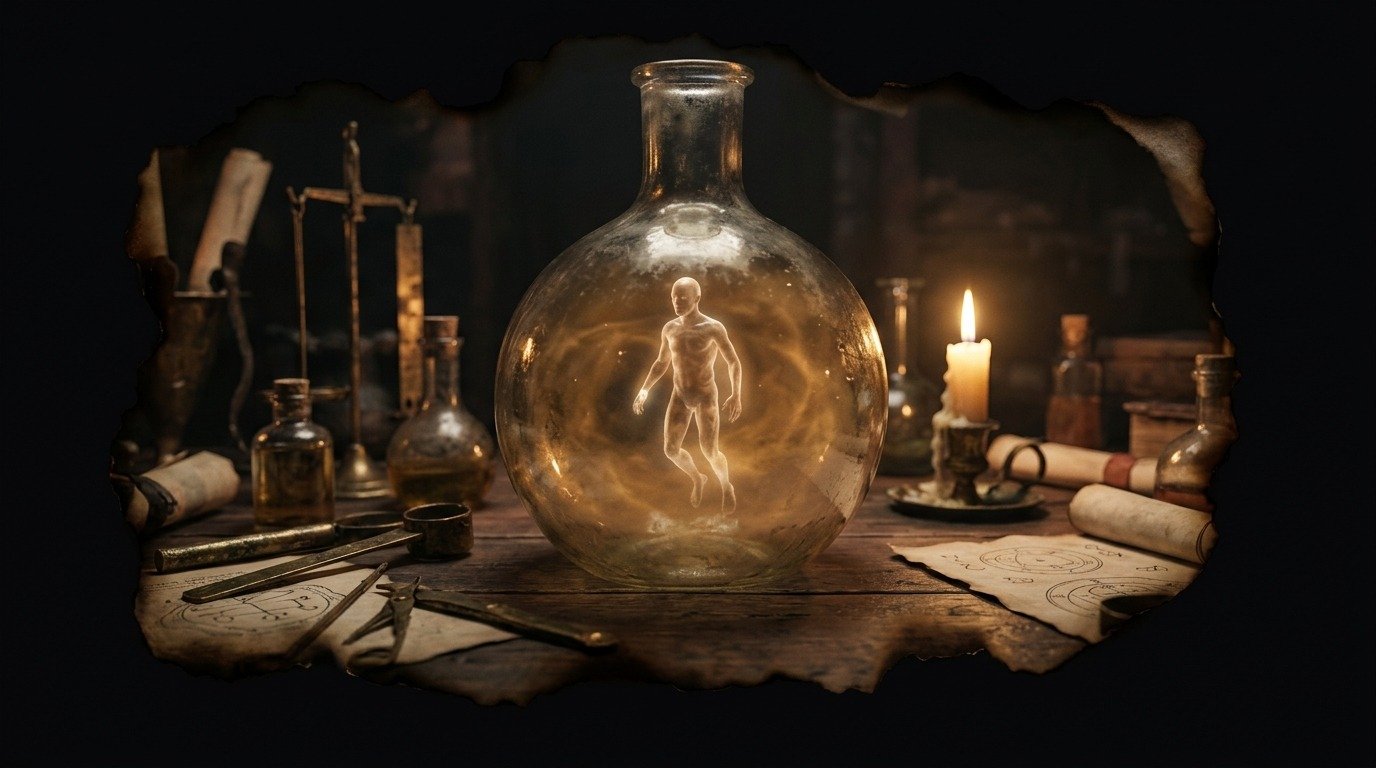
Homunculus: Life Synthesized in the Flask
The Secret Genesis of the Artificial Man
The homunculus (from the Latin *homunculus*, "little man") represents alchemy's darkest and most ambitious desire: the transgression of the laws of natural procreation to engender human life through the art of mineral and organic synthesis. The roots of this concept run deep into the Hispano-Arabic Hermetic corpus, specifically in the treatises attributed to Jābir ibn Hayyān (Geber), who in his *Kitāb al-Ustuqus al-Thānī* (The Second Book of the Elements) expounds the doctrine of *Takwin*, the artificial creation of life in the laboratory, which ranged from plants and animals to modified human beings. However, the definitive formula that defined the homunculus in Western esotericism was codified by the Swiss physician and alchemist Paracelsus in the 16th century, in his treatise *De Natura Rerum*. Paracelsus demystified spontaneous generation and proposed a rigorous method based on the controlled putrefaction of human vital fluids within a hermetic glass vessel.
Paracelsus's Recipe and Hermetic Putrefaction
The Paracelsian process of generating the homunculus is a direct application of the alchemical maxim *solve et coagula* applied to the biological plane. The formula requires that a man's semen be sealed in a glass cucurbit and buried in horse manure for forty days at a constant, warm temperature (the alchemical equivalent of uterine warmth). During this period, the seminal fluid enters a state of putrefaction (*nigredo*), where the latent life force begins to organize itself. At the end of the forty days, the putrefied semen acquires a rudimentary human form, translucent and lacking solid substance. Paracelsus instructs that, from this point on, the being must be fed daily with the *arcanum* of human blood for forty weeks (the duration of a natural gestation), keeping it always under the constant warmth of the manure. If the process is uninterrupted and it is shielded from direct sunlight, the homunculus will fully develop, presenting itself as a miniature human child, endowed with all its limbs and organs, but gifted with psychic faculties and an intelligence far superior to those of a common infant.
Esoteric Meaning: The Tragedy of Soulless Creation
Within the framework of the Kabbalah and spiritual alchemy, the homunculus is a deeply tragic and ontologically incomplete being. Unlike a man born of woman, who possesses the direct divine spark of the breath (*Neshamah*), the homunculus is a creation of the microcosm. It possesses *Nephesh* (the animal or vital soul, provided by the blood of its sustainer) and can develop a refined *Ruach* (the rational intellect), but it lacks the transcendental principle of divine individuality. It is an organic automaton of the highest sophistication. Metaphorically, it represents the Faustian ambition of the human intellect attempting to usurp the Creator's throne. Lacking an immortal soul, the homunculus is indissolubly bound to the earth and the laboratory of its birth. It is not an heir to the spiritual realm; it is a creature of the astral plane condensed into physical matter. In Masonic and Rosicrucian allegories, the homunculus is also the symbol of the neophyte who has not yet received spiritual light: a semi-formed being in the womb of ignorance who needs the "philosophers' fire" to acquire true consciousness.
Alchemical Properties, Limitations, and Warnings
Alchemical manuscripts warn that the homunculus possesses gifts that arouse the greed of the wise: it is a natural seer, capable of perceiving nature spirits (gnomes, sylphs, salamanders, and undines) and revealing the location of hidden treasures and secrets of Hermetic medicine. Its vision is not clouded by the sensory illusions that affect the common human eye.
Nonetheless, its possession is a latent danger to the operator. Being a creature born of putrefaction and blood, its temperament is inherently unstable. The homunculus tends toward deep melancholy and malevolence if it feels imprisoned or if it becomes aware of its own artificial nature. It must remain confined within the flask or vessel where it was engendered; if the glass breaks and the homunculus comes into direct contact with the impure atmosphere of our world without proper preparation, its body withers and dissolves in a matter of minutes, returning to its primal state of decomposed organic matter.
Comments
Share information, an experience, or a source to help enrich this entry. They are automatically reviewed before being published.
Loading comments...