Kabbalah
Kabbalah: The Mystical Map of Creation
What It Is
Kabbalah is a discipline and school of esoteric thought originating in Jewish mysticism. Its purpose is to explain the relationship between God, the infinite and unknowable Creator (*Ein Sof*), and the mortal and finite universe, which constitutes His creation. It seeks to unveil the hidden meaning of sacred texts and the structure of the universe.
How It Works
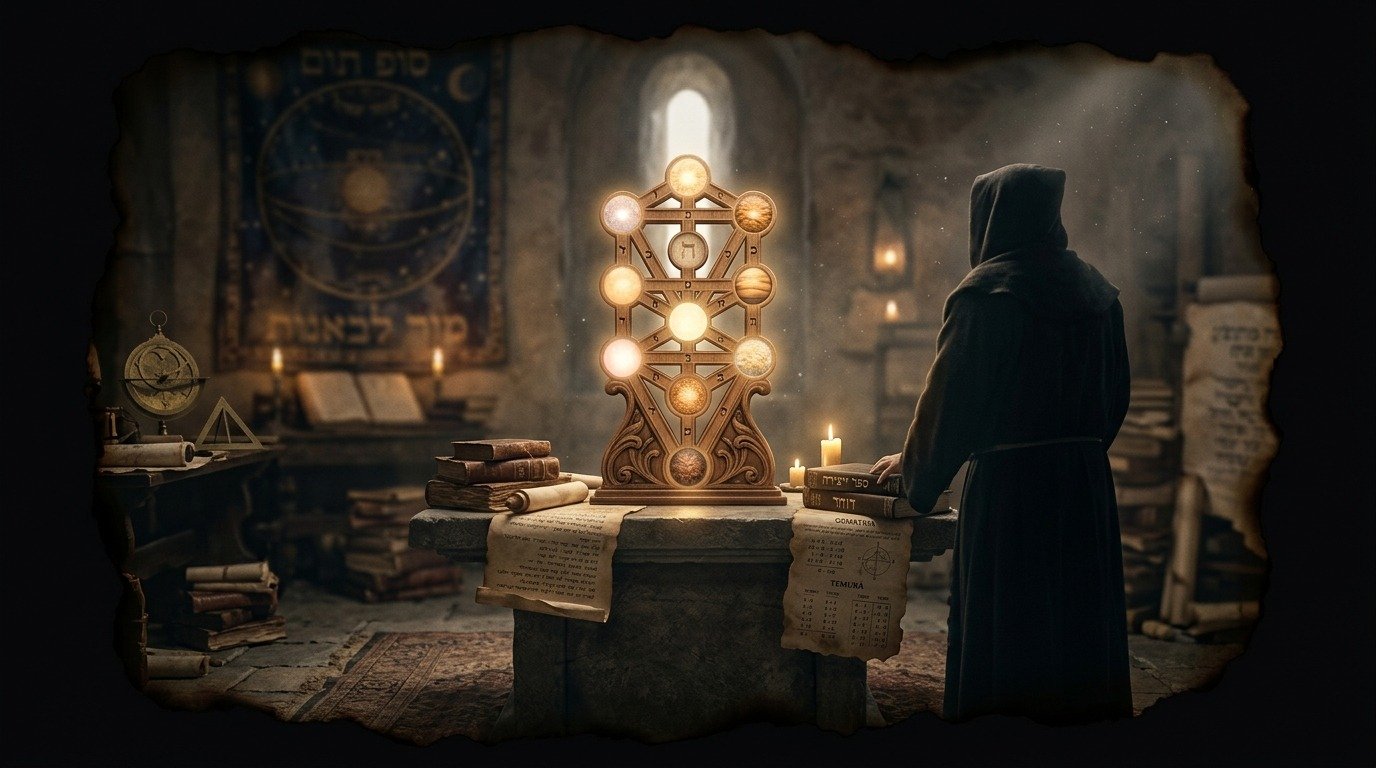
The system of Kabbalah is structured around visual and linguistic representations of the divine. The central concept is the Tree of Life (*Etz Chaim*). This glyph is composed of ten divine emanations called *Sefirot* (singular: *Sefirah*), connected by twenty-two paths.
The Sefirot represent the phases of the process of creation and the divine attributes: 1. **Keter** (Crown): Pure divine will. 2. **Chokhmah** (Wisdom): The seed of creation. 3. **Binah** (Understanding): The matrix that gives form to creation. 4. **Chesed** (Mercy): Expansive love. 5. **Gevurah** (Strength): Rigor and discipline. 6. **Tiphereth** (Beauty): Balance and harmony. 7. **Netzach** (Victory): Persistence and instinct. 8. **Hod** (Splendor): Intellect and communication. 9. **Yesod** (Foundation): The plane of vital energies and the basis of manifestation. 10. **Malkuth** (Kingdom): The physical and instrumental plane.
To decipher sacred texts, Kabbalah uses three hermeneutic techniques based on the Hebrew alphabet: - **Gematria**: Assigns a numerical value to each letter. Words with the same numerical value reveal hidden mystical connections. - **Notarikon**: Creates new words using the initial or final letters of a phrase, or vice versa. - **Temurah**: Permutes letters according to specific algebraic rules to reveal hidden meanings.
Origin and History
The roots of Kabbalah are found in Jewish mysticism of the 1st and 2nd centuries AD, particularly in the literature of the heavenly palaces (*Heikhalot*) and the fiery chariot (*Merkabah*).
The two foundational texts of Kabbalah are the *Sefer Yetzirah* (Book of Creation), written between the 2nd and 6th centuries AD, and the *Zohar* (Book of Splendor), which appeared in Spain in the 13th century. The *Zohar* was compiled and written by the Castilian mystic Moses de León.
In the 16th century, the city of Safed, in Galilee, became the Kabbalistic center of the world. There, Isaac Luria revolutionized the discipline by introducing the concepts of *Tzimtzum* (the self-contraction of God to make space for creation), *Shevirat HaKelim* (the shattering of the sacred vessels), and *Tikkun* (the restoration of divine order).
Starting in the Renaissance, intellectuals such as Giovanni Pico della Mirandola adapted these concepts to create Christian Kabbalah, which attempted to validate Christian theology through Kabbalistic methods. In the 19th century, this branch evolved into Hermetic Qabalah, detached from Jewish orthodoxy and adapted by modern occultism.
Key Figures
- **Moses de León (1240–1305)**: Spanish rabbi and mystic, author and disseminator of the central body of the *Zohar*. - **Isaac Luria (1534–1572)**: The "Ari", whose teachings reformulated all subsequent Kabbalistic cosmology. - **Giovanni Pico della Mirandola (1463–1494)**: Italian humanist, founder of Christian Kabbalah. - **Éliphas Lévi (1810–1875)**: French occultist who unified Kabbalah with the Tarot, assigning the 22 major arcana to the 22 paths of the Tree of Life.
How It Is Understood Today
Today, Orthodox Jewish Kabbalah (a path of rigorous Torah study) and Hermetic or contemporary Kabbalah (a system of self-knowledge and ceremonial magic) coexist. Historically, it is valued as one of humanity's most complex theosophical and cosmological systems, with a major influence on depth psychology.
Connections
Kabbalah is closely related to the Tarot (where the Tree of Life organizes the arcana), Ceremonial Magic (especially the Golden Dawn), Hermeticism, and Alchemy.
Comments
Share information, an experience, or a source to help enrich this entry. They are automatically reviewed before being published.
Loading comments...