Alchemy
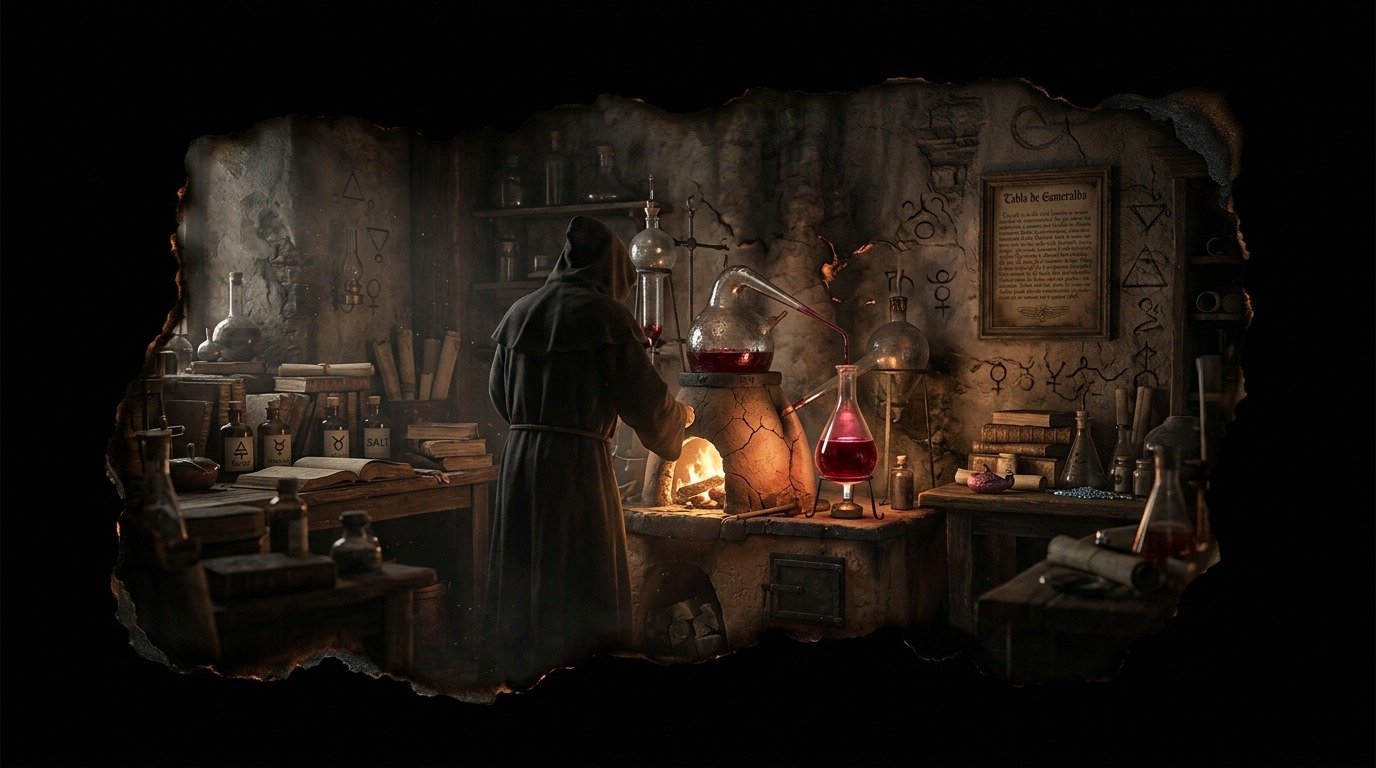
Alchemy: The Transmutation of Matter and the Soul
The Art of Transmutation
Alchemy is an esoteric discipline and a philosophical tradition centered on the transmutation of matter and the perfection of the spirit. Its operational objective is twofold: the conversion of base metals into gold (chrysopoeia) and the creation of the Philosopher's Stone, an agent capable of granting immortality and perfect health through the Elixir of Life. For the alchemist, matter possesses life and is interconnected with the cosmos; therefore, purifying a metal in the laboratory is equivalent to purifying and perfecting the operator's own soul.
The System and Phases of the Great Work
The alchemical process to obtain the Philosopher's Stone is called the Great Work (*Magnum Opus*). This work is carried out in a special furnace called an athanor, using distillation and condensation tools such as the alembic and the retort. The process is divided into phases that represent both physical states of matter and stages of spiritual transformation: * **Nigredo (black work):** It is the phase of dissolution, decomposition, and putrefaction. It represents the death of the previous state of matter and, on a spiritual level, the confrontation with shadows and the destruction of the ego. * **Albedo (white work):** It is the phase of purification and washing. Matter is cleansed of its impurities. It represents the awakening of consciousness, enlightenment, and the revelation of the soul. * **Citrinitas (yellow work):** It is the phase of combustion and maturation, where solar light begins to integrate into matter. In late alchemy, this phase was frequently assimilated into the rubedo. * **Rubedo (red work):** It is the final phase of fixation and coagulation. The reconciliation and union of opposites (the Sacred Marriage or *Coniunctio*) takes place. From this union, the Philosopher's Stone is born, representing the fully realized human being.
The theory of matter in European alchemy is governed by the *Tria Prima*, the three fundamental principles systematized by Paracelsus: * **Sulfur (*Sulphur*):** The active, masculine, igneous, and combustible principle. It represents the soul. * **Mercury (*Mercurius*):** The passive, feminine, fluid, and volatile principle. It represents the spirit. * **Salt (*Sal*):** The neutral principle of solidity and cohesion. It represents the physical body that unites the other two.
Origin and Historical Evolution
Western alchemy was born in Hellenistic Egypt, with its epicenter in Alexandria between the 1st and 3rd centuries AD. During this period, Egyptian metallurgical techniques, the Greek philosophy of the four elements of Aristotle, and mystical doctrines oriented toward personal salvation merged. Its most famous text, the *Emerald Tablet*—attributed to Hermes Trismegistus and known through Arabic versions from the 8th and 9th centuries—establishes the law of correspondence between the macrocosm and the microcosm.
In the 8th century, alchemical knowledge was adopted and developed by the Islamic world. The scholar Jabir ibn Hayyan (Geber) expanded the theory of matter by postulating that all metals are composed of varying proportions of sulfur and mercury. Al-Razi contributed systematic classifications of substances and laboratory methods that professionalized the practice.
Beginning in the 12th century, translations of Arabic texts into Latin introduced the discipline to Western Europe. Medieval thinkers such as Albertus Magnus and Roger Bacon studied its theoretical principles. During the Renaissance, alchemy became firmly integrated with Neoplatonism, Hermeticism, and Christian Kabbalah, reaching its practical and intellectual peak in the 16th and 17th centuries.
Key Figures
* **Hermes Trismegistus:** A mythical and syncretic figure (a fusion of the Egyptian god Thoth and the Greek Hermes) considered the founder of the Hermetic doctrine and alchemy. * **Zosimos of Panopolis (3rd–4th centuries AD):** An Egyptian-Greek alchemist whose treatises are the oldest surviving historical texts on the practice. * **Jabir ibn Hayyan (721–815 AD):** A Persian alchemist who laid the methodological and experimental foundations of the discipline in the Islamic world. * **Nicolas Flamel (1330–1418):** A French scribe whom 17th-century literature turned into a legend, attributing to him the actual transmutation of mercury into gold through an ancient manuscript. * **Paracelsus (1493–1541):** A Swiss physician who shifted the goal of alchemy from obtaining gold to creating mineral medicines, founding iatrochemistry. * **Isaac Newton (1643–1727):** An English physicist who dedicated decades of his life to the experimental study of traditional alchemical manuscripts in his private laboratory.
Alchemy Today
In contemporary esotericism, alchemy is understood and practiced primarily as a path of inner development and self-knowledge. In the 20th century, the Swiss psychologist Carl Gustav Jung reinterpreted alchemy by proposing that the symbolism of the Great Work is an external projection of the process of individuation, the psychological path through which the human being integrates their conscious mind with their unconscious. For its part, the history of science studies it as the direct and necessary precursor to modern chemistry.
Connections
Alchemy maintains a direct relationship with Hermeticism as its philosophical framework; with Astrology, which assigns a ruling planet to each metal (the Sun rules gold, the Moon silver, Mars iron); with the historical figure of Paracelsus; and with the symbol of the Philosopher's Stone.
Comments
Share information, an experience, or a source to help enrich this entry. They are automatically reviewed before being published.
Loading comments...