Hermes
Hermes: The Wind That Crosses Thresholds
The Dawn of the Sacred Thief
In a dark cave on Mount Cyllene, in Arcadia, the nymph Maia gave birth to a child who did not know the stillness of the cradle. By noon of his first day of life, Hermes had already slipped out of his swaddling clothes and was exploring the outside world. On the threshold of the cave, he came across a tortoise; with a mixture of ruthless curiosity and creative genius, he emptied the shell, stretched sheep gut across it, and constructed the first lyre, coaxing from it notes of a sweetness so deep that they moved the stones. As evening fell, the newborn god made his way to the pastures of Pieria and stole fifty sacred cows from his brother Apollo. To leave no trace, he forced the cattle to walk backward and crafted sandals from myrtle branches to erase his own tracks. When an enraged Apollo discovered the infant back in his cradle, feigning angelic innocence, he brought him before Zeus. Instead of punishing him, the king of Olympus burst into laughter at his youngest son's cunning, sealing a truce between the brothers when Hermes gifted the lyre to Apollo in exchange for the golden caduceus.
The Lord of Roads and Crossroads
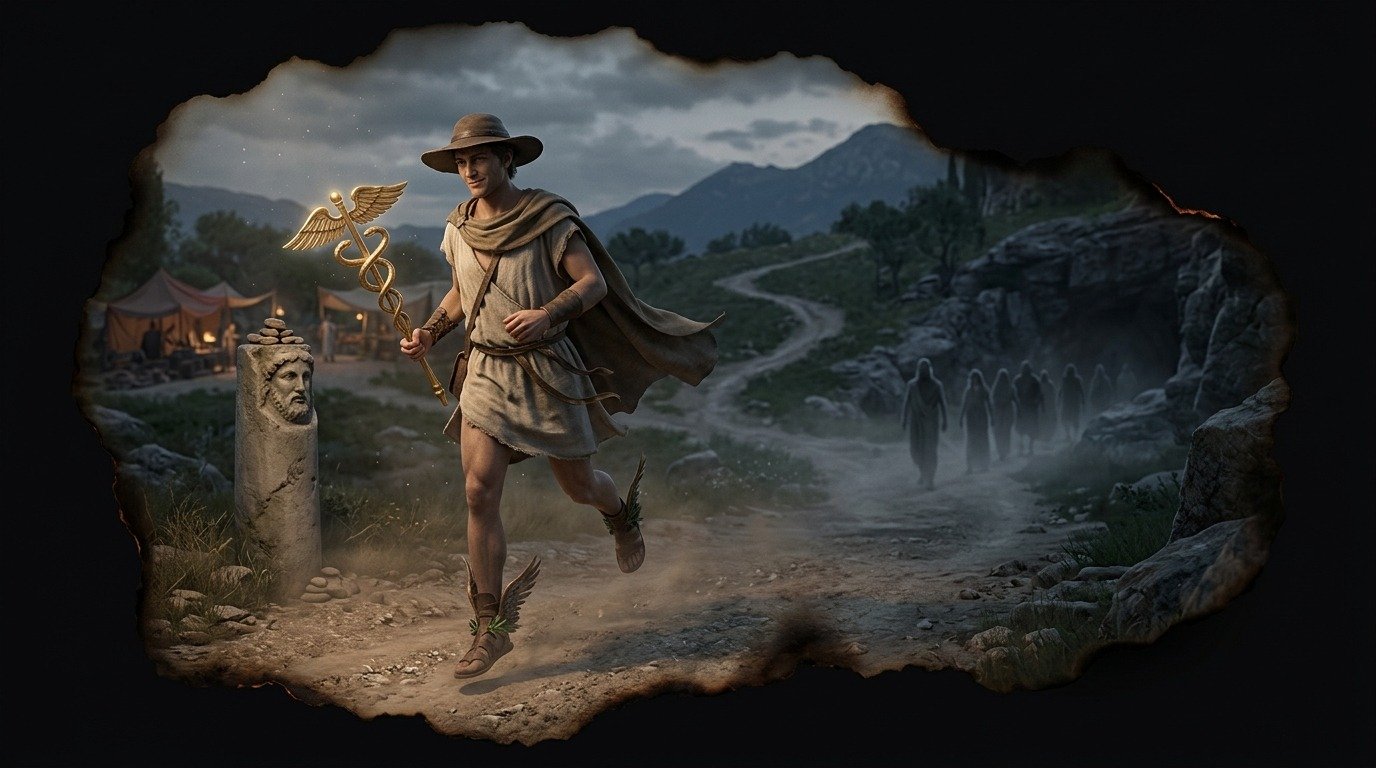
Hermes is the god of that which does not stop, the patron of transition and the space that exists between borders. His domain is the dusty roads, the marketplaces where bartering demands cunning, the ports where ships unload foreign goods, and the crossroads where travelers must choose a destination. His symbols, the winged sandals and the wide-brimmed hat, represent the speed of thought and the freedom of one who belongs to no fixed place. He is not a god who demands monumental temples; his presence is marked by "herms," mounds of stones or pillars bearing his face that travelers feed as they pass to ask for protection against the dangers of the road and highwaymen. His morality is fluid: he protects the honest merchant and the clever thief alike, the diplomat weaving alliances and the spy stealing secrets in the night. For Hermes, the only true sin is immobility.
Psychopomp: The Whisper That Guides the Shadows
Hermes's most difficult journey does not take place under the sun, but in the descent into the abyss. He is the Psychopomp, the conductor of souls, the only one of the Olympian gods who has the right to freely cross the borders of Hades without becoming trapped in his domains. When the thread of life is cut, Hermes appears at the edge of the deathbed, not with the scythe of terror, but with a gentle touch of his caduceus that induces a light sleep and releases the spirit from its fleshly envelope. He leads the shadows through the underground paths, guiding them along the banks of the River Styx so they do not get lost in the mist of oblivion before Charon picks them up in his boat. In this role, the mischievous god of the marketplaces becomes a figure of compassionate and silent solemnity. He is the necessary bridge between the light of the living and the eternal silence of the underworld.
The Word That Deceives and Saves
Hermes rules over communication, eloquence, and the power of the word to reveal or mislead. He is the messenger who translates the will of the gods to mortals, transforming incomprehensible decrees into human language. But he is also the herald who resorts to white lies or brilliant deception to resolve crises that the brute force of other gods would only worsen. When the hundred-eyed monster, Argus, was guarding the nymph Io by order of Hera, no god could approach without being detected. It was Hermes who, disguised as a shepherd, lulled the giant to sleep eye by eye with his stories and the sound of his pan flute before cutting off his head. His wit is his sword; his agility, his Clipeum / the shield. In a universe of heavy and wrathful deities, Hermes survives and triumphs because he is faster than anger, craftier than strength, and as unpredictable as the wind that changes direction at dusk.
Comments
Share information, an experience, or a source to help enrich this entry. They are automatically reviewed before being published.
Loading comments...