Apollo
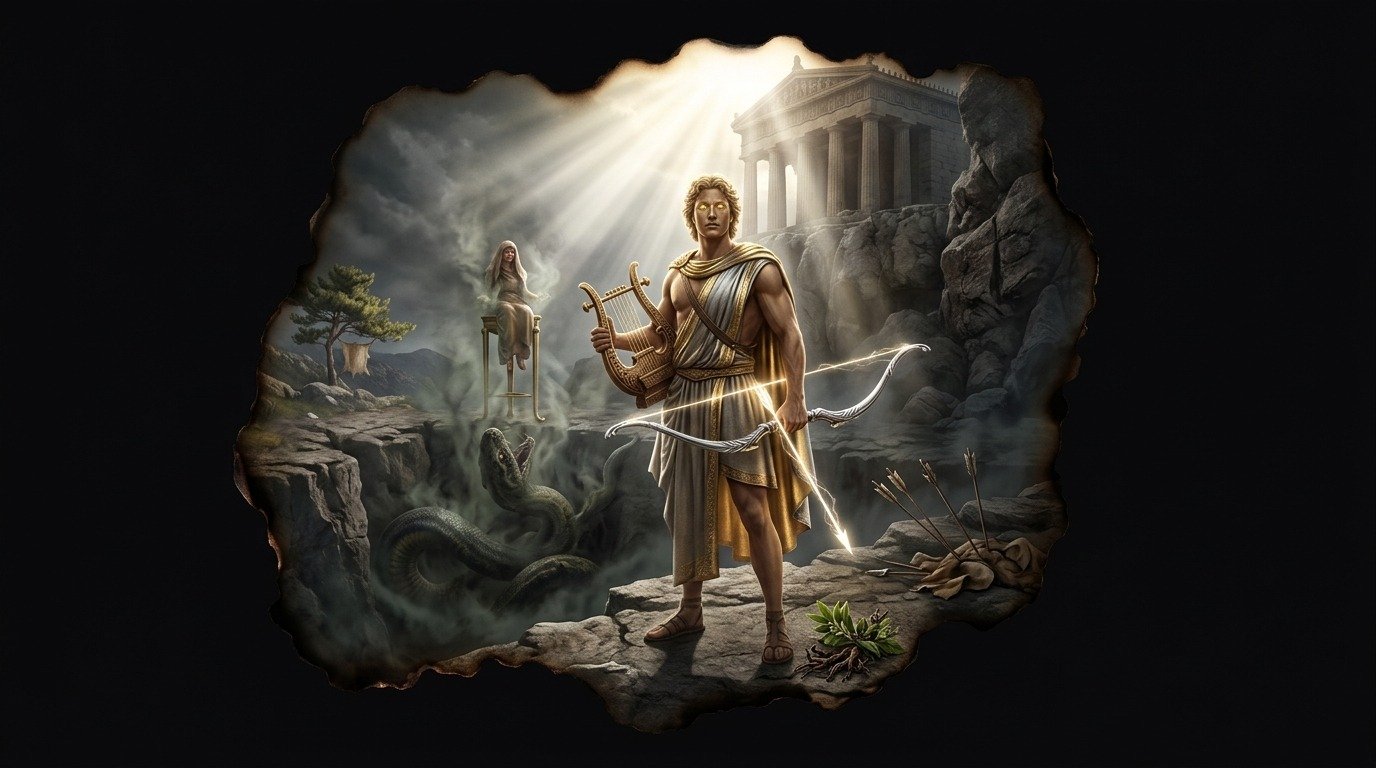
Apollo: The Light That Heals and the Arrow That Carries the Plague
The Wandering Rock and the Birth of the Sun
The birth of light required a sanctuary that did not belong to the mainland. Leto of the dark hair wandered the world, pursued by the jealousy of the Queen of Olympus, who had sworn that no place that received the light of the sun would shelter her labor. Only Delos, a barren and invisible rock drifting upon the waves of the Aegean Sea, dared to receive her. There, beneath the shadow of a palm tree and clinging to the slopes of Mount Cynthus, the mother gave birth to the divine twins.
When he took his first breath, the wandering island anchored itself to the ocean floor by means of four pillars of diamond, and the surrounding waters were dyed a blue so deep that it seemed to glow from within. The goddesses present fed him nectar and ambrosia, and instantly the swaddling bands wrapping him fell away like threads of light. The child knew no weakness; he stood up, took the silver bow that Hephaestus had forged for him, and claimed his domains before the firmament: the lyre, the bow, and the ability to reveal to men the unyielding will of his father.
The Bow, the Lyre, and the Abyss of Delphi
His figure represents the ideal of harmony, but it is a tense harmony, like the string of his two great instruments: the golden lyre and the silver bow. Both are made of the same wood and demand the same extreme precision. The bow kills from afar with a clean whistle; the lyre heals the soul and orders the cosmos with its vibrations. He is the god of music who banishes the darkness of the mind, but also the one who tenses the string to punish the pride of mortals with invisible plagues that travel on the tips of his arrows.
His most terrible and foundational feat occurred on the slopes of Mount Parnassus. There dwelt Python, a colossal serpent born of primeval mud that terrorized men and guarded the rifts in the earth from which the vapors of the underworld emanated. The god of light descended from the heights and, with a hundred arrows that flashed like lightning, riddled the monster in its own lair.
Upon the rotting blood of the beast, he founded his sanctuary at Delphi. In that place, the prophetess, suspended on a bronze tripod above the rift where the serpent's corpse still decomposed, lent her body so that the voice of the god could blow through her lips, delivering oracles that decided the fate of entire kingdoms.
The Relentless Purifier
He is the god who defines the boundaries of sanity and beauty, but his golden eyes know no mercy when the natural order is broken. The children of Niobe discovered this, falling one by one beneath his silent projectiles when their mother dared to compare herself to Leto. The satyr Marsyas discovered this, believing his rustic flute could compete with the celestial music of the lyre; the god defeated him in the contest and flayed him alive, hanging his skin from a pine tree so the wind would make it sing a hymn of warning against mortal vanity.
Despite his celestial cruelty, he is also the great purifier of men. His hands, which can send the plague to army camps, are the very same that taught mortals the art of medicine. Through his son Asclepius, he transmitted the knowledge of herbs that soothe pain and the scalpel that halts death. He demands purity of spirit and body; he is the sun that dispels the miasmas of the swamp and the guilt of the repentant murderer, restoring light to those who grope in the darkness of their own deeds.
Comments
Share information, an experience, or a source to help enrich this entry. They are automatically reviewed before being published.
Loading comments...