Delphi
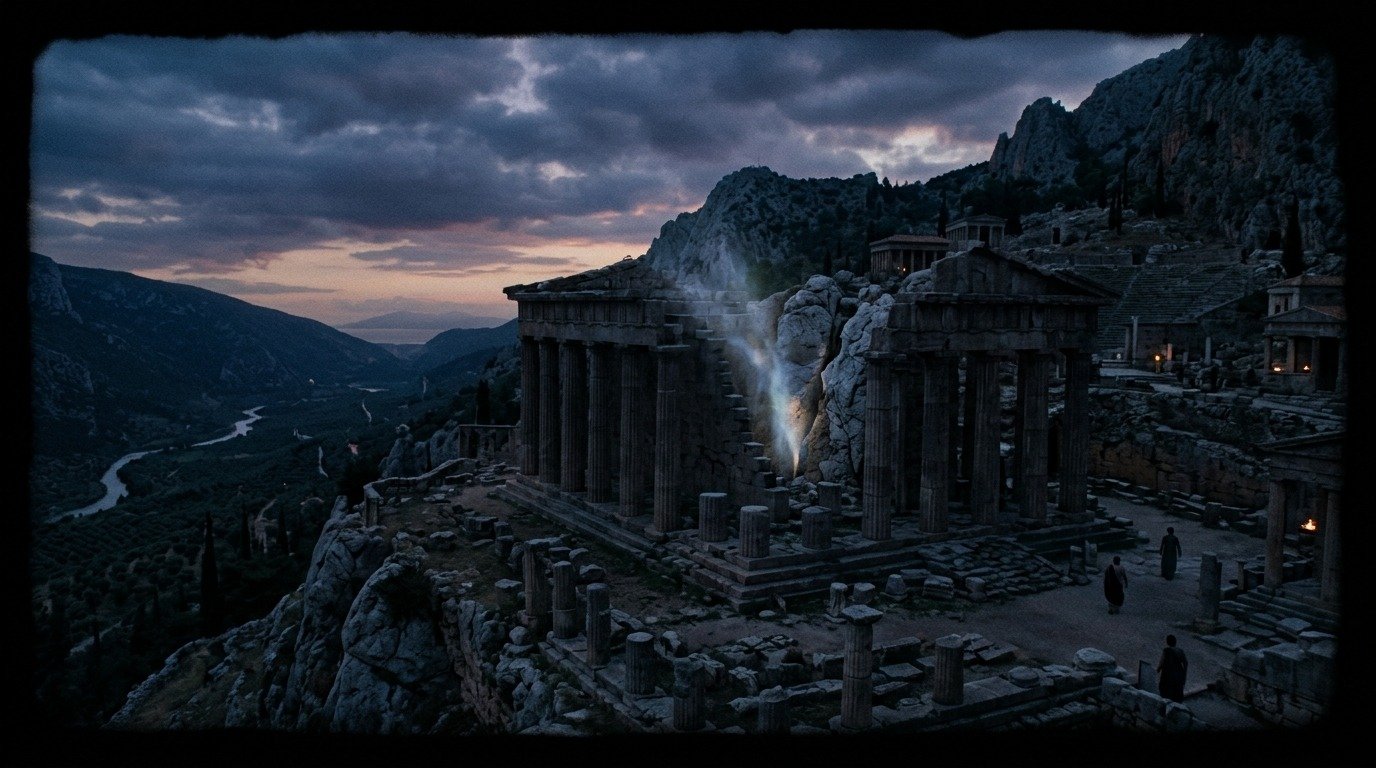
Delphi: The Whisper of the Earth That Ruled the Ancient World
The Consultation That Changed History
In the summer of 480 BC, three Athenian emissaries stumbled up the slope of Mount Parnassus. Xerxes, the king of Persia, was advancing southward with an army that made the earth tremble, and Athens was searching for an answer to survive. In the twilight of the temple of Apollo, the men waited in front of the adyton, the most sacred chamber. There, seated on a golden tripod placed directly over a cleft in the rock, the Pythia inhaled the vapors rising from the ground. Her eyes stared into nothingness, her body tensed, and from her mouth burst a cracked, harsh, alien voice: "The wooden wall will be your salvation." The emissaries deciphered the riddle, built a fleet of ships, and destroyed the Persians in the Bay of Salamis. Greece was saved because a woman, in a deep trance, listened to the whisper from the depths of Delphi.
The Voice of the Gods in the Rock
Delphi began as a chasm consecrated to Mother Earth, Gaia, protected by a gigantic mythological serpent named Python. Greek myth tells that Apollo, the god of light and prophecy, descended from Olympus, killed the beast with his arrows, and claimed the site. To consecrate his victory, he buried the monster's body beneath the temple. The decomposing fluids of Python, heated by subterranean fire, became the prophetic gas that the priestesses inhaled to commune with the god. During nearly a thousand years, Delphi functioned as the political and spiritual center of the Mediterranean. Kings of Lydia, generals of Sparta, and philosophers of Rome traveled for months to deposit gold in its treasuries and ask a single question. The Pythia, a local woman chosen for her devout life, fasted, purified herself in the waters of the Castalian Spring, and chewed laurel leaves before descending into the sacred pit. Her answers, often incoherent and violent, were translated by the priests into hexameter verses that decided the founding of colonies, the start of wars, or the fall of dynasties.
The Center of the Universe and Its Secrets
For the ancient Greeks, Delphi was no ordinary sanctuary; it was the *Omphalos*, the navel of the world. According to theogony, Zeus released two eagles from opposite ends of the universe, and the birds crossed paths exactly over this spot on the slope of Parnassus. A carved stone shaped like a beehive marked the exact meeting place. The legend of the sanctuary asserts that the prophetic power did not belong to the priestess, but to the earth itself. If a Pythia attempted to enter the adyton without the proper rituals or if the atmosphere was not propitious, the gas would attack her. Chroniclers of the time, such as Plutarch, who was a priest at Delphi, recorded the case of a young priestess who entered a hysterical trance, ran toward the exit screaming in terror, and collapsed. She died a few days later, her brain consumed by the delirium of the god.
The Wind Between the Broken Columns
Anyone walking along the Sacred Way of Delphi today feels the pressure of the height and the void. The ruins of the temple of Apollo are silhouetted against the abyss of the Pleistus Valley, where thousands of olive trees cascade like a green river toward the Gulf of Corinth. Travelers who visit the site at dawn, before the crowds arrive, describe an absolute silence that is suddenly broken by gusts of freezing wind coming down from the peaks of Parnassus. Upon approaching the temple's foundations, some visitors claim to feel a subtle vibration beneath the soles of their feet, a resonance rising through their ankles. The water of the Castalian Spring continues to gush from the rock, icy and crystal clear, inviting the curious to wet their hands in the same flow where the prophetesses washed their hair before dying a little in each trance.
What Science Unearthed
For centuries, modern historians dismissed the existence of prophetic vapors, attributing the Pythia's trance to pure religious suggestion or simulation. However, in the year 2001, a team of geologists and archaeologists led by Jelle de Boer discovered that the temple of Delphi lies exactly at the intersection of two active geological faults: the Delphi fault and the Kerna fault. The tectonic movement of these faults over bituminous limestone deposits generated heat and friction, releasing gases through fissures in the rock. Analysis of the water from the underground springs revealed the presence of ethylene, methane, and carbon dioxide. Ethlene, in low concentrations, produces a state of euphoria, physical dissociation, and mystical trance, which coincides with ancient descriptions of the Pythia floating on the words of Apollo. Other scientists dispute whether the gas ever reached sufficient quantities, and the debate remains open.
The Last Prophecy
In the year 362 AD, the Roman Emperor Julian the Apostate attempted to restore the pagan splendor of Delphi in the face of advancing Christianity. He sent his personal physician, Oribasius, to consult the oracle. The Pythia's response was the last recorded in history: "Tell the king that the temple has fallen to the ground. Apollo no longer has his hut here, nor the prophetic laurel, nor the talking spring. The talking water has dried up." Today, the cleft is sealed by the collapse of centuries, but Parnassus continues to watch over the empty stones.
Comments
Share information, an experience, or a source to help enrich this entry. They are automatically reviewed before being published.
Loading comments...