Gaia
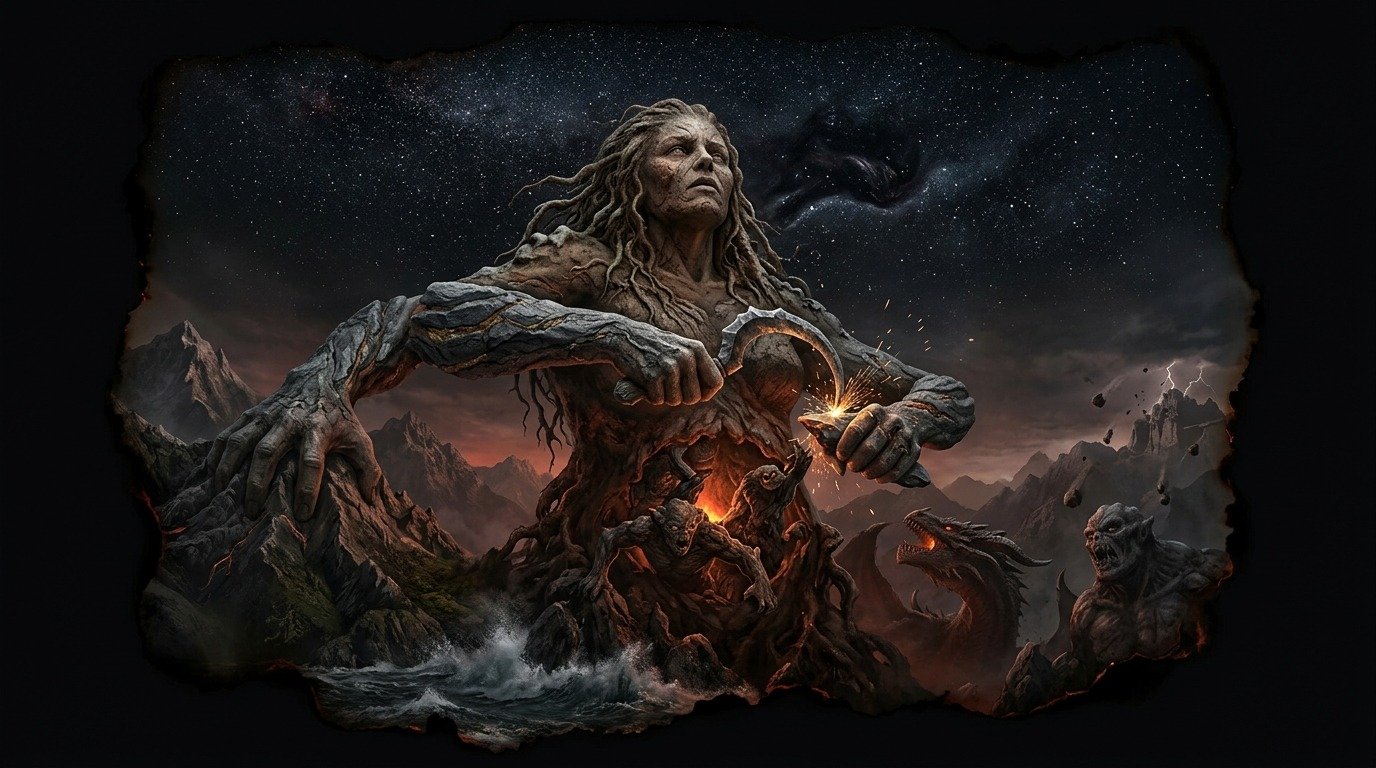
Gaia: The Primordial Depths From Which the World Springs
The Clay of the Beginning
Before gods, temples, or light itself existed, there was Chaos, an immense and formless void. From that absolute nothingness emerged Gaia, the Earth, not as a mere stage for life, but as the firm, eternal, and indestructible foundation upon which all reality would rest. She is the ground that supports the footsteps of the immortals and the common grave that receives the dead; the original matter that breathes, feels, and conspires.
Without the need for any union, Gaia begot from her own body the great mountain ranges that crown the horizon and Pontus, the barren sea of raging waves. But her most monumental creation was the firmament, Uranus, destined to cover her completely to serve as an eternal dwelling for the gods. By creating him, Gaia defined the boundaries of the cosmos, though she would soon discover that her own creation would become her oppressor.
The Conspiring Womb
Gaia's pain was not that of an ordinary mother, but that of a tectonic force subjected to unbearable pressure. With her children trapped inside her by Uranus's cruelty, her own body became a burning dungeon. It was she who conceived the rebellion, extracting a gray and unknown metal from her depths to forge the first flint sickle. She herself trained the hand of her son Cronus and celebrated the slash that freed her womb from the suffocating embrace of the firmament.
However, Gaia does not tolerate any absolute ruler, not even those she herself helps to crown. When Cronus proved to be a tyrant as ruthless as his father by devouring his own children, Gaia conspired once more, guiding Rhea to save the infant Zeus and prophesying the end of the Titans' reign. Her loyalty did not belong to any divine dynasty, but to the dynamic balance of life that had to keep springing from her bosom.
The Rebellion of Rock Flesh
The rise of the Olympian gods to power did not bring peace to Mother Earth. Seeing her children, the Titans, chained forever in Tartarus ignited her ancestral wrath. Gaia, who had been Zeus's support in his youth, became his worst nightmare. From her union with Tartarus, she conceived Typhon, a colossal creature with dragon heads and fire-spitting eyes, whose mere presence sent the Olympians fleeing to the lands of Egypt.
Later, she spurred the Giants to storm the peaks of Olympus, using entire mountains as projectiles. Although the new gods triumphed thanks to lightning bolts and the cunning of mortals, Gaia remained undefeated. She cannot be chained or destroyed, for doing so would mean the end of the world. She is still there, beneath the asphalt of the cities and the roots of the old forests, a sleeping monster watching the coming and going of men and gods with the infinite patience of rock.
Comments
Share information, an experience, or a source to help enrich this entry. They are automatically reviewed before being published.
Loading comments...