Helios
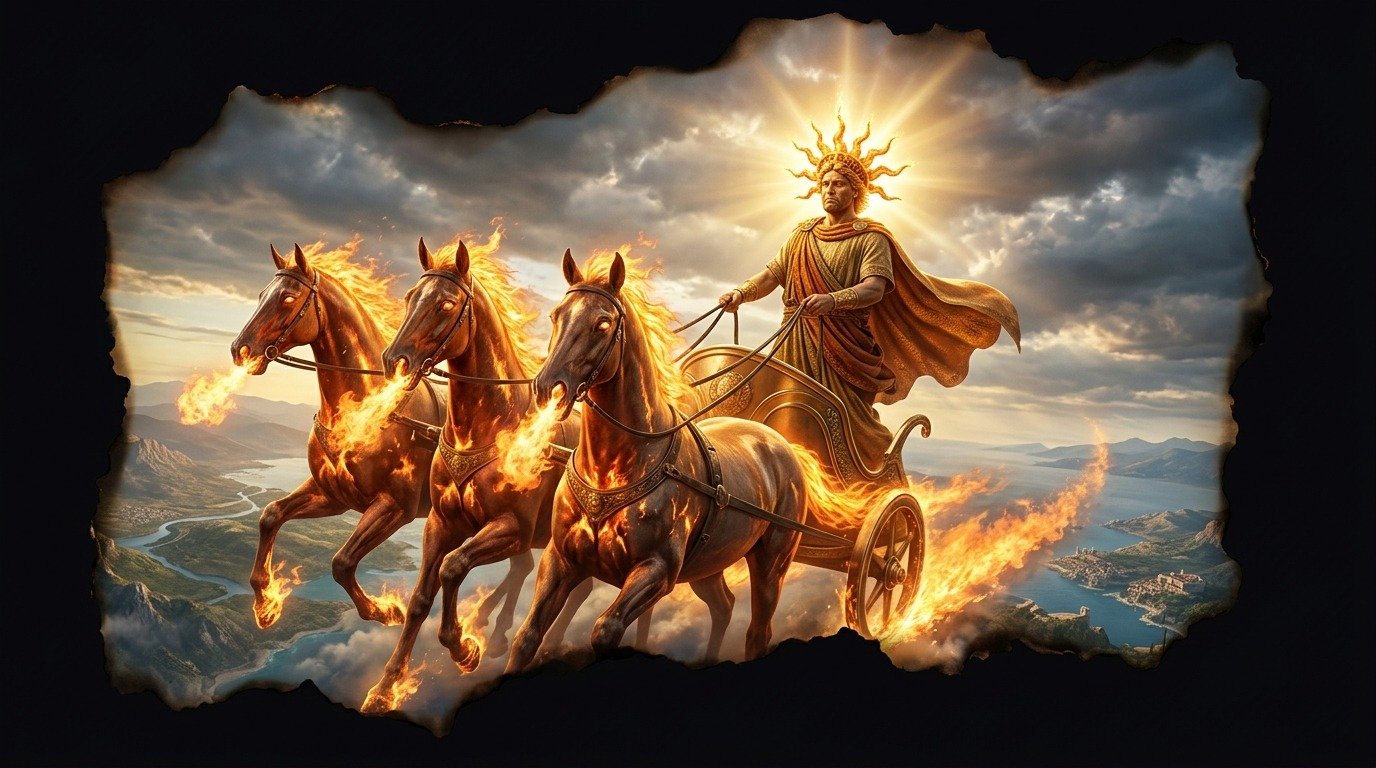
Helios: The All-Seeing Golden Eye
The Gallop of Celestial Fire
Long before others claimed the light, the Titan Helios ruled the day. Son of the Titans Hyperion and Theia, his presence is a constant blaze that dissipates the shadows of the world. Every morning, when his sister Eos, the rosy-fingered dawn, opens the golden gates of the palace of the East, Helios rises from the depths of the ocean in his chariot of gold and bronze, pulled by four stallions that breathe fire from their maws. Crowned with a diadem of solar rays so dazzling that mortals cannot look at him directly, he travels across the celestial vault, tracing a perfect arc. His journey allows no pauses or detours; the order of the cosmos depends on the steady pace of his horses. As evening falls, he descends at the western edge of the world, where he plunges into a golden cup forged by Hephaestus that transports him, skirting the currents of the great river Oceanus, back to his eastern palace to begin the cycle once more.
The Unwavering Witness of Men
Due to his elevated position and his penetrating light, nothing that occurs under the sky can be hidden from the eyes of Helios. He is the ultimate spy of gods and men, the silent witness to solemn oaths and crimes perpetrated in the dark. It was Helios who, from his chariot of fire, beheld the exact moment when Hades emerged from the depths to abduct the young Persephone, later revealing the secret to a desperate Demeter. It was also he who warned Hephaestus of the secret affair between Ares and Aphrodite, illuminating the lovers' bed so that the blacksmith god's bronze net would catch them in their shame. In a world of divine intrigue, the light of Helios is cold truth, devoid of shadows.
The Fall of the Golden Chariot
The myth that best defines the implacable nature of Helios is the tragedy of his own son, Phaethon. Eager to prove his divine lineage, the youth begged his father to allow him to drive the chariot of the sun for a single day. Helios, having sworn by the waters of the Styx to grant him any wish, tried in vain to dissuade him, warning him of the ungovernable strength of the horses and the dangers of the celestial route. The disaster was immediate. Feeling a weak hand on the reins, the steeds bolted, ascending too high and freezing the earth, only to descend abruptly, burning forests, drying up rivers, and turning fertile plains into arid deserts. To save the world from total incineration, Zeus was forced to strike down the youth with a thunderbolt. Helios, plunged into the grief of a father contemplating the ashes of his own son, extinguished his fire for an entire day, leaving the universe in a twilight of mourning, before being forced to take up the golden reins once more so that life would not perish in permanent darkness.
Comments
Share information, an experience, or a source to help enrich this entry. They are automatically reviewed before being published.
Loading comments...