Demeter
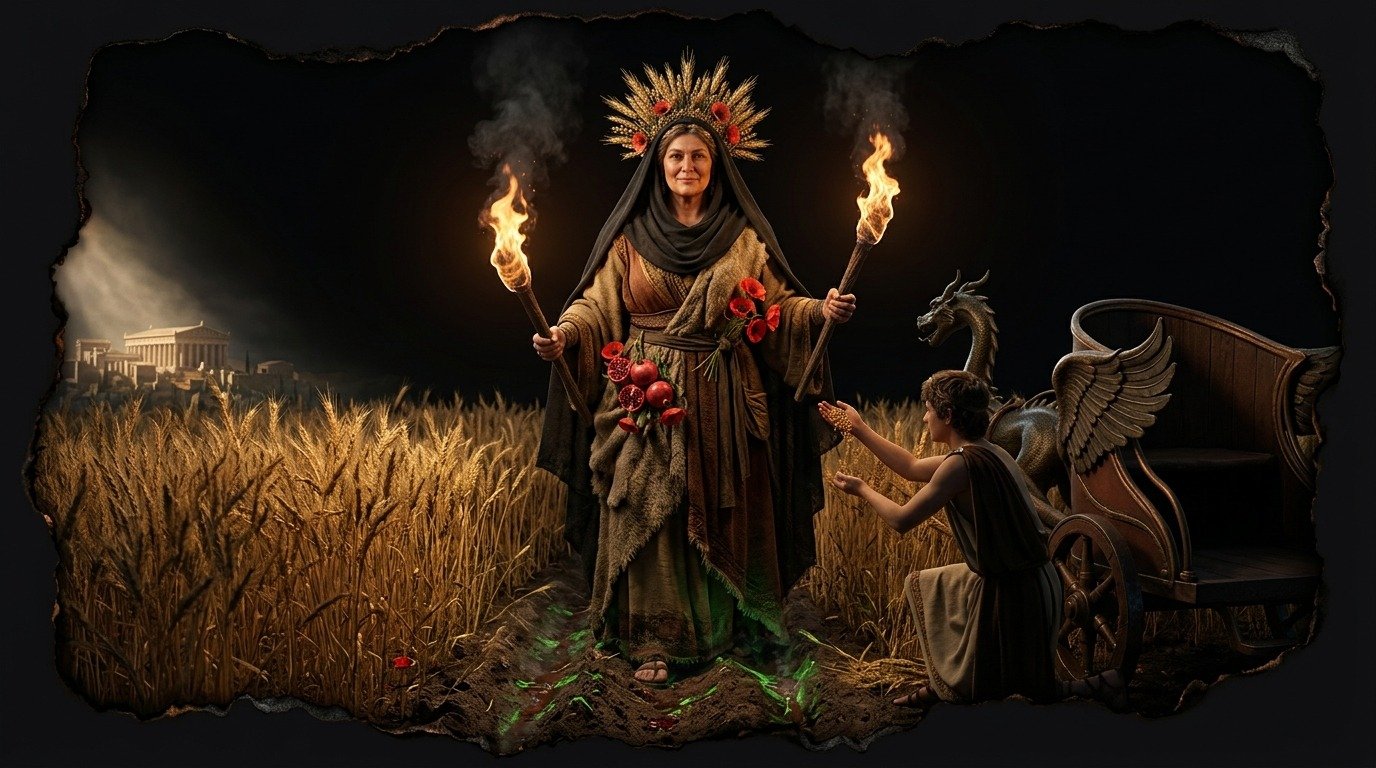
Demeter: the law of the stalk and the nourishing earth
The blood of the earth
Demeter is the force that throbs beneath the plowed soil, the sap that rises through the stalks, and the golden color of the ear of wheat ripening under the summer sun. Daughter of Cronus and Rhea, her lineage is as ancient as the plow itself. While her brothers fought over lightning bolts and the seas, she dedicated herself to teaching humans the art of agriculture, tearing them away from a wild and nomadic life to establish the foundations of civilization and the sacred laws that govern human communities. Her presence is warm yet imposing. She is depicted with a crown of ears of wheat, carrying lit torches in her hands or holding a pomegranate and a poppy—flowers that grow among the grain and symbolize both fertility and the deep sleep of the earth during winter. Demeter is the nourishing mother, but her generosity is subject to a rigorous law: the earth only returns what has been sown with respect and reverence.
The grief that froze the world
The central myth of Demeter is that of a mother stripped of her center. When her daughter Persephone disappeared without a trace, Demeter abandoned Olympus, covered herself in a black veil of mourning, and wandered the earth for nine days and nine nights without tasting nectar or ambrosia. In her hands, she carried torches lit by the flames of Mount Etna, searching every corner of the known world for her daughter's face. In her grief, Demeter arrived at the city of Eleusis disguised as an old woman and offered herself as a nursemaid in the house of King Celeus. She attempted to make the child Demophon immortal by dipping him into the sacred fire at night to strip away his mortality, but upon being discovered by the screams of Queen Metanira, the goddess revealed her true and dazzling nature. She demanded that a great temple be built for her and, secluded in her sanctuary, unleashed her wrath upon creation: she forbade seeds from germinating, dried up the roots beneath the soil, and condemned oxen to drag the plow in vain over a barren and dusty land. Famine threatened to extinguish humanity and deprive the gods of their sacrifices, forcing Zeus to intervene with the sovereign of the harvests.
The mysteries of the golden stalk
The resolution of her grief gave rise to the cycle of life and death. After agreeing that Persephone would spend part of the year with her and another part in the underworld, Demeter allowed the earth to clothe itself in green once more and the fields to burst into abundance. Before returning to Olympus, the goddess gave Triptolemus, a prince of Eleusis, wheat seeds and a winged chariot drawn by dragons to sow the grain throughout the inhabited world. In Eleusis, Demeter established the Eleusinian Mysteries, the most sacred and secret rites of the ancient world. Through these rituals, initiates dramatically experienced the descent into darkness and the return to the light, learning that death is not the end of the journey, but a necessary transition, similar to that of the seed that must rot beneath the dark earth to rise again as a golden stalk under the spring sky.
Comments
Share information, an experience, or a source to help enrich this entry. They are automatically reviewed before being published.
Loading comments...