Zeus
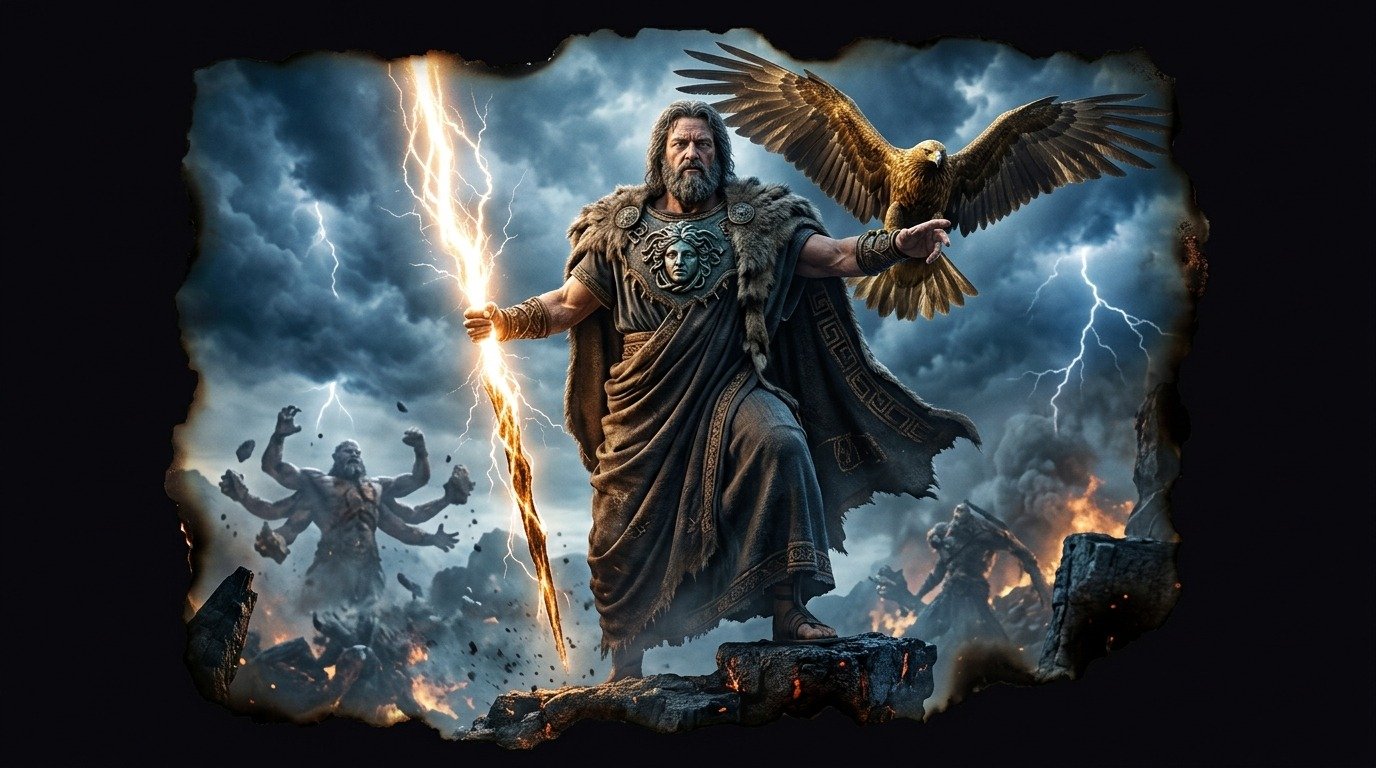
Zeus: The Sovereign of Lightning and the Storm
The Hidden Birth in the Rock
Before becoming the king of the firmament, Zeus was a whisper hidden in the depths of Crete. His father, the Titan Cronus, devoured his children as soon as they were born, consumed in turn by panic over a prophecy of overthrow. But destiny has winding paths. When the sixth child was ready to be born, the Titaness Rhea deceived her husband by handing him a stone wrapped in swaddling clothes, which he swallowed without hesitation, while the true baby was secretly taken to the cave of Mount Ida. There, the future lord of Olympus grew among the foliage and the stone. He was nursed by the goat Amalthea, whose milk gave him primordial strength, and protected by the Curetes, rustic warriors who struck their bronze shields with spears whenever the child cried, drowning out his wails so that the suspicious ear of Cronus would not discover the hiding place. In that sacred twilight, surrounded by bees that offered him honey and nymphs who guarded his breath, Zeus matured not only in size, but in a cunning as sharp as the mountain wind. From the earth itself, he learned that power does not reside in strength alone, but in knowing how to wait for the exact moment to strike.
The War That Shook the Cosmos
When Zeus emerged from his refuge, all of creation held its breath. With the help of the Oceanid Metis, prudence personified, he administered an emetic draft to his father. Cronus, convulsing, first vomited the stone that had supplanted him and then, one by one, Zeus's older siblings: Hestia, Demeter, Hera, Hades, and Poseidon, all of them already adults and thirsty for justice. Thus began the Titanomachy, a ten-year war that tore apart the foundations of the universe. To tip the scales, Zeus descended into the abyss of Tartarus and freed the Cyclopes and the Hecatoncheires, hundred-handed giants chained by Cronus. In gratitude, the Cyclopes, divine blacksmiths, forged the ultimate weapon for Zeus: the thunderbolt, a spear of blinding fire and thunder. The final battle was a cataclysm of cosmic proportions. With the Hecatoncheires hurling entire hills and Zeus launching lightning bolts from the summit of Olympus, the air burned and the seas boiled. Zeus's definitive blow shattered the sovereignty of the Titans, burying them in the abyss of Tartarus. By claiming the throne of the world, Zeus not only crowned himself as the victor but as the great orderer of primordial chaos, dividing the cosmos with his brothers and reserving the infinite sky for himself.
The Verdict of the Sky and the Law of the Thunderbolt
The presence of Zeus is recognized in the sudden change of the weather, in the heavy air before the storm, and in the majestic flight of the eagle watching from the heights. He is not a god who observes in silence; his will is active and, often, devastating. He rules from Olympus with the aegis upon his shoulders, a goat-skin shield that instills a sacred terror in whoever beholds it, decorated with the head of Medusa to petrify the audacity of mortals. His power is absolute yet dynamic. It manifests in the transgressive justice of men, protecting suppliants and guests under the law of hospitality, a sacred pact that no one violated without fearing that a thunderbolt would incinerate their lineage. Zeus is also the force of metamorphosis: to intervene in the mortal world, he adopts the form of an impeccably white bull, a swan of dazzling plumage, or an all-penetrating shower of gold. These transformations are not mere whims, but the irruption of divinity fertilizing the earth and engendering heroes, sowing the seed of greatness and tragedy in the human dynasty.
Comments
Share information, an experience, or a source to help enrich this entry. They are automatically reviewed before being published.
Loading comments...