Poseidon
Poseidon: The Earth-Shaker and the Blue Abyss
The Roar That Emerges from the Waves
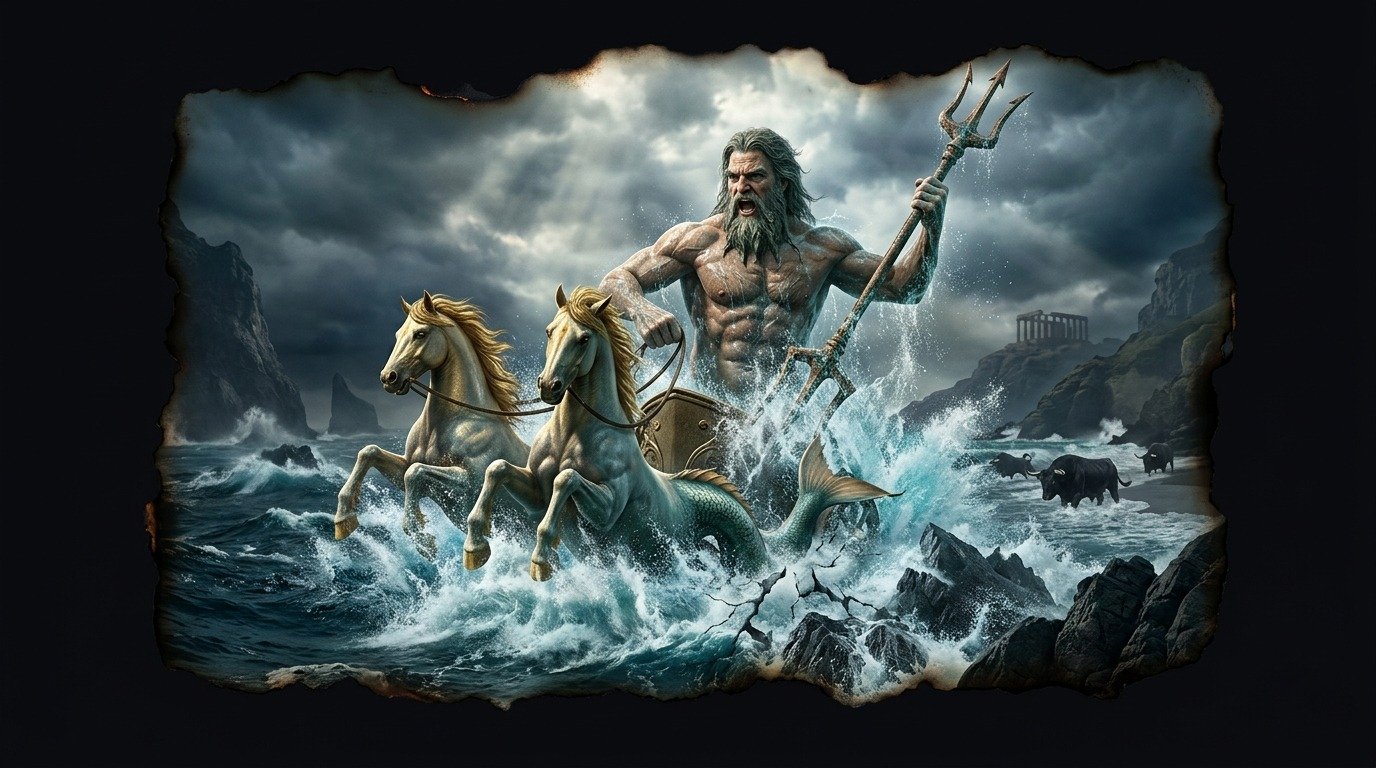
Poseidon knows neither the moderation of the heavens nor the stillness of the earth; his nature is perpetual motion, the rising tide, and the fracturing ground. At birth, he suffered the same fate as his siblings, swallowed by Cronus, but upon being freed and following the fall of the Titans, chance granted him dominion over the waters, from the shallowest currents of the rivers to the abyssal trenches where sunlight has never penetrated. The Cyclopes forged the trident for him, a three-pronged bronze weapon that is as much a scepter of sovereignty as an instrument of cataclysm. When Poseidon strikes the ground with his trident, the earth shudders with earthquakes that split open chasms, and islands emerge or sink beneath the raging foam. His home is not in the heights of Olympus, though he goes there for divine assemblies, but in a golden palace in the depths of Aegae, where the ceilings are made of seashells that open with the tide and the floors are of pearls and coral that glow with a phosphorescent light.
The Gallop of the Foam and the Earthquake
Poseidon's connection to the earth is as deep as his dominion over the sea. He is the creator and tamer of horses, animals that in Greek mythology run parallel to the white-crested waves crashing against the cliffs. It is said that, in his dispute with Athena for the patronage of the city of Attica, Poseidon struck the rock of the Acropolis with his trident, causing a saltwater spring to gush forth and, in some traditions, the first warhorse, a gift of military power and brute strength. His temperament is identical to the ocean he rules: he can be in a dead calm that lulls sailors to sleep, or erupt into a wrathful tempest that shatters ship hulls in a matter of minutes. Poseidon fathered monstrous and formidable creatures, such as the winged horse Pegasus, born from the severed neck of Medusa, whom the god had possessed in the temple of Athena, or the giant Polyphemus. When Odysseus blinded the latter, the sea god unleashed a relentless pursuit that kept the hero far from his home for ten years, proving that the sea never forgets an affront and that its currents always collect their debts with blood and salt.
The Wrath of the Trident and the Sculpted Coast
Poseidon's footprint is read on the rocky cliffs carved by the constant onslaught of water and on the capes where temples rise defying the abyss, such as that of Sounion, where sailors offered sacrifices before venturing into the Aegean Sea. In those sanctuaries, the smell of saltpeter mingles with the smoke of black bulls drowned in the waves as an offering to his insatiable appetite. When Poseidon travels, the surface of the sea flattens out of respect for his passage. He rides in a chariot drawn by hippocampi—creatures half-horse, half-fish—with bronze hooves and golden manes. In his wake, the monsters of the deep, from whales to Nereids, emerge to dance around their lord, celebrating the god who not only delineates the borders of the continents, but also bears the weight of the world upon his damp shoulders.
Comments
Share information, an experience, or a source to help enrich this entry. They are automatically reviewed before being published.
Loading comments...