Selene
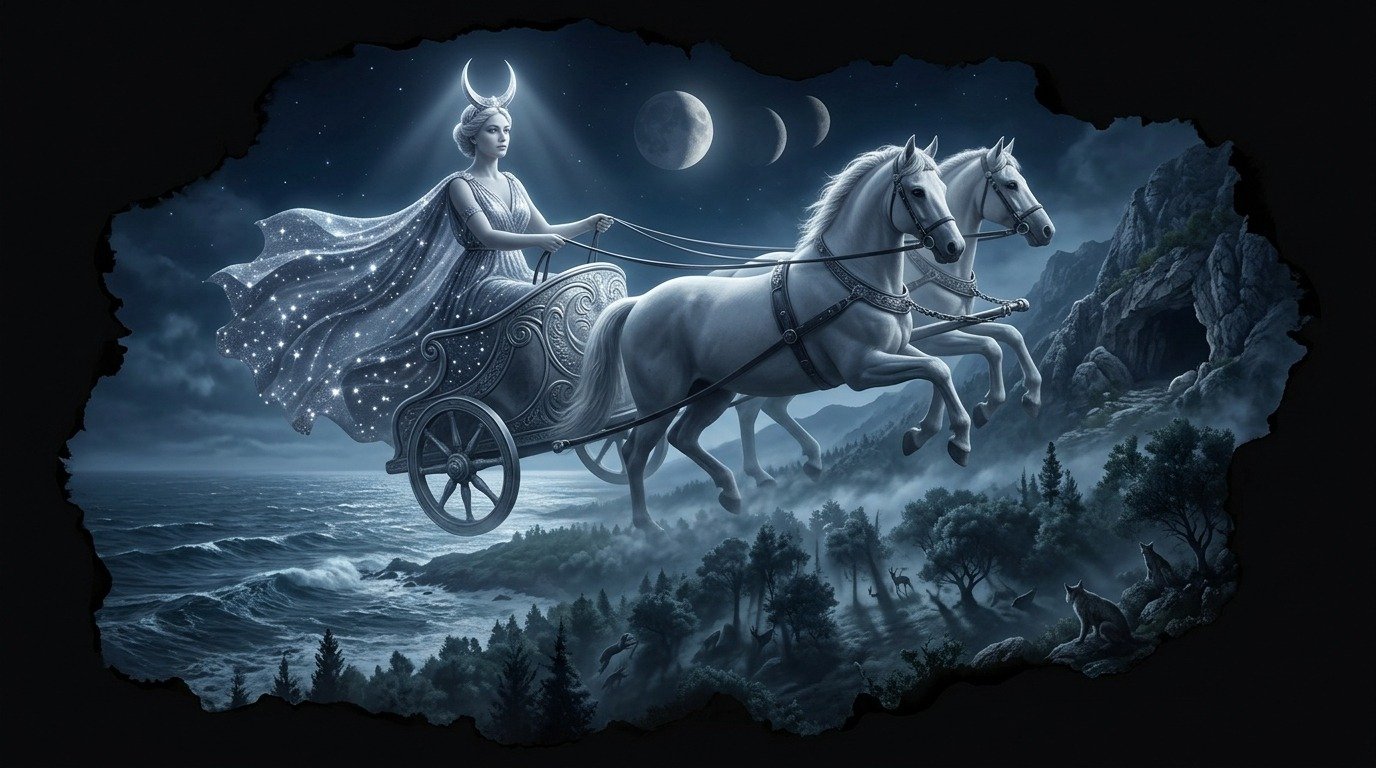
Selene: The Silver Crown Upon the Night Abyss
The Birth of the Nightly Glow
When the sun extinguishes its last golden breath on the western horizon, the firmament demands a sovereign to rule the twilight. From the union of the Titans Hyperion and Theia, primordial forces of light and radiance, Selene was born. Sister of the radiant Helios and the fiery Eos, she received dominion over the deep night, an inheritance exercised not with the violence of fire, but with the subtle and cold caress of silver.
While her siblings awaken the world with the din of chariots and violent colors, Selene emerges from the Ocean that surrounds the earth with divine parsimony. She bathes in ancestral waters to purify her ivory face, wears robes that gleam with the brilliance of the stars, and ascends her silver chariot, drawn by oxen of immaculate whiteness or by docile horses that move without a sound. Her passage through the sky is not an intrusion; it is a silent tide that alters the minds of men and awakens the murmur of beasts.
The Silver Chariot and the Dance of the Firmament
Selene's power is measured in the subtle alteration of the sublunary world. Under her gaze, the ocean tides rise as if wishing to touch her mantle, responding to the magnetism of her crescent crown, a silver arch that adorns her brow and projects horns of light upon the darkness. Ancient hunters knew that the forest under her dominion became a deceptive mirror: shadows lengthened, paths shifted, and nocturnal beasts hunted with a keenness blessed by their pale mistress.
Her influence is not limited to land and water; it penetrates directly into the temples of the human mind. Selene is the mother of sacred madness, the delirium that assails poets and the deranged in the middle of the night. When her face shows itself full and round at its zenith, the veil between reason and the abyss becomes so thin that men lose their minds, transformed by the cold light that reveals what the sun insists on hiding.
The Eternal Sleep of Endymion
The eternity of a deity is usually lonely, but Selene's heart found its anchor on the slopes of Mount Latmus. There she first saw Endymion, a shepherd of beauty so perfect he seemed sculpted by the gods themselves. Seeing him sleep under the light of her own rays, the goddess experienced a desire so deep that she stopped her chariot in the sky, descending in a beam of silver light to kiss his closed eyelids.
Knowing that time would devour the mortal's youth and wither his flesh, Selene could not bear the thought of his death. Her plea to the forces of destiny was not to grant him active immortality, which often becomes a curse, but a darker and more merciful pact: Endymion would sleep forever, immune to the passage of ages, with an incorruptible youth. In a hidden cave, the shepherd rests in an eternal slumber, and every night Selene descends from the firmament to lie by his side, loving a man who only knows her in the unreachable territory of dreams.
The Pale Mistress of Time
Selene's march marks the rhythm of the months and structures the passage of time for mortals. Her cycle of death and rebirth, waning to the point of disappearance only to rise again from nothingness, taught men the mystery of regeneration and return. Although over the centuries other deities of the forest and the hunt claimed part of her brilliance, Selene remains as the pure embodiment of the satellite, the silver eye that watches over the sleep of the living and the rest of the dead, immutable in her course over the black back of the night.
Comments
Share information, an experience, or a source to help enrich this entry. They are automatically reviewed before being published.
Loading comments...