Pan
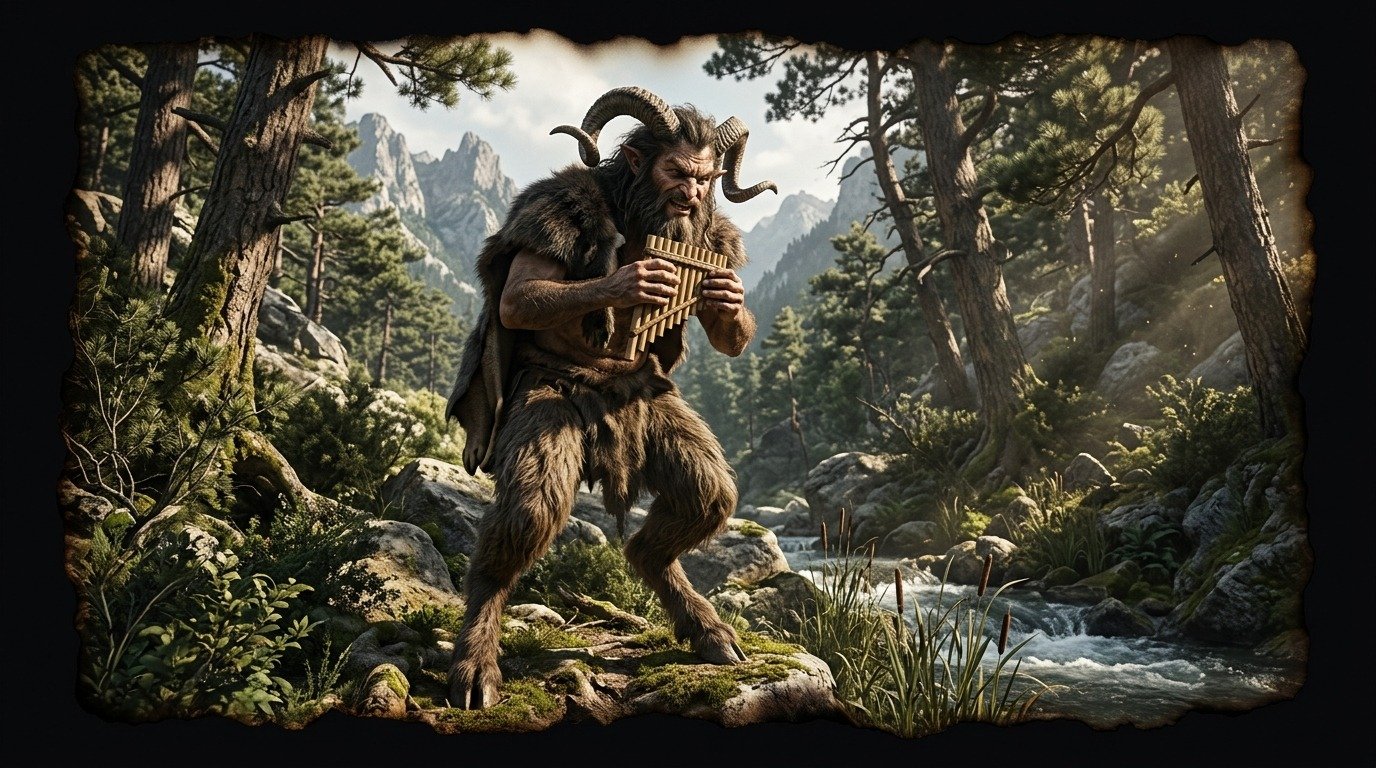
Pan: The Wild Music of the Untamed Land
The Breath of the Forests of Arcadia
In the deepest and most mountainous corners of Arcadia, where civilization is nothing but a distant idea, the air smells of pine, damp earth, and goat skin. From that mud and the wild breeze, Pan was born. The son of Hermes and a forest nymph, his arrival into the world struck horror into his own mother: the newborn had goat legs covered in coarse hair, sharp horns sprouting from his forehead, and a shaggy beard that twitched with his shrill laughter.
However, Hermes saw in this creature the very essence of living nature. He wrapped him in hare skins and carried him to Olympus, where his bizarre appearance and festive temperament delighted the gods, especially Dionysus, who found in him a kindred spirit. Despite the affection of the heavens, Pan rejected the comfort of divine marble and returned to the earth, to the rocky gorges, the dense forests, and the meadows where herding is the only law.
The Cry That Shakes the Valleys
Pan is the personification of wild life in its purest and most contradictory state. He is the benevolent protector of herds of goats and sheep, the one who helps hunters find their prey in the thicket, and the one who rests in the shade of the trees during the stifling heat of midday. In those sacred hours, when the sun is at its highest and nature seems to hold its breath in absolute silence, no mortal dares to make a sound, for disturbing Pan's sleep is to awaken one of the most terrifying forces of creation.
If interrupted, the god does not use bronze weapons or armies of heroes; he emits a colossal scream, a sound that seems to burst from the very depths of the earth, capable of instilling a blind, irrational, and uncontrolled fear in the breasts of men and beasts. It is "panic," a terror that dissolves minds, sends armies fleeing in stampedes, and turns reason to ashes, proving that nature, beneath its apparent calm, hides an abyss of untamable chaos.
The Syrinx and Lost Loves
Pan's existence oscillates between the violence of panic and the sweetness of his music. His heart, as wild as his appearance, constantly pursued the forest nymphs, who often fled in terror from his advances. The most famous of these pursuits involved the nymph Syrinx, who, finding herself cornered by the god along the banks of the River Ladon, begged her water sisters to save her. The moment Pan reached out his arms to embrace her, his hands found only a bundle of reeds that hissed sadly in the wind.
The god's grief was transformed into art. He cut the reeds into different lengths, bound them with beeswax, and blew through them, creating the syrinx or pan flute. The melody that burst from the instrument was so beautiful and laden with nostalgia that the nymphs emerged from their hiding places to listen, and the very trees seemed to bend toward the sound. Through his music, Pan found a way to possess the beauty of nature that always slipped through his fingers.
The Whisper of the Death of the Great God
The figure of Pan represents a direct connection to a world where boundaries between the human, the animal, and the divine did not exist. For this reason, his legend is linked to one of the most singular episodes of ancient history. During the reign of the Roman emperor Tiberius, the crew of a ship sailing near the islands of Paxos heard a mysterious voice crying out from the shore: "Announce that the great Pan is dead!" As the news spread, a groan of grief seemed to sweep through all the forests of the earth. With his supposed death, the ancient world lost its wild innocence, withdrawing the old gods from the trees and rivers, though those who venture alone into the thick of the forest swear that, in the silence of midday, the distant whistle of a reed flute can still be heard.
Comments
Share information, an experience, or a source to help enrich this entry. They are automatically reviewed before being published.
Loading comments...