Nemesis
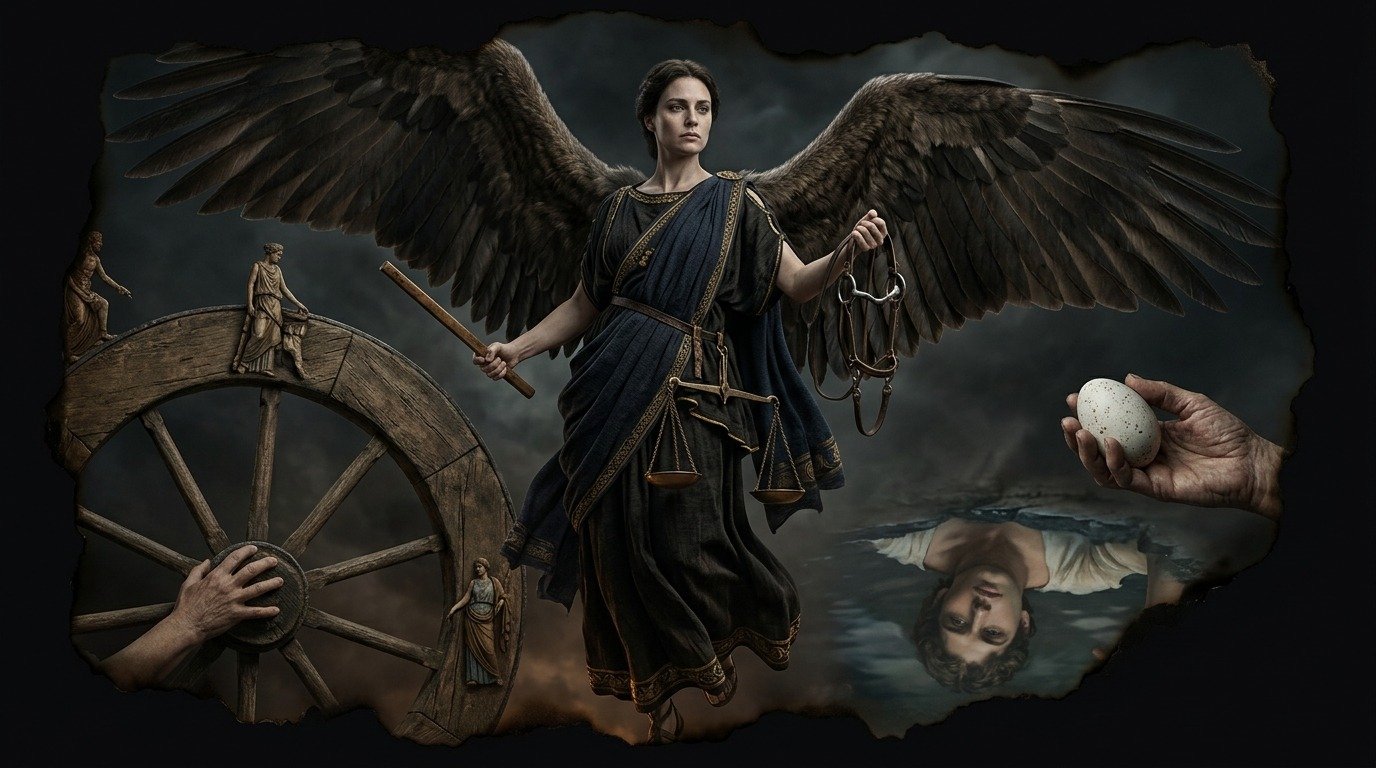
Nemesis: the implacable scales of destiny
The daughter of the primordial night
Before the justice of human laws or the punishments of the courts of Olympus existed, there was a need to maintain the order of the universe. From the depths of Nyx, the primordial night who gave birth to the deepest and most fearsome concepts of the cosmos, Nemesis was born. She is not a deity of personal vengeance or petty spite; she is the personification of divine retribution, the force responsible for crushing the pride of men and restoring balance when the scales of life tip too far to one side. Her presence is cold, solemn, and inevitable. She is depicted with the wings of a griffin, an animal that knows no mercy in the hunt, dressed in dark robes and carrying in her hands the instruments of exact measurement: a ruler or measuring rod to calculate the height of human pride, a bridle to rein in the impulses of the bold, and a scale that weighs the actions of man against his destiny.
The measuring rod and the wheel of destiny
The power of Nemesis is activated by excess, known as *hubris*. When a mortal accumulates too much wealth, too much beauty, or too much luck, the cosmic order is in danger of breaking. Men tend to believe themselves equal or superior to the gods when the wind blows in their favor, forgetting their ephemeral nature. It is at that moment of maximum glory that Nemesis silently descends. Her intervention is not always loud; it often takes the form of a subtle chain of misfortunes that reduces the proud to nothing. She is the one who spins the wheel of fortune, ensuring that whoever is at the peak today bites the dust of the road tomorrow. Victorious generals feared her gaze more than enemy swords, and it was customary to make sacrifices in her name after a great victory to apologize for having been too fortunate.
The punishment of Narcissus and the egg of destiny
The relentlessness of Nemesis was recorded in the memory of the world through the punishment imposed on Narcissus. This young man, endowed with a beauty that rivaled that of the immortals, cruelly despised the love of all who approached him, breaking hearts without showing the slightest remorse. Seeing this excess of pride and lack of mercy, Nemesis heard the pleas of one of his victims and decreed a perfect sentence: Narcissus would love with the same intensity with which he had been loved, but his love would be unattainable. She guided him to a pool of crystal-clear water where the youth saw his own reflection and became trapped in the contemplation of himself until he wasted away and died, a victim of his own beauty measured by the justice of the goddess. The influence of Nemesis extends even to the foundations of the great tragedies of mythical history. It is said that it was she, in the form of a goose fleeing the harassment of Zeus, who laid the egg from which Helen of Troy would be born. By delivering this egg to Leda, Nemesis sowed the seed of discord that would culminate in the fall of the most prosperous city in Asia Minor, thus balancing the power of a dynasty that had become too great and proud for the earth it walked upon.
The shadow behind the triumph
Nemesis remains as the shadow that accompanies every achievement, the constant warning that every excess requires an equivalent payment. Her worship was not based on loving devotion, but on reverent respect and awe. The Greeks knew that one can flee from the wrath of kings and the storms of Poseidon, but there is no corner of the universe where a man can hide from the measuring rod of Nemesis once he has dared to cross the line that the limits of destiny have drawn for him.
Comments
Share information, an experience, or a source to help enrich this entry. They are automatically reviewed before being published.
Loading comments...