Hera
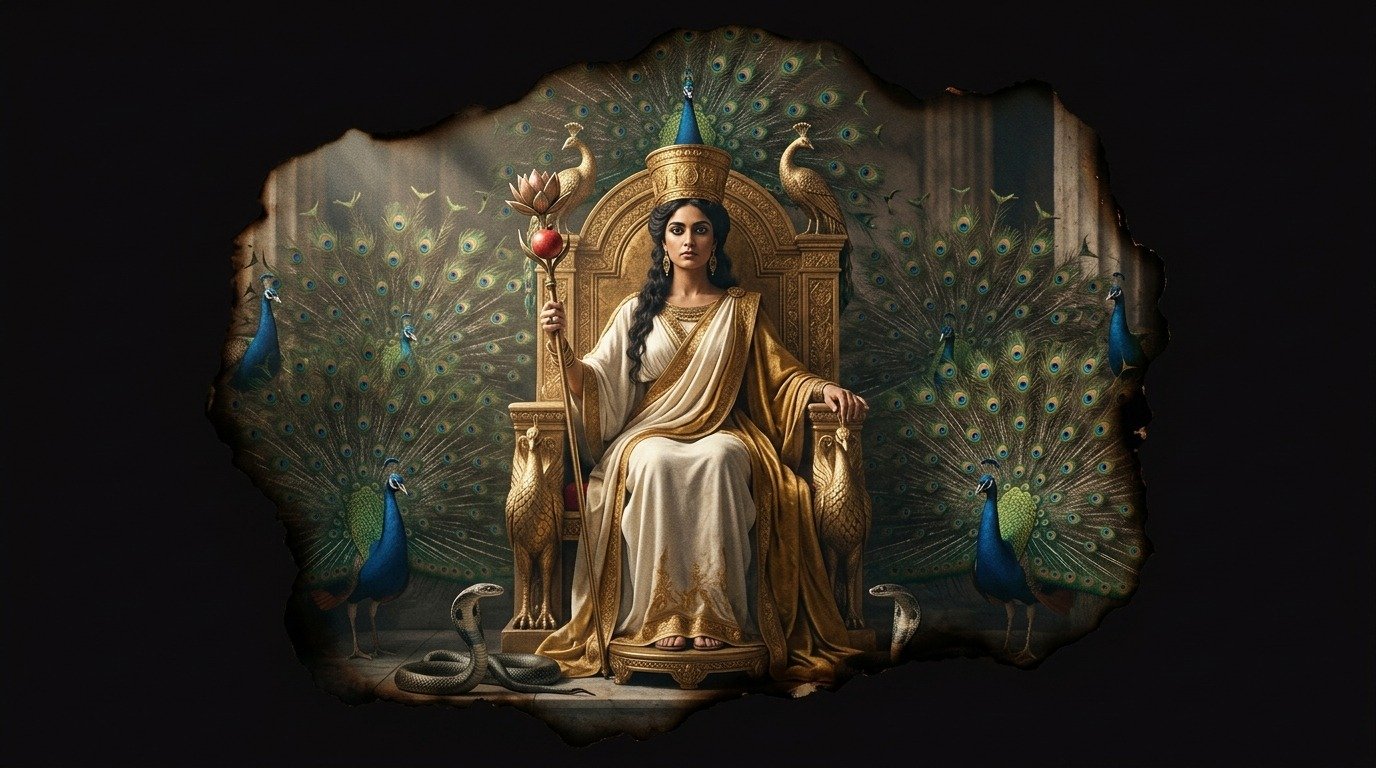
Hera: The Golden Crown and the Peacock Throne
The Queen of the Sovereign Gaze
Hera is not a deity who shares glory; she demands it. Daughter of Cronus and Rhea, devoured and then vomited up by her father, she emerged from the womb of the earth with a Herculean dignity that rivaled that of her brothers. When Zeus saw her on the island of Samos, he was captivated by her imperial bearing and her large, deep eyes, often described as those of a sacred heifer for their stillness and solemnity. To approach her, the cunning god transformed himself into a helpless, storm-drenched cuckoo; Hera, taking pity, pressed the bird to her breast to warm it, at which moment Zeus regained his divine form. Their union was no simple marriage, but the sacred nuptials that united heaven and the moist earth. As a dowry, the great mother Gaia gifted them a tree that bore golden apples at the edge of the world, the Garden of the Hesperides. Hera thus crowned herself with the *polos*, the cylindrical tiara of the great mother goddesses, and sat upon a throne of solid gold from which she not only watches over Olympus, but also upholds the order of civilization through marriage and legitimate lineage.
The Wrath That Tempers Destiny
Hera's fury is often narrated as a fit of jealousy, but her wrath is actually a force of cosmic balance. As the protector of marital cords and dynastic sovereignty, every infidelity of Zeus is not merely an offense to her pride, but a crack in the structure of the order they themselves swore to defend. Her vengeance is not a blind outburst, but a cold, patient punishment of monumental proportions. It was her constant hostility that forged the myth of Heracles. By sending serpents to his cradle and subjecting him to the twelve impossible labors through King Eurystheus, Hera did not simply seek the death of the hero, but to test the limits of human endurance. Without Hera's relentless pursuit, the demigod would never have achieved apotheosis or won his place among the stars. In the same way, during the Trojan War, her disdain for the Trojans after the Judgment of Paris led her to weave a web of political and military intrigue that culminated in the ashes of the great city, proving that the will of the Queen of Olympus can bend the destiny of entire empires.
The Inviolable Cord and the Peacock of a Hundred Eyes
Hera dwells in the most ancient and colossal temples, where the limestone columns smell of incense and sacrificial fat. Her presence is announced by the unfurling of the peacock, whose feathers bear the eyes of Argus, the hundred-lidded giant whom she herself consecrated after his death at the hands of Hermes. Those all-seeing, leaden eyes are a reminder of her eternal vigilance over the promises of men. Each year, Hera travels in her celestial chariot, whose bronze axles and golden wheels are assembled by her daughter Hebe, to the spring of Canathus in Nauplia. There, by immersing herself in the sacred waters, the goddess recovers her ritual virginity, an act of renewal symbolizing that her power does not depend on her union with Zeus, but emanates from her own immortal essence. She is the guardian of childbirth, the one who decides when wombs open and when they close, the one who holds the scepter with the lotus flower and the pomegranate fruit, symbols of a life that flourishes under her strict and majestic discretion.
Comments
Share information, an experience, or a source to help enrich this entry. They are automatically reviewed before being published.
Loading comments...