Hecate
Hecate: The Lady of the Three Faces and the Crossroads
The Titaness Who Kept Her Throne
In the depths of the cosmos, where the light of the Olympian gods fails to impose its absolute order, dwells a deity older, darker, and far more respected. Hecate is a Titaness, daughter of Perses and Asteria, heirs to the power of night and destructive stars. When the new gods overthrew the ancient giants and Titans, Zeus, in a gesture of unusual prudence, did not touch Hecate's domains. On the contrary, he allowed her to retain her sovereignty over the earth, the barren sea, and the starry sky, granting her a power that no other individual god could match. Hecate does not dwell in the luminous halls of Olympus, nor does she meddle in the family intrigues of the celestial deities. Her palace is in the underworld, beside the throne of Persephone, or at the boundaries where the world of the living collides with the realm of shadows. Her presence is heralded by the howling of the black dogs that run by her side and the scent of sulfur and rotting leaves from marginal swamps.
The Triple Gaze in the Penumbra
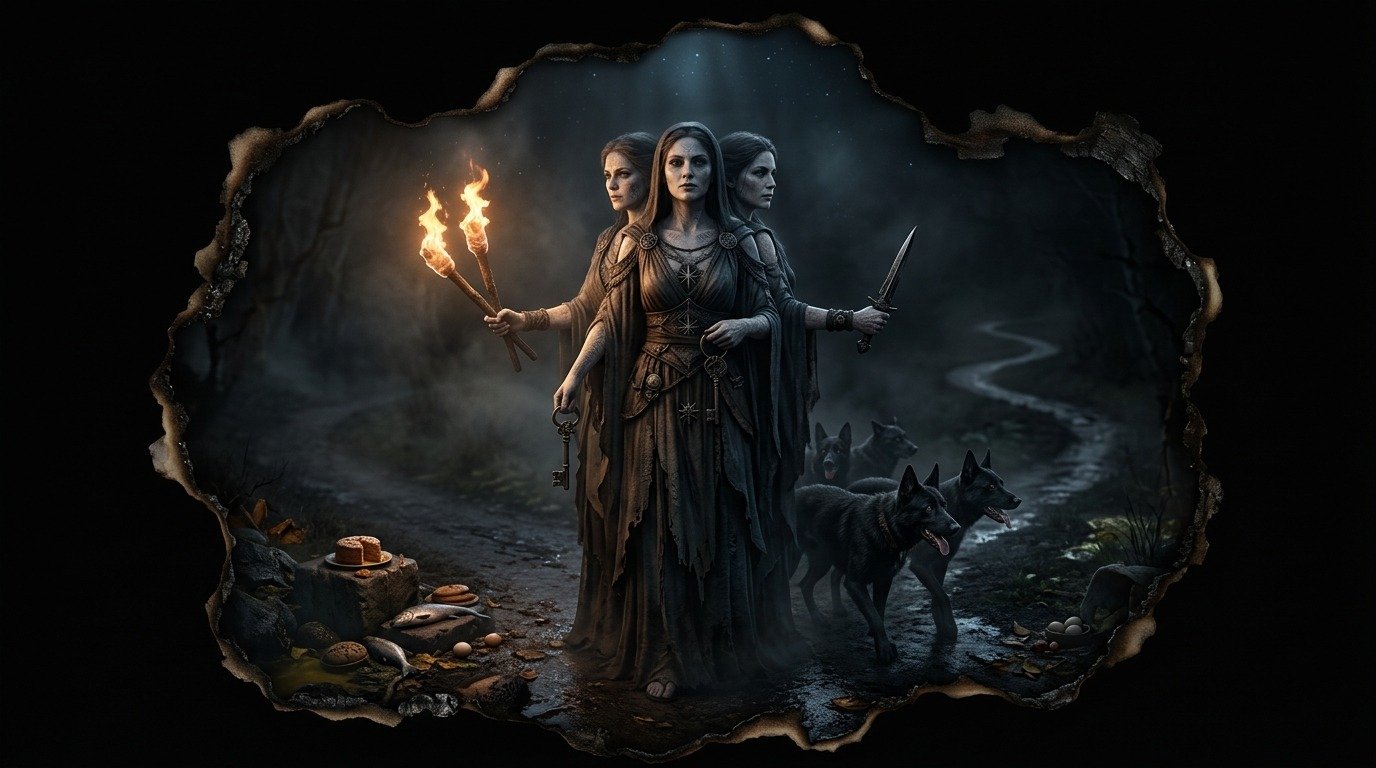
Hecate's physiognomy defies mortal comprehension. She is often depicted as a triple figure, with three bodies or three heads looking in opposite directions. This trinity is no coincidence; it represents her dominion over pasts, presents, and futures, as well as her ability to watch over crossroads—those points on the path where decisions become final and where a man's destiny can bend toward ruin or salvation. In her hands she holds the attributes of her sovereign power: the burning torches with which she illuminates the paths of Hades and the secrets of the human soul; the keys that open and close the gates between worlds, preventing the dead from escaping and the living from entering ahead of time; and the dagger with which she cuts through the illusions of men. Her gaze does not judge under the laws of human morality, but under the laws of cosmic necessity and the purest magic.
The Guide of the Underworld and the Whisper of the Witches
The myth that consolidated her place among men was the desperate search of the goddess Demeter after the abduction of her daughter. In a world plunged into winter and silence, only Hecate, from her deep cave, heard the cries of the young girl being dragged into the abyss. With her torches lit, the goddess of the crossroads guided the mother through the darkness to the realm of the dead, becoming from then on the eternal companion and protector of Persephone during her months of winter confinement. This familiarity with death made her the undisputed patroness of sorcery, necromancy, and poisonous potions. The witches of antiquity, from the mythical Medea to the sibyls of underground caverns, invoked her name under the cover of the waning moon. Hecate is the one who whispers in the ear of those who seek forbidden power, the one who opens the earth to let wandering specters emerge, and the one who appeases the suffering souls who find no rest on the shores of the Styx.
Offerings at the Crossroads
The worship of Hecate was not performed in marble temples under the sun, but at the edges of roads, where the earth forks in three directions. There, during moonless nights, suppliants left "Hecate's suppers": offerings of fish, honey cakes, and eggs to appease the hunger of the goddess and her retinue of specters. Placing a statue of Hecate at the entrance door of a house was the safest method to keep evil spirits at bay, for she, who rules over thresholds, has the power to close the door to the terror of the night or to invite it in.
Comments
Share information, an experience, or a source to help enrich this entry. They are automatically reviewed before being published.
Loading comments...