Sibyls
Sibyls: The Underground Voices That Guided the Destiny of Rome
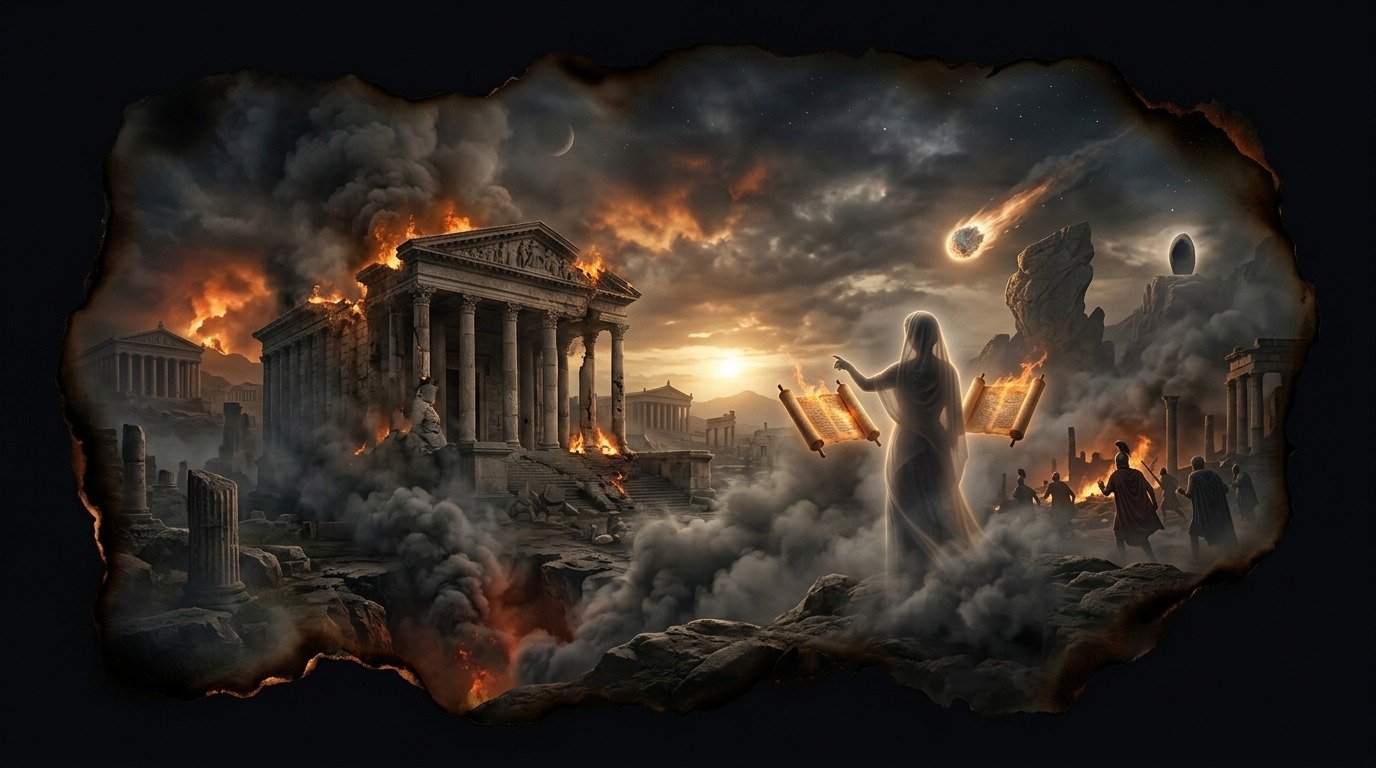
In the sixth century BC, a mysterious old woman appeared before Tarquin the Proud, the last king of Rome, to offer him nine sacred books containing the prophecies of the Sibyl of Cumae regarding the destiny of the empire. When the monarch rejected the exorbitant price demanded, the woman burned three of the volumes, returned to offer the remaining six for the same price, and upon a second refusal, destroyed three more; terrified by the omen, Tarquin bought the final three books for the original sum. These texts, guarded in the temple of Jupiter Capitolinus under strict state secrecy, became the Sibylline Books. They were the ultimate resource of the Roman Senate, a supreme oracle that was only opened in moments of extreme national desperation, when plagues, military defeats, or signs from the heavens threatened to destroy the Republic.
The Guardians of Apollo's Abysses
The Sibyl was not a single person, but rather a lineage of ecstatic prophetesses distributed across strategic points of the ancient world, from Persia and Libya to Delphi and Cumae. These women, consecrated to the god Apollo, lived in deep caves or temples built over volcanic fissures from which underground gases emanated. To utter her prophecies, the Sibyl entered a state of sacred frenzy induced by inhaling these vapors and chewing laurel leaves. Her cries and disjointed verses were compiled by priests, who were responsible for translating the delirium into coherent texts that determined whether Rome should go to war or offer sacrifices to foreign deities to appease the wrath of the gods.
The Oracle That Saved Rome from Hannibal
Consulting the Sibylline Books changed the course of European history during the Second Punic War. When the Carthaginian general Hannibal Barca was destroying Roman legions on Italian soil, the Senate, on the brink of collapse, ordered the priests to decipher the sacred scrolls kept on the Capitoline. The Sibylline text indicated that Rome would only be saved if it brought the sacred stone of the goddess Cybele, the Mother of the Gods, from Asia Minor. The Romans obeyed the prophecy, established the deity's cult in the heart of the city, and, shortly thereafter, managed to defeat the Carthaginian forces, consolidating the absolute authority of the books over the military destiny of the Republic.
From Pagan Temples to Christian Cathedrals
Over the centuries, the influence of the Sibyls underwent an extraordinary transformation. When Emperor Constantine adopted Christianity, the theologians of the new faith did not destroy the memory of the pagan prophetesses, but rather reoriented their writings. Early Christian apologists claimed that the Sibyls had foretold the coming of Jesus Christ long before the Hebrew prophets. This cultural assimilation was so profound that during the Renaissance, the painter Michelangelo decorated the ceiling of the Sistine Chapel in the Vatican by alternating the figures of the Old Testament prophets with monumental portraits of the Sibyls of Cumae, Delphi, Erythrae, Libya, and Persia, presenting them as bearers of divine revelation to the Gentile world.
The Final Fire Upon the Sacred Scrolls
The original Sibylline Books guarded by Rome were lost in the year 83 BC, when the Temple of Jupiter burned down during the civil wars. To recover the prophecies, the Senate sent emissaries throughout the Mediterranean to collect surviving Sibylline verses in private hands and reconstruct the official collection. This second compilation was definitively destroyed in the fifth century AD by order of the Roman general Stilicho, who sought to eradicate the last vestiges of pagan religion in an already fully Christianized empire. Today, in the Phlegraean Fields of Cumae, the underground gallery carved into the volcanic rock remains empty, but the wind whistling through its hundred entrances evokes the whisper of the voices that once ruled the destiny of the Caesars.
Comments
Share information, an experience, or a source to help enrich this entry. They are automatically reviewed before being published.
Loading comments...