Nostradamus
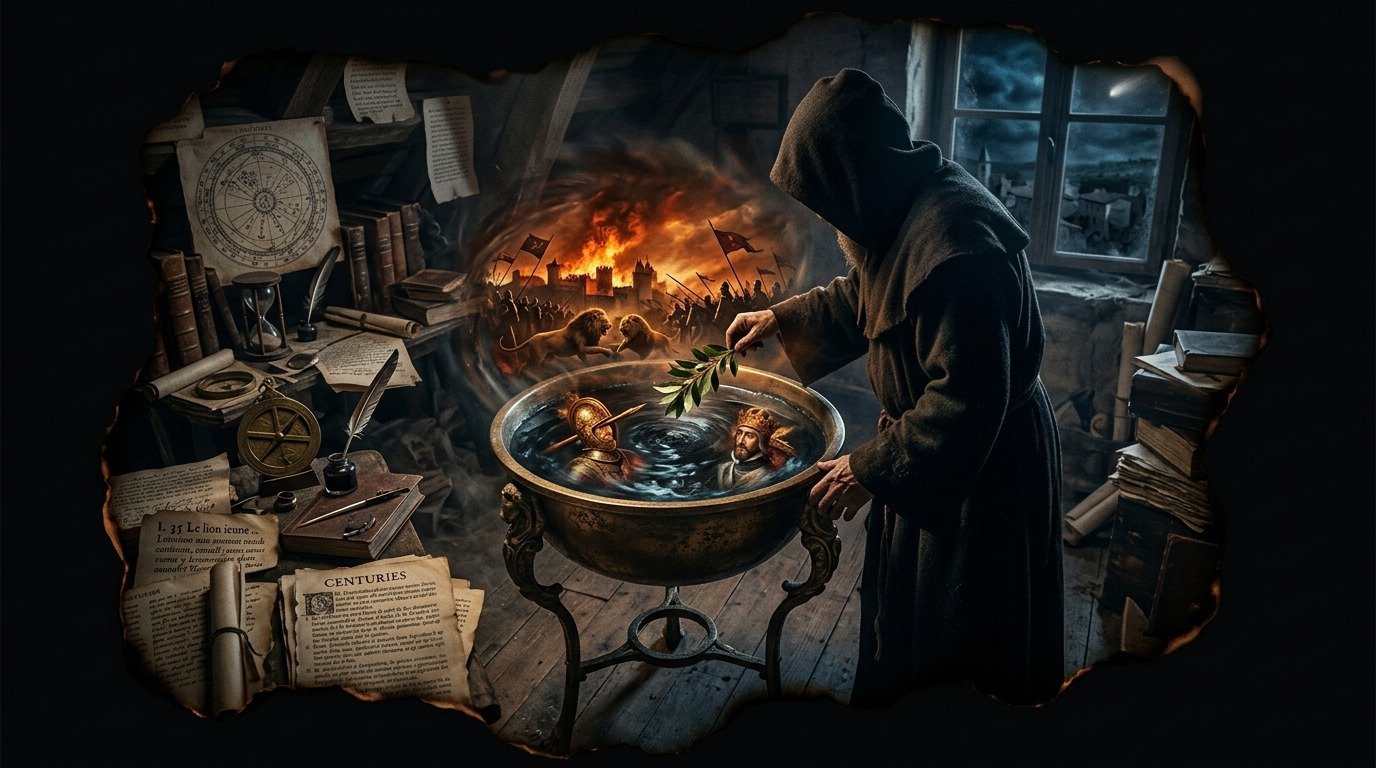
Nostradamus: The Doctor Who Looked into the Future in the Bronze Bowl
Nostradamus (Michel de Nostredame, 1503–1566) was a French physician who in 1555 published a book of prophecies in verse that has never gone out of print. His followers credit him with foretelling the death of King Henry II, the French Revolution, Napoleon, and Hitler, and every major global catastrophe triggers a renewed search of his quatrains. For nearly five centuries, he has been the most famous prophet of the Western world.
He himself recounted how he saw the future in the first two quatrains of his book: at night, alone in his study in Salon-de-Provence, sitting before a bronze tripod with a bowl of water, holding a wand with which he would wet the water and the hem of his robe, waiting for the vision to arrive.
The visions this man put to paper were not clear; they presented themselves as a labyrinth of metaphors, anagrams, and enigmatic images. He wrote in quatrains: four-line stanzas in Middle French mixed with Latin, Greek, and Provençal dialect. In those obscure lines, the future appeared as an relentless succession of catastrophes. He spoke of "the young lion who will overcome the old one on the field of combat in a single battle," of a "pierced eye in a golden cage," and of a cruel death for a monarch. His prophecies also foretold plagues, famine, decapitated kings, and three terrible figures who would mark the path toward the end of times: the three antichrists. The tradition of his followers holds that the first of them would be born in Italy, the second would come from northern Europe bringing total war, and the third would plunge the world into a final conflict before the absolute end.
The Plague Doctor Who Defied the Stars
Michel de Nostredame was born in December 1503 in Saint-Rémy-de-Provence, in the south of France, into a family of Jewish origin that had converted to Catholicism. He studied medicine at the University of Montpellier, where he stood out for his heterodox treatments against the Black Death. At a time when official medicine bled patients to the point of exhaustion, Nostradamus prescribed extreme hygiene, fresh air, and pills of his own invention made from rose hips, rich in vitamin C. However, the plague showed him no mercy: his first wife and their two children died from the epidemic while he was treating other patients in the region.
Isolated and scarred by tragedy, he settled in Salon-de-Provence, remarried, and began to shift his focus from medicine to astrology, ancient texts, and the occult. In 1555, he published the first edition of his *Prophecies*; with subsequent editions, the work grew to nearly one thousand poetic quatrains grouped into sections of one hundred verses called "Centuries." To avoid the scrutiny of the Inquisition, which zealously prosecuted witchcraft and divination, the apothecary designed a deliberately cryptic language, altering the chronological order and mixing languages so that only those dedicated to deciphering the keys would find his warnings.
The Echo of the Quatrains in the Courts of Europe
The impact of his writings was immediate and reached the highest echelons of the monarchy. The Queen of France, Catherine de' Medici, summoned him to court in 1555, drawn by the fame of his almanacs and predictions. In 1559, four years after the publication of a quatrain that many later read as foretelling the death of her husband, King Henry II, the king participated in a jousting tournament. The lance of his opponent, the young Count of Montgomery, shattered during the clash, and a splinter pierced the golden visor of the monarch's helmet, puncturing his eye and causing a ten-day agony. The prophecy of the "young lion" and the "pierced eye in a golden cage" immediately took on a terrifying power.
From that moment on, Nostradamus's book became an object of constant consultation for courtiers, generals, and conspirators. Over the centuries, interpreters of his texts believed they identified in his pages the outbreak of the French Revolution, the decapitation of Louis XVI, the rise of Napoleon Bonaparte, and the advent of a German leader whom Nostradamus called "Hister," directly associated with Adolf Hitler. During World War II, both the Nazi propaganda ministry and the Allied intelligence services used pamphlets with alleged, manipulated quatrains of Nostradamus to demoralize the enemy on the battlefield.
The Sieve of History and the Year of Terror
Historical research and literary analysis show that the apparent precision of Nostradamus's visions is due to their studied ambiguity. His quatrains lack exact dates and a defined chronological order, allowing each era to project its own fears onto the texts. The term "Hister," which his followers associated with Hitler, is actually the classical Latin name for the Danube River, near whose banks the battles described in that particular quatrain take place.
The most famous prediction that included an explicit date pointed to the year 1999: "The year one thousand nine hundred ninety-nine, seven months, from the sky will come a great King of Terror." The month of July of that year passed without planetary cataclysms or space invasions. Likewise, the more detailed prophecies about modern events that frequently circulate on the internet—such as those describing "two iron birds" destroying the Twin Towers—are apocryphal; they never appeared in the original 16th-century editions and were written after the facts to feed the legend of his infallibility.
On the eve of July 2, 1566, weakened by gout and dropsy, Nostradamus told his secretary, Jean de Chavigny: "You will not see me alive at sunrise." The next morning, the secretary found him dead in his room, next to his writing desk. His remains rest in the Collegiate Church of Saint-Laurent in Salon-de-Provence. Today, his texts remain open under the suspicion that, in one of their obscure lines, the next great collapse of the world is encoded.
Comments
Share information, an experience, or a source to help enrich this entry. They are automatically reviewed before being published.
Loading comments...