Mother Shipton
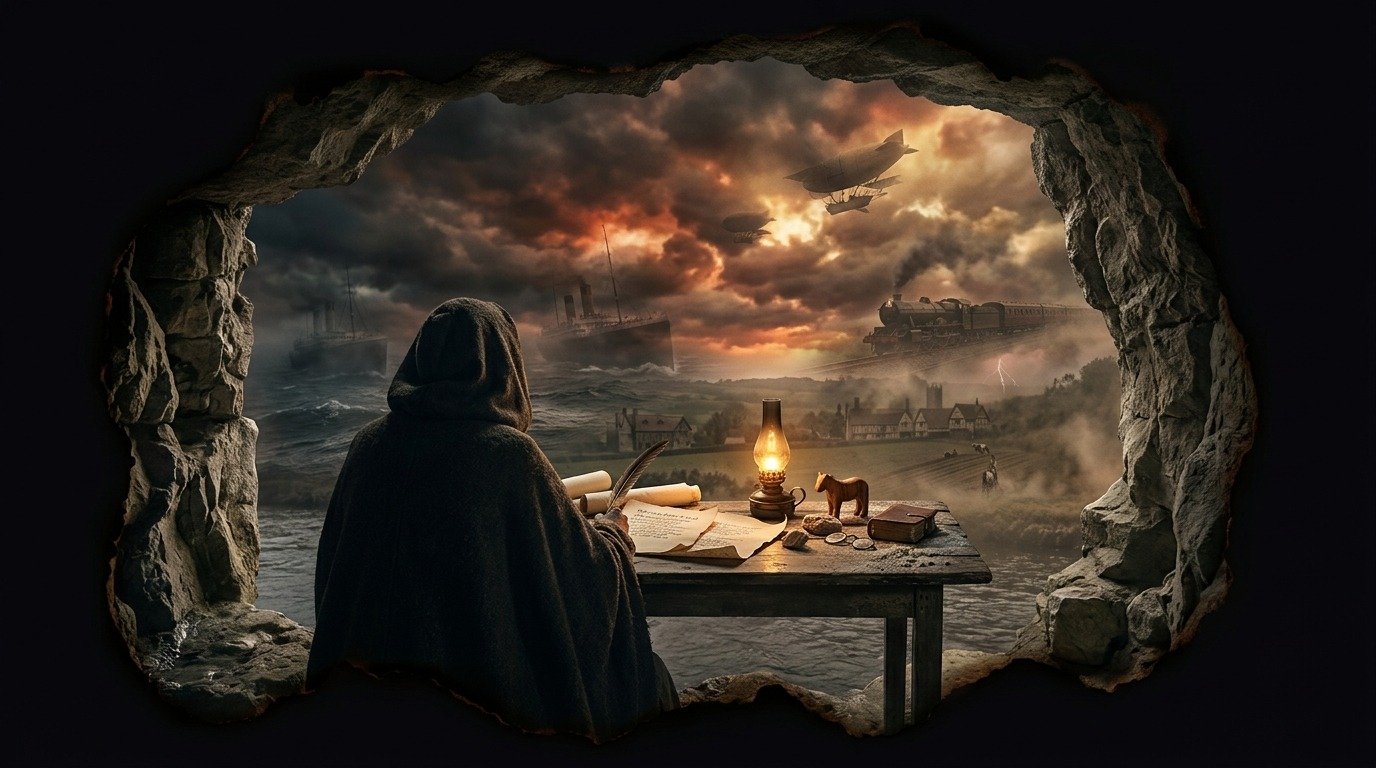
Mother Shipton: The Cursed Prophetess of the Yorkshire Forests
In the year 1530, on the outskirts of the English city of York, a grotesque-looking woman named Ursula Southeil, known to everyone as Mother Shipton, prophesied that the powerful Cardinal Thomas Wolsey would see the city from afar but would never set foot in it. A few months later, just as the cardinal stopped on a hill to look at the towers of York Cathedral, the emissaries of King Henry VIII arrested him for high treason; Wolsey died on the way back to London without having fulfilled his wish.
This prediction consolidated Mother Shipton's fame as the most feared seer of Tudor England. Her visions, passed down in simple verses by the rural population, not only spoke of court intrigues, but also foretold a radical technological transformation in the world and, ultimately, its total destruction.
The Devil's Daughter in Knaresborough Cave
The legend of Ursula Southeil was born in 1488 in a damp cave on the banks of the River Nidd, in Knaresborough. Her mother, a fifteen-year-old orphan girl, claimed to have been seduced by a dark spirit. Ursula was born with severe physical deformities: a hunched back, crooked legs, and a disproportionate nose that the townspeople compared to the beak of a bird of prey.
Isolated from society due to her appearance and accused of witchcraft from her youth, Ursula retreated to live in the same cave where she had been born. There, she began to study the medicinal properties of forest plants and to make predictions about the inhabitants of the region, who came to her with a mixture of dread and desperate curiosity.
Horseless Carriages and Iron Ships
The most famous prophecies circulating under her name describe the landscape of the Industrial Revolution and the modern era: carriages that move without horses, men traveling underwater in metal vessels, messages that go around the world in an instant, and human beings flying through the air like birds.
The problem is that these verses do not appear in any ancient edition: they first appeared in Charles Hindley's 1862 version, written when trains, the telegraph, and iron ships already existed.
The Panic of the Year 1881
Over the centuries, the texts attributed to Mother Shipton were published in various popular pamphlets that grew her legend after the Great Fire of London in 1666, an event many claimed she had foreseen. However, the greatest impact of her work occurred in the 19th century.
In 1862, a publisher named Charles Hindley published an extended version of the prophecies that included a terrible verse: the world would come to an end in the year 1881. The prophecy caused a wave of real panic in several rural areas of England during that year; many families abandoned their homes and spent entire nights in the open in the fields or inside churches, waiting for the final cataclysm that never arrived.
The Fraud Revealed and the Petrifying Well
The ultimate irony is that the fraud had already been confessed before the panic: in 1873, Charles Hindley publicly admitted to having invented several of the verses, including the one with the date of the end of the world. The confession was not enough to stop the fear of 1881. Despite this literary fraud, the figure of Mother Shipton survived in British folklore. Her oldest prophecies, such as that of Cardinal Wolsey, are known from a pamphlet printed in 1641, more than a century after the events.
Knaresborough Cave and the adjacent petrifying well, whose waters have such a high mineral concentration that they cover any object left under them in stone within a few months, continue to attract visitors from all over the world. The site remains as the physical testimony of the woman who, from the marginalization of her cave, drew the profile of the modern world with her words.
Comments
Share information, an experience, or a source to help enrich this entry. They are automatically reviewed before being published.
Loading comments...