Hephaestus
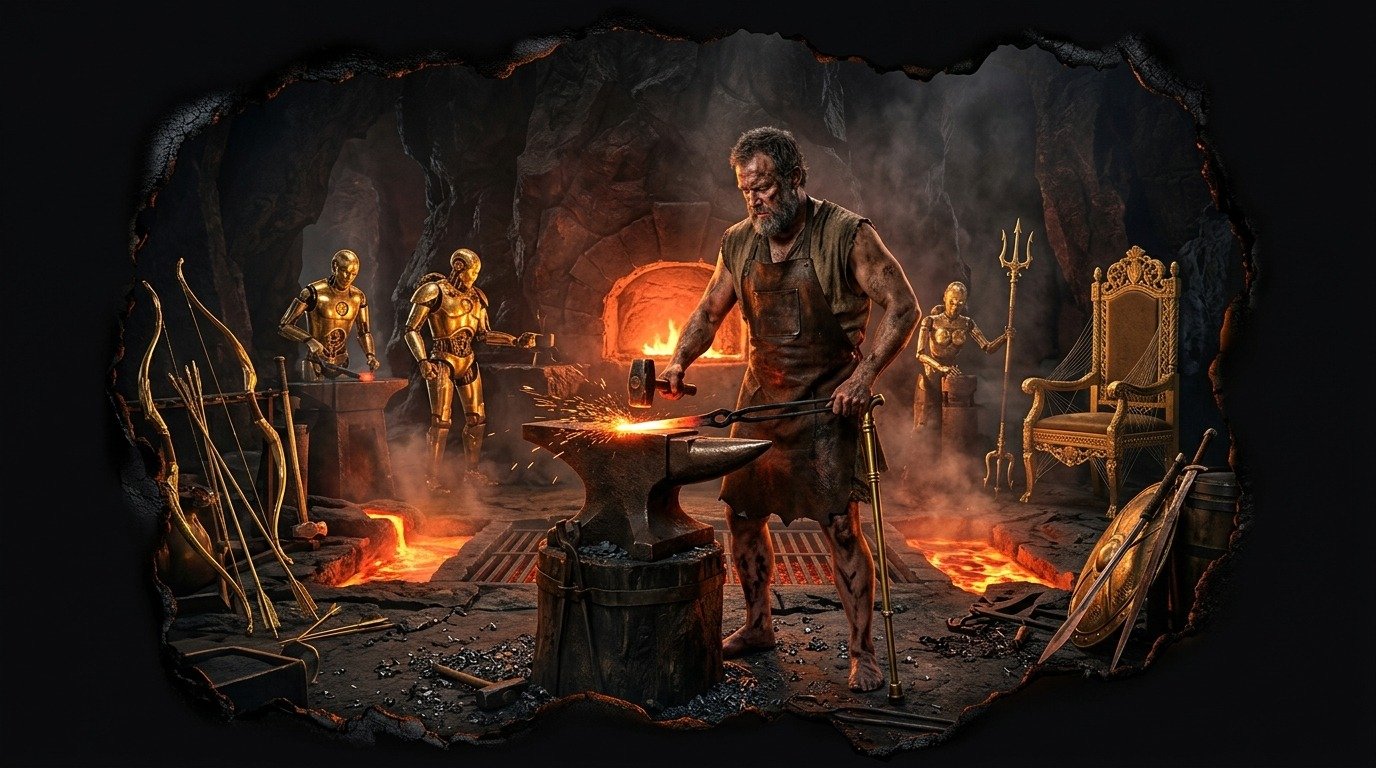
Hephaestus: The Fire That Forges Destiny Beneath the Earth
The Fall from Olympus and the Nest of the Abysses
Hephaestus's destiny was sealed with a crash of broken bones and the whistling of the wind in an endless fall. He was not born to celestial applause, but from the solitary resentment of Hera, who wished to engender an offspring without the intervention of Zeus. But upon seeing the thin, deformed creature with twisted feet that she had brought into the world, the queen of the gods felt disgust and pitilessly cast him down from the summit of Olympus. The baby fell for an entire day before crashing into the ocean, where the sea nymphs Thetis and Eurynome rescued him from the depths of the waters. In an underwater grotto, lulled by the murmur of the tides and the steam of volcanic vents hidden beneath the sea, the wounded god found his true language. His hands, clumsy for walking, possessed a miraculous precision. There he set up his first forge, transforming red coral, sunken gold, and bronze into wonders that had never been seen on earth. He learned that metal, just like him, needed to be broken and subjected to extreme fire to reveal its true strength.
The Beat of the Anvil and the Mastery of Metal
Hephaestus does not reign over the open air or clear summits; his empire is the interior of mountains, the beating heart of the volcanoes of Sicily and the Aegean islands. When the earth trembles and the hillsides spew ash and burning lava, mortals know that the smith god is working against the clock at his bronze anvil. His power does not reside in brute strength, but in the sovereignty of technique and the transmutation of matter. He created the weapons of the gods: the thunderbolts of Zeus, the trident of Poseidon, and the golden arrows of Artemis and Apollo. But his genius went far beyond weaponry: he sculpted automatons of pure gold that breathed, moved, and assisted him in his daily labors, endowing them with a mechanical intelligence that mimicked life itself. Every work that came from his hands was perfect, a sublime compensation for the imperfection of his own body.
The Golden Throne and the Silent Revenge
Hephaestus's return to Olympus was not a plea, but a conquest of ingenuity. He sent his mother Hera a throne of solid gold, carved with such astonishing beauty that the queen did not hesitate to sit in it. The instant her arms touched the armrests, invisible bonds, as fine as spider silk but as unbreakable as diamond, imprisoned her. No god, not even the almighty Zeus, could break the mechanism. The gods sent messengers, but Hephaestus rejected them all with the coldness of tempered iron. It was Dionysus who managed to soften him, not with threats, but with the warmth of wine and the promise of a place that belonged to him by right. Drunk and riding on a donkey, Hephaestus finally ascended to Olympus to free his mother, demanding in exchange the hand of Aphrodite, the goddess of beauty. The marriage united the most sublime of desire with the roughest of matter, a tense alliance that always oscillated between aesthetic contempt and beauty's inevitable dependence on the art that shapes it.
The God Who Sustains the Glory of Others
Despite the mockery of the other gods for his limp and his soot-covered face, Olympus depends on the sweat of Hephaestus. Without his bronze palaces, the deities would live exposed to the elements; without the armor he forged for Achilles or the invisible net with which he caught his own wife alongside Ares in the bed of betrayal, the myths would lack their most dramatic twists. Hephaestus represents the transforming power of pain. He is the only god who works with his hands, the one who knows the value of effort and the patience of the artisan. His footprint survives in every corner where human fire is lit to create, in bent metal, and in the conviction that even the deepest wounds can become, under the right hammer, an imperishable work of art.
Comments
Share information, an experience, or a source to help enrich this entry. They are automatically reviewed before being published.
Loading comments...