Griffin
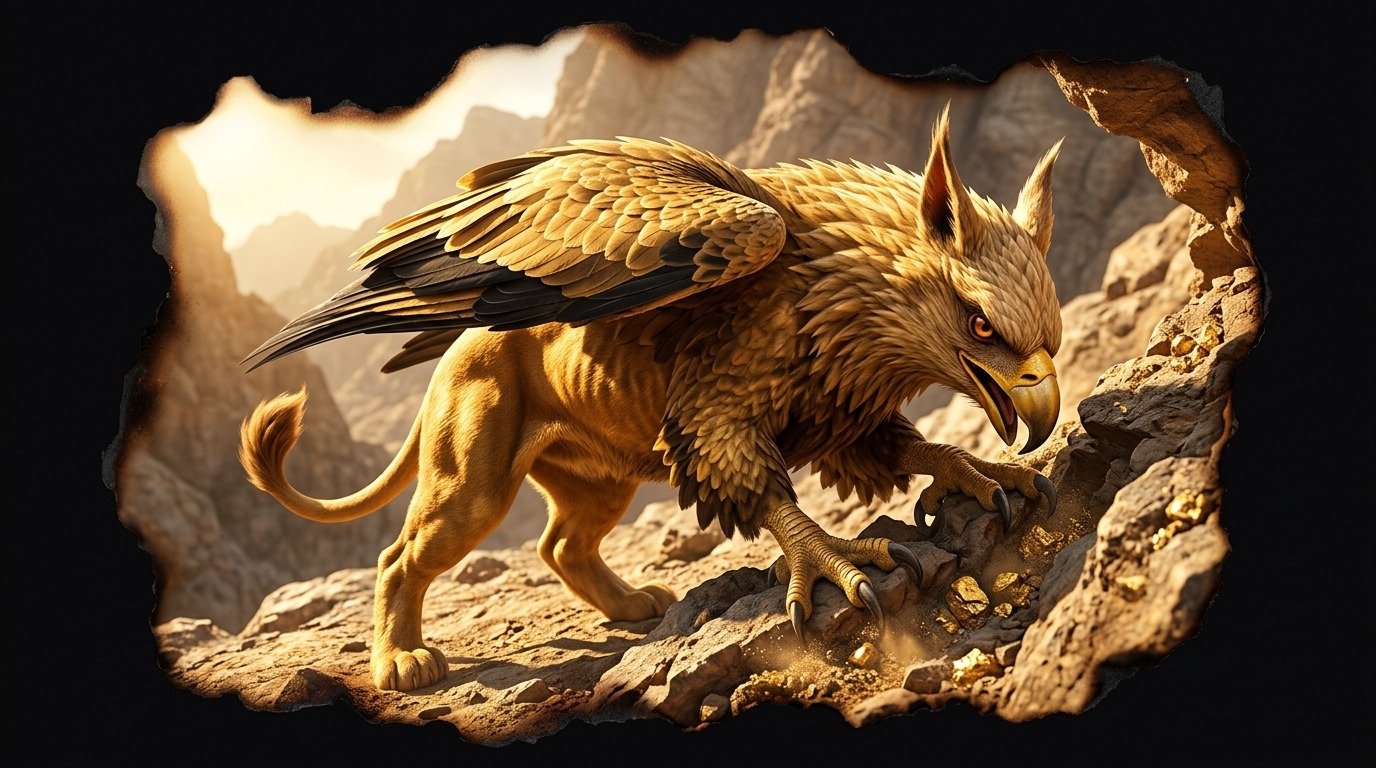
The Griffin: The Solar Guardian of Gold and the Reaches of Hyperborea
Genesis in the Steppes and the Ends of the World
The Griffin (from the Greek *gryps*, and this possibly derived from the Akkadian *kurību*, the protective winged being) is one of the oldest mythical zoological manifestations of the Mediterranean basin and the Eurasian steppes. Although classical Greek literature places it in the northern mountains, among the Hyperboreans and the mysterious one-eyed Arimaspi, its earliest visual representations date back to the fourth millennium BCE on the cylinder seals of Elam (modern-day Iran) and predynastic Egypt. Modern historical and paleontological research, led by folklorist Adrienne Mayor, posits a fascinating thesis: the myth of the Griffin may have originated from the accounts of Scythian nomads who traveled the gold routes of the Gobi Desert and the Altai Mountains. These herders frequently encountered fossilized skeletons of *Protoceratops*, herbivorous dinosaurs from the Cretaceous period whose curved parrot-like beak, prominent claws, quadrupedal body, and bony frill (which could be interpreted as the beginning of wings or large ears) matched down to the millimeter the description of the Griffin that protected the gold deposits of the desert sands.
Physical Attributes and the Duality of Its Nature
The Griffin is the hybrid par excellence of the two animal sovereignties of the visible cosmos: the eagle, queen of the air and the spiritual domain, and the lion, king of the earth and the physical-material plane. Its traditional anatomy features the head, chest, foreclaws, and wings of a giant eagle with golden, white, or black plumage, fused with the torso, hind legs, and tail of a lion with a tawny coat. In ancient descriptions, such as those of Claudius Aelianus in his *De Natura Animalium*, it is added that its ears are pointed and erect, its eyes glow like burning embers, and its claws are so large and hard that the inhabitants of the frontiers used them to make drinking cups of inestimable value. This hybridization gives it a biphasic nature. It is not a chaotic monster like the Chimera, but a being of order and high solar vibration. Its flight speed is comparable to lightning, while its terrestrial strength surpasses that of a hundred lions combined. Aelian also points out that the Griffin does not build nests in trees, but in the crevices of rocky mountains, lining them with the gold it actively unearths with its curved beak—not out of greed, but due to a natural attraction to the pure vibration of this solar metal.
Esoteric Symbolism, Alchemy, and Heraldry
In esoteric doctrine, the Griffin is the hieroglyph of the conjunction of opposites: the Volatile element (air, the eagle's wings) and the Fixed element (earth, the lion's body). In the alchemical Great Work, it represents the third stage of transmutation, where sulfur and mercury unite under the influence of the spiritual sun to produce the philosopher's stone. Hence its close relationship with gold: the Griffin is the guardian of spiritual light condensed in raw matter. During the Middle Ages, the Griffin underwent a profound theological reinterpretation. Isidore of Seville and, later, Christian bestiaries saw in it a dual representation of the nature of Christ: its eagle half symbolized his divinity and his ascension into heaven, while its lion half represented his humanity, his royalty, and his strength on earth. In the realm of heraldry, the Griffin became the emblem of armed vigilance, indomitable courage, and the custody of royal or sacred secrets. It represented the wise warrior, who unites the visual acuity of the intellect with the executive power of the sword.
Presence in Art and Safeguarding Practices
The Griffin is, above all, a guardian of divine treasures. It is directly associated with Apollo, whom it serves as a mount on his annual journeys to mythical Hyperborea, and with Nemesis, the goddess of retributive justice, whose chariot it pulled to ensure the swift punishment of the proud. The magical properties attributed to its remains were highly coveted in the medieval hermetic trade: * **The Griffin's Claw**: It was believed that cups carved from Griffin claws possessed the apotropaic property of detecting poisons in liquids. If a toxic substance was poured into the cup, the horn or claw would begin to sweat copiously or change color, neutralizing the lethal effect. Many of these "claws" preserved in European cathedral treasuries turned out to be highly valued ibex or African rhinoceros horns. * **The Feathers of Sight**: It was claimed that a single Griffin feather placed over the eyes of a blind person could restore spiritual and physical vision, due to the immense light and solar charge that the creature absorbed during its flights close to the celestial spheres.
Comments
Share information, an experience, or a source to help enrich this entry. They are automatically reviewed before being published.
Loading comments...