Millennium
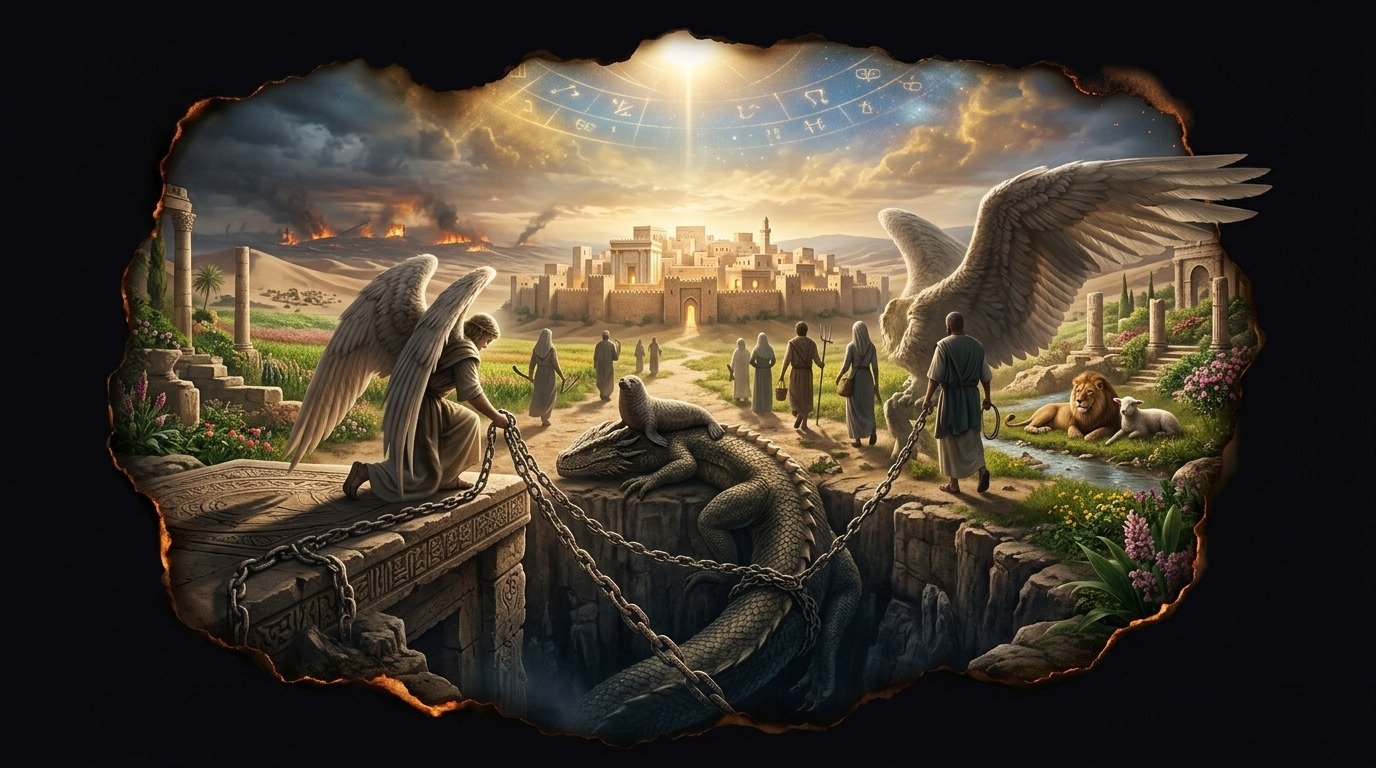
Millennium: The Thousand Years of Peace Before the Final Storm
The Millennium is a period of exactly one thousand years prophesied in chapter twenty of the Book of Revelation, during which Jesus Christ will reign over the Earth alongside his resurrected saints. At the beginning of this cycle, an angel will descend from heaven with the key to the abyss and a great chain in his hand to bind the Dragon, that ancient serpent who is the Devil, locking him under seal so that he can no longer deceive the nations. This time represents an era of total harmony where violence, disease, and injustice will be eradicated from the planet.
This prophecy gave rise to "millenarianism," a theological, social, and political movement that holds that human history will culminate in a golden age of earthly justice before the final judgment and the dissolution of the physical universe. Unlike the abstract celestial heaven, the Millennium promises perfection within earthly geography: the restoration of nature, universal peace among peoples, and the submission of all rulers to the Messiah's scepter of justice.
The Binding of the Dragon and the Final Rebellion
The sequence of the Millennium begins immediately after the destruction of the Beast and the False Prophet at the Battle of Armageddon. With the rebel leaders eliminated, an angel executes the sentence against Satan, confining him to the abyss of the Earth for ten centuries. In parallel, thrones are established for those who suffered martyrdom for refusing to worship the Beast and receive its mark. They return to life in what the text calls "the first resurrection" and assume the governmental administration of the planet alongside Christ.
During these thousand years, the Earth experiences a radical transformation. According to Old Testament prophecies traditionally associated with this period by millenarians, the wolf and the lamb will graze together, deserts will bloom like gardens, human beings will live for hundreds of years in perfect health, and weapons of war will be melted down to make farming tools. Justice will be firmly applied, and there will be no room for social or economic oppression.
However, the Millennium is not the definitive state of creation. John's text warns that, once the thousand years are completed, Satan will be released from his prison for a short period of time. The arch-enemy will go out to deceive once again the nations in the four corners of the Earth, known as Gog and Magog, succeeding in gathering an army as numerous as the sand of the sea. This immense coalition will march to surround the camp of the saints and the beloved city of Jerusalem, but before they can begin the battle, fire will fall from heaven and consume them completely, putting an end to the final rebellion in history.
The Millenarian Dream of the Early Church
During the first three centuries of the Christian era, millenarianism (then called *chiliasm*, from the Greek *chilioi*, thousand) was the majority belief among the Church Fathers, including figures such as Justin Martyr, Irenaeus of Lyons, and Tertullian. In an era when Christians were a persecuted minority under the Roman Empire, the promise of a physical kingdom where they would be vindicated over their oppressors on this very Earth offered invaluable comfort. These theologians described the Millennium with details of material and agricultural abundance bordering on the fantastic, where vines would produce gigantic clusters and the land would spontaneously flow with milk and honey.
The situation changed drastically in the fourth century, when the Emperor Constantine legalized Christianity and it became the official religion of the empire. An earthly kingdom ruled by Christ no longer seemed an urgent need for a Church that now enjoyed imperial power. Theologians like Augustine of Hippo actively combated literal chiliasm, reclassifying it as a carnal heresy. Augustine proposed the "amillennialist" interpretation, which holds that the "thousand years" are a metaphor for the current era of the Church on Earth, and that Christ's kingdom is exercised spiritually through the sacraments and the ecclesiastical hierarchy, rather than through a future political government.
Armed Revolutions in the Name of the Thousand Years
Despite the official condemnation of the institutional Church, the millenarian flame was never completely extinguished and resurges with force in times of deep social crisis. During the Late Middle Ages and the Reformation, the desire to establish the Millennium immediately drove violent revolutionary movements. Believers assumed they should not wait idly for Christ to bind the devil, but rather that they themselves had to act as agents of earthly purification by destroying the rich and corrupt.
The most extreme example occurred in 1534 in the German city of Münster, during the Anabaptist rebellion. Led by Jan Matthys and later by the tailor John of Leiden, the insurgents took control of the city, expelled the Catholic bishop, and proclaimed Münster to be the "New Jerusalem," the place chosen by God to begin the thousand-year reign.
They established a theocratic dictatorship based on the abolition of private property, the burning of all books other than the Bible, and compulsory polygamy. John of Leiden crowned himself "King of the Millennium." The experiment ended in June 1535, when the bishop's troops recaptured the city after a ruthless siege, executing the leaders and hanging their bodies in iron cages on the tower of St. Lambert's Church.
The Three Faces of the Future Kingdom
Today, Christian theology is divided into three main positions regarding the Millennium. *Premillennialism* maintains the original view of the early Church: Christ will physically return before the Millennium to defeat the Antichrist and establish his earthly kingdom of peace. *Amillennialism* continues the Augustinian line: the thousand years are symbolic and represent the time between the first and second coming of Christ.
Finally, *Postmillennialism* holds that the Church has the responsibility to reform society and establish an era of world peace and justice through the preaching of the Gospel and social action; only when this earthly kingdom of peace has been gradually consolidated for a thousand years will Jesus Christ return for the final judgment.
This latter perspective drove much of the social optimism and missionary work of the nineteenth century, assuming that the scientific and moral progress of humanity was proof that the Millennium was already underway on the planet. However, the outbreak of the two world wars in the twentieth century shattered faith in this inevitable progress, turning the world's attention back toward the more catastrophic and divinely-intervened interpretations of Revelation.
Comments
Share information, an experience, or a source to help enrich this entry. They are automatically reviewed before being published.
Loading comments...