Antichrist
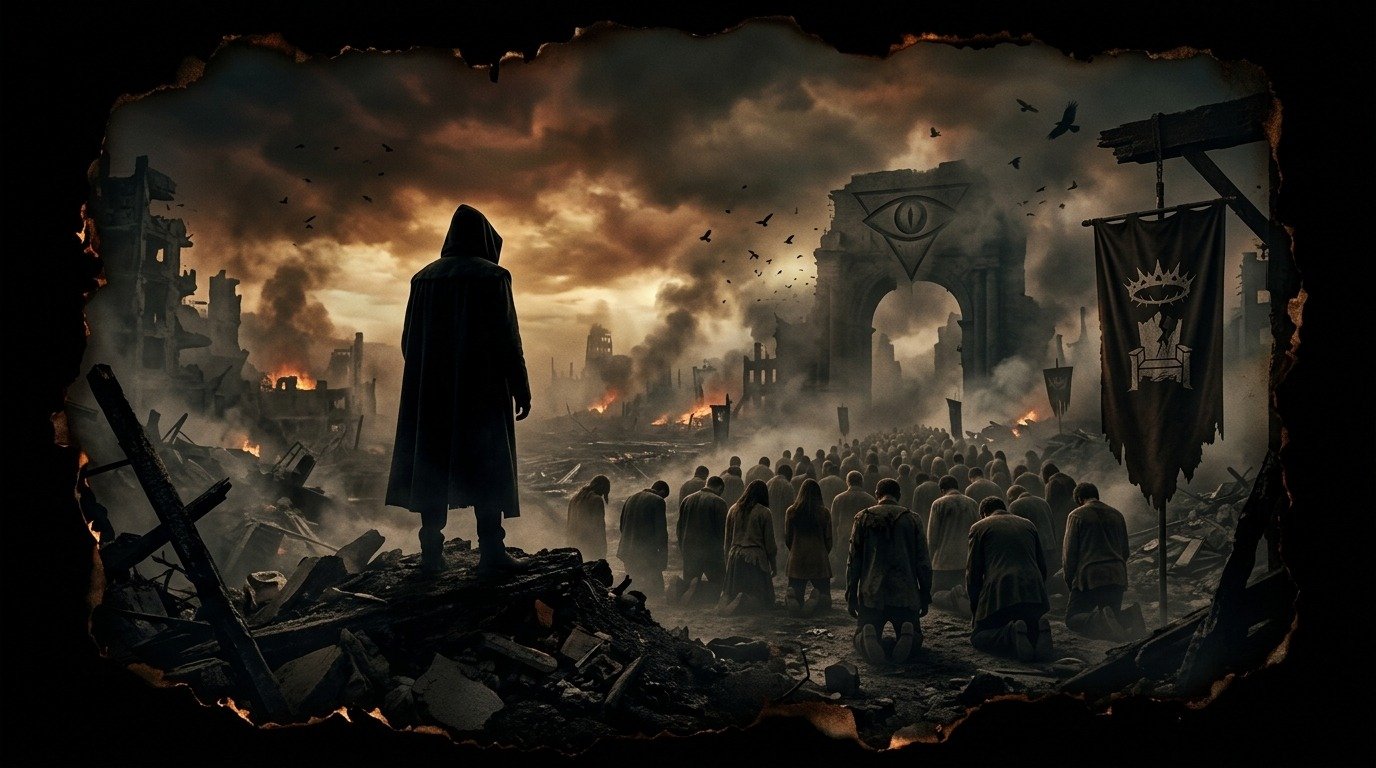
Antichrist: the great deceiver of the end times
The Antichrist is, in Christian tradition, the great deceiver of the end times: a leader who will appear in the midst of wars and chaos, promise peace to the world, perform wonders, unite nations under his power, and ultimately demand to be worshiped as God. According to the traditional reading of Revelation, he will reign for three and a half years, impose a mark without which no one can buy or sell, and be defeated in the final battle. Throughout history, his name has been given to emperors, popes, kings, and dictators.
The dark double
The theology of the end of the world describes the Antichrist not as a monster with horns and claws, but as the most perfect and dangerous imitation of divinity. He is the dark double, the exact reverse of the light. If tradition teaches that the redeemer stripped himself of his glory to serve in poverty, the great deceiver will rise on pride, wealth, and absolute power.
Eschatological texts detail his rise with surgical precision. His arrival will be preceded by an era of global chaos, apostasy, and natural disasters that will leave nations on their knees. In this scenario of despair, he will emerge as an extraordinary political leader, a charismatic peacemaker who will succeed in uniting historically clashing peoples under a single government. He will perform astounding wonders: he will make fire come down from heaven and apparently heal a mortal wound that he himself will suffer, faking his own resurrection.
His reign, however, will be a trap of three and a half years. Once his absolute power is consolidated, he will demand divine worship. Supported by a mystical ally known as the False Prophet, he will impose a mark on the right hand or forehead of every inhabitant of the Earth. Without this seal, no one will be able to buy, sell, or survive in the new order. Those who refuse to worship his image will face relentless persecution, the most violent recorded in history, until the conflict culminates in the plain of Armageddon, where his empire of deceit will be destroyed by the breath of the mouth of the true redeemer.
The birth of the Beast
The figure of the great opponent did not emerge from nothing; it was forged in the pain of ancient empires. Although the word "Antichrist" appears for the first time in the letters of the apostle John in the first century, the concept has its roots in much older prophecies. Centuries earlier, the prophet Daniel already spoke of a "little horn," a proud and cunning king who would defile the sanctuary and change times and law.
For the early Christians who read the revelations of John's Apocalypse, the end of times was not a distant theory, but a daily reality under the fist of Rome. They identified the first shadow of the Antichrist in the figure of Emperor Nero. That ruler who was blamed for the burning of his own capital, who used believers as human torches in his gardens, and who demanded to be worshiped as an incarnate god, fit perfectly into the mold of the absolute persecutor. The number of the Beast itself, the famous 666, finds its translation in Hebrew gematria as "Neron Qesar". When Nero died, the legend of his return was born: the *Nero Redivivus*, the belief that the tyrant had not actually died, but was waiting in the shadows of the east to return and claim his throne of blood.
A thousand faces for a single enemy
Throughout the centuries, the figure of the great deceiver became the most feared political and theological weapon in the West. In the Middle Ages, Abbot Joachim of Fiore mapped out the history of the world and announced that the Antichrist had already been born and that his public manifestation was imminent. The Black Death and the Mongol invasions did nothing but fuel this collective panic; people scanned the horizon looking for the armies of Gog and Magog that were to clear the way for the tyrant.
During the schism of the Protestant Reformation in the sixteenth century, prophecy was used as an accusing mirror. Martin Luther publicly declared that the Pope of Rome was the very Antichrist incarnate, an usurper who sat in the temple of God, passing himself off as God. Rome struck back in kind, pointing to the rebel monk as the Beast who sought to drag souls into the abyss of heresy.
With the arrival of modernity, the figure shed its ecclesiastical robes to adopt the form of the great transformers of the geopolitical map. Napoleon Bonaparte, with his ambition to unify Europe under a single code and his contempt for traditional crowns, was seen by his Russian and English contemporaries as the enemy of God. In the twentieth century, the industrial scale of death under the totalitarian regimes of Adolf Hitler and Joseph Stalin led millions of people to believe that the mark of the Beast had finally materialized in concentration camps and ideological passports.
The eternal suspicion
History shows that every era of profound crisis has baptized its own Antichrist. All those empires fell, the tyrants grew old and died, and the world continued to spin on its axis. None of the dates set for the end of the established order were fulfilled as the visionaries of each century imagined.
However, for scholars of eschatology, the lack of a definitive fulfillment does not invalidate the prophecy; on the contrary, it confirms it. Tradition teaches that the spirit of the deceiver operates constantly throughout the ages, rehearsing his role in lesser tyrants before the grand final performance.
The warning of the grimoire remains in effect, suspended over the future of humanity. The real danger of the Antichrist has never lain in his ability to instill terror, but in his extraordinary talent for making himself loved. His greatest triumph will not be the destruction of cities, but the moment when the world, weary of freedom and uncertainty, voluntarily hands over its keys to the man who promised to save it from itself.
Comments
Share information, an experience, or a source to help enrich this entry. They are automatically reviewed before being published.
Loading comments...