Apocalypse
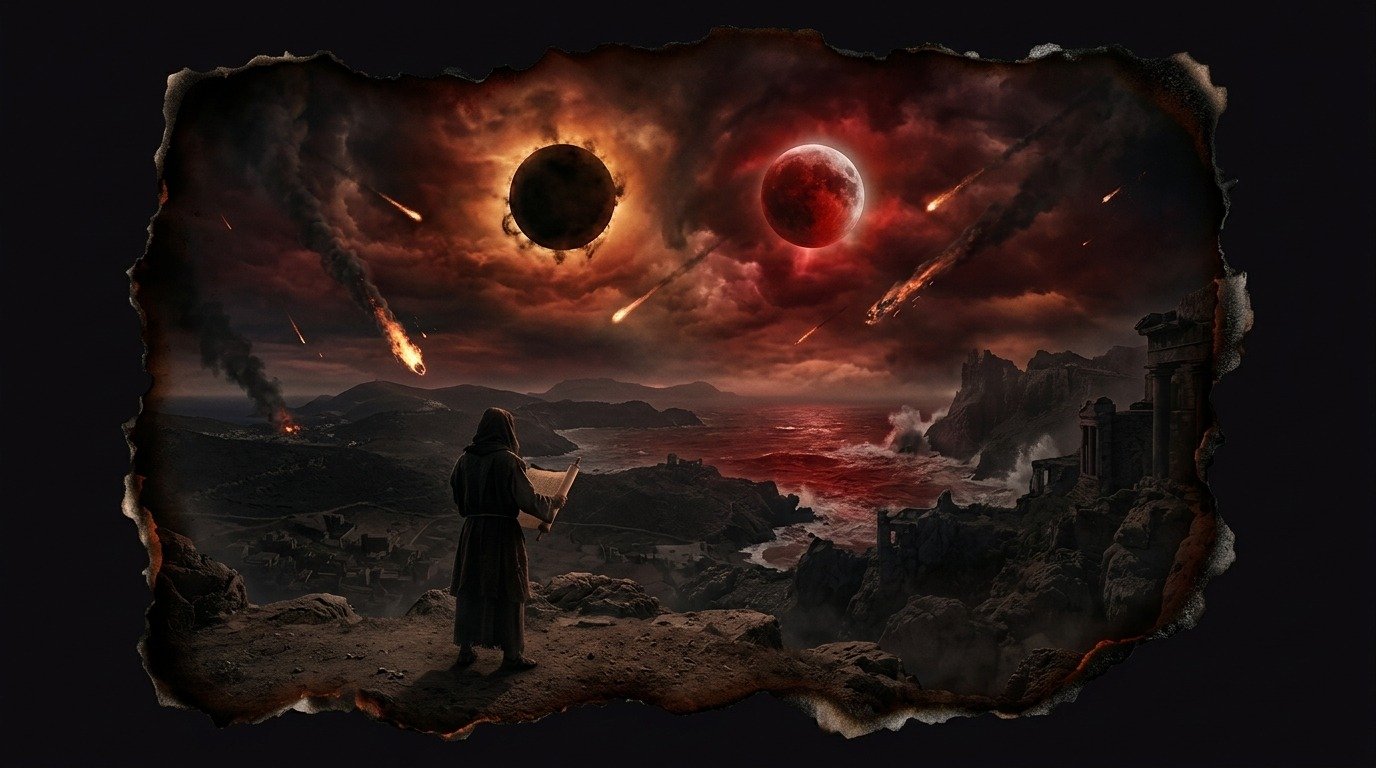
Apocalypse: The Revelation of John and the Collapse of the Cosmos
In the year 95 AD, imprisoned on the arid island of Patmos by order of the Roman emperor Domitian, a man named John wrote the text that would define the fear and hope of the Western world: the Book of Revelation or Apocalypse. This manuscript describes, through a series of linked visions, the total destruction of the cosmic and earthly order as a preliminary step to the establishment of a divine kingdom. It is not a simple natural cataclysm, but a judgment of divine proportions where the heavens are torn apart, the stars fall, and human history is dismantled step by step. The structure of this destruction unfolds through three cycles of seven judgments each: the seven seals, the seven trumpets, and the seven bowls of divine wrath. As each cycle progresses, the plagues and disasters become more devastating, reducing first to a third and then to the entirety the light of the sun, drinking water, the Earth's vegetation, and life in the oceans, culminating in the fall of Great Babylon and the descent of the New Jerusalem.
The Unsealing of the End of the World
The narrative of the Apocalypse begins at the throne of God, where a scroll sealed with seven wax seals awaits to be opened. Only a wounded but victorious Lamb is worthy of breaking them. With the breaking of the first four seals, the Four Horsemen burst into history: Conquest, War, Famine, and Death, who receive the power to ravage a fourth of the Earth. The fifth seal shows the souls of the martyrs crying out for justice under the heavenly altar, and the sixth unleashes a global-scale earthquake where the sun turns black like sackcloth of hair and the moon turns to blood. When the Lamb opens the seventh seal, there is absolute silence in heaven for about half an hour. This silence precedes the handing of seven trumpets to seven angels. The first four trumpets ruin nature: fire mixed with blood burns a third of the trees; a burning mountain falls into the sea, turning its waters into blood; a star called Wormwood falls upon the rivers, making them bitter, and the light of the celestial bodies is darkened by a third. The remaining trumpets release direct torments upon humanity, such as a plague of locusts with human faces and scorpion tails that torture men for five months without allowing them to die. The climax of divine punishment arrives with the seven bowls of wrath, poured out by angels directly onto creation. Unlike the trumpets, which affected only a fraction of the world, the bowls bring total destruction. Malignant sores break out on those who bear the mark of the Beast, the planet's waters turn into thick blood, the sun burns men with scorching fire, and the great city of iniquity is split into three parts under the greatest earthquake in human history, accompanied by hailstones weighing more than forty kilograms (eighty-eight pounds).
The Origin Among the Stones of Patmos
The Apocalypse was written in a context of extreme oppression. Under the rule of Domitian, the Roman Empire demanded the worship of the emperor as a living god. For the Christian communities of Asia Minor, refusing to participate in this state cult meant economic exclusion, imprisonment, or execution. John of Patmos wrote his text using the language of Jewish apocalyptic literature, a genre characterized by the use of hidden symbols, angelic visions, and monstrous beasts, designed to convey a message of resistance that Roman censors could not easily decipher. In this system of symbols, the "Bestia del Mar" represented Roman imperial power itself, its seven heads alluded to the hills of Rome, and the number 666 was a numerical code corresponding to the name of Emperor Nero. The Apocalypse was not originally conceived as a chronological riddle for the 21st century, but as a letter of resistance and comfort for the seven churches of Asia Minor, assuring them that the empire persecuting them was doomed to imminent destruction and that the final triumph belonged to God.
From Resistance to Historical Obsession
Over the centuries, the Apocalypse ceased to be read as a historical document about Roman persecution and became a roadmap for deciphering the future of the planet. During the Middle Ages, in the face of plagues, invasions, and ecclesiastical schisms, theologians feverishly sought to identify the characters of John's book in their own time. Joachim of Fiore, a 12th-century Calabrian abbot, divided the history of the world into three ages based on his readings of the text, predicting that the Age of the Holy Spirit would begin in the year 1260, bringing an era of monastic peace before the final judgment. During the Protestant Reformation of the 16th century, the text was transformed into a weapon of theological combat. Martin Luther and other reformers directly identified the Pope of Rome with the Antichrist and the Catholic Church with the Whore of Babylon. The Catholic Church responded by interpreting the book's prophecies as events that had already occurred in the first centuries of Christianity or as spiritual mysteries that should not be dated. This tension made the Apocalypse the most debated, censored, and illustrated book in the Bible.
The Fate of the Prophecy
Despite the countless dates proposed by various groups over two millennia, none of the literal interpretations of the cosmic collapse of the Apocalypse have materialized in history. The heavens have not rolled up like a scroll, nor have the rivers turned into wormwood. However, the language of John's book has migrated from theology to the secular imagination. Today, warnings about ecological collapse, nuclear war, and global pandemics are routinely described under the term "apocalyptic," demonstrating that, even without the mystical component, humanity continues to structure its fear of the future according to the pattern of destruction and renewal designed by the exile of Patmos.
Comments
Share information, an experience, or a source to help enrich this entry. They are automatically reviewed before being published.
Loading comments...