Ragnarök
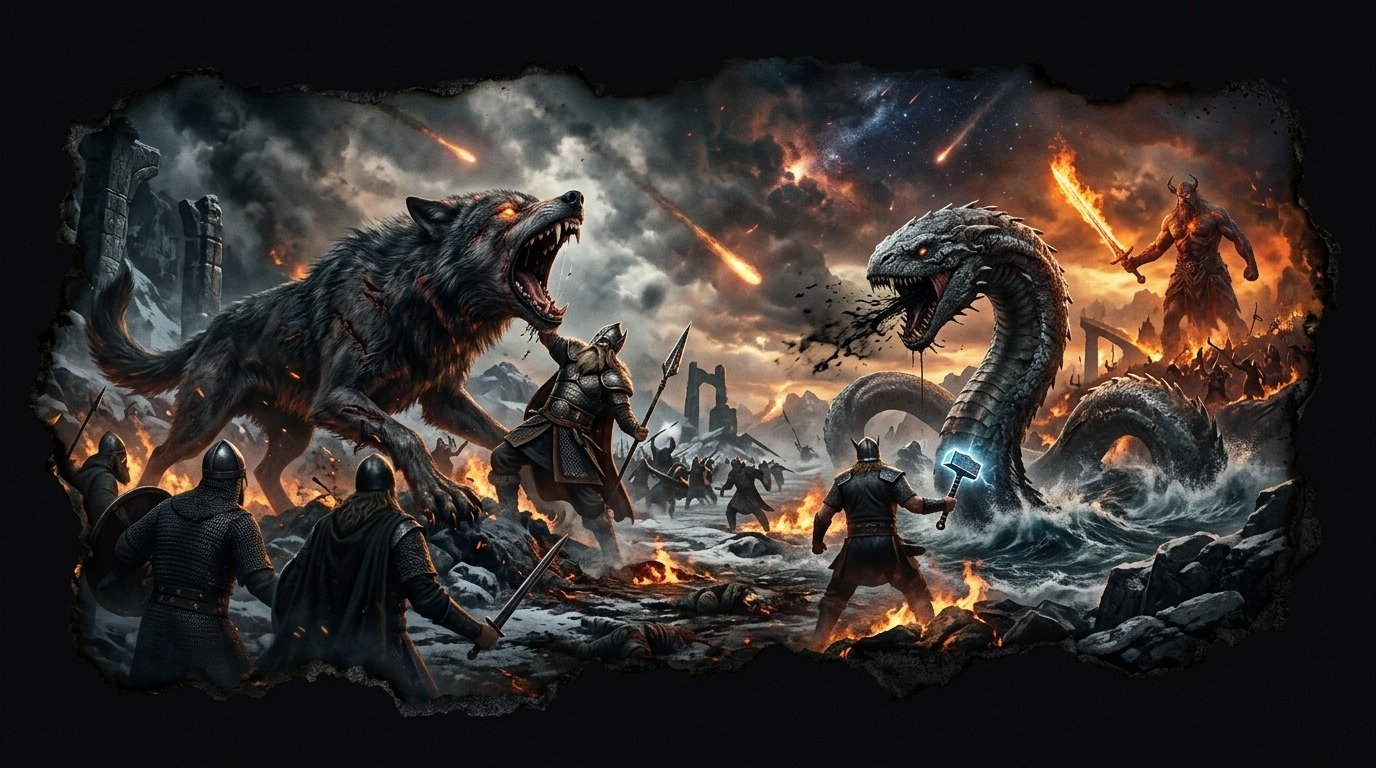
Ragnarök: The Three-Year Winter and the Collapse of the Gods
Ragnarök is the end of the Viking world: a final battle in which Odin, Thor, and almost all the Norse gods die, the sun and the moon are devoured, the world burns and sinks into the sea. But it is not the absolute end: a new land rises from the waters, and two humans hidden in the world tree repopulate it. This is foretold by the *Völuspá*, the prophecy that a dead seeress revealed to Odin himself.
The first sign is Fimbulwinter: three consecutive winters with no summer in between. Famine unleashes war between brothers. Afterward, the wolves Sköll and Hati catch up to the sun and the moon, the stars fall from the sky, and the earth trembles so violently that all chains are broken, including the one binding the wolf Fenrir.
The Unleashing of the Beasts and the Last Battle
The release of the forces of chaos marks the beginning of the end. The giant wolf Fenrir, whose gaping jaws touch heaven and earth, advances, destroying everything in his path, with fire spewing from his eyes and nostrils. Beside him, the Midgard Serpent, Jörmungandr, emerges from the ocean, churning the waters, flooding the coasts, and spitting a black venom that contaminates the air and the seas. From the east, the ship Naglfar, built from the nails of dead men, sails upon the rising waves, crewed by frost giants. From the south, the sky tears open and the sons of Muspell appear, led by Surtr, the fire giant, who wields a sword that shines brighter than the sun. As they cross the Bifröst bridge, the rainbow connecting the worlds shatters under the weight of the invading hosts. Heimdall, the guardian of Asgard, blows the horn Gjallarhorn with all his might. His call resounds through the nine worlds, summoning the gods and the fallen warriors of Valhalla. The stage for the final confrontation is the plain of Vigrid, a battlefield that stretches for one hundred leagues in every direction. There, order and chaos destroy each other. Odin attacks Fenrir, but the wolf swallows him whole; immediately, his son Vidar steps forward, treading on the beast's lower jaw with his boot and tearing its throat, avenging the Allfather. Thor faces the serpent Jörmungandr and manages to smash its head with his hammer Mjölnir, but he can only take nine steps before falling dead, suffocated by the venom the beast breathed upon him. Freyr falls before Surtr because he lacks his magic sword, and Loki and Heimdall slay each other in an agonizing combat. Finally, Surtr flings his purifying fire over the nine worlds. The scorched earth sinks into the black ocean. Silence dominates the cosmos.
Rebirth from the Ashes
The destruction is not absolute emptiness. The Norse prophecy foretells that, from the deep waters, a new land will emerge, green, beautiful, and fertile, where crops will grow without needing to be sown. A new solar deity, daughter of the previous one, will journey across the sky. Two human beings, named Lif and Lifthrasir, survive the conflagration hidden within the roots of the world tree, Yggdrasil, nourishing themselves on the morning dew. From them, the new humanity will descend. The surviving gods, including the sons of Odin and Thor, will gather in the ruins of Asgard. There, among the fresh grass, they will find the golden gaming pieces they used to play with before the disaster, ready to begin an era of peace free from the shadows of the past.
The Voice of the Seeress in the Frozen North
This vision of the cosmic cataclysm comes primarily from two medieval Icelandic texts: the *Poetic Edda*, a collection of anonymous poems dating back to the oral tradition of the Viking Age, and the *Prose Edda*, written in the 13th century by the scholar and historian Snorri Sturluson. The most famous poem in the collection, the *Völuspá* (The Prophecy of the Seeress), features a dead prophetess whom Odin resurrects so she may reveal to him the origin and final destiny of the universe. For the Norse peoples, who inhabited a hostile geography of active volcanoes, glaciers, and endless winter nights, Ragnarök was no distant metaphor. The fear of extreme cold and social isolation under an endless winter reflected their worst everyday fears, projected onto a divine scale.
Ethics in the Face of the Abyss
Unlike Middle Eastern eschatologies, where the final judgment separates the righteous from the sinners, Ragnarök presents an inescapable destiny that affects the guilty and the innocent alike. The Norse gods are neither immortal nor omnipotent; they know the prophecy of their downfall and know they will lose the battle, yet they choose to march toward it with their heads held high. This belief shaped the code of conduct of Viking warriors. If the universe itself was doomed to disappear and not even the gods could escape their fate, the only possible victory for a mortal lay in showing courage in the face of inevitable death. To die with sword in hand to join the ranks of Odin in Valhalla was the supreme honor, a way of preparing for the final battle alongside their creators.
The True End of an Era
The end of the Norse world occurred historically between the 10th and 12th centuries, but it did not arrive with fire or giant wolves, but rather with the gradual conversion of Scandinavia to Christianity. The ancient pagan temples, such as the great sanctuary of Uppsala in Sweden, where sacrifices were made to Odin, Thor, and Freyr, were demolished and replaced by stave churches. Christian missionaries used the very structure of the Ragnarök myth to facilitate the religious transition. By presenting the death of the old gods as a fait accompli and connecting the return of Baldr (the god of light and justice) with the figure of Jesus Christ, converts were able to assimilate the new faith without entirely breaking with their poetic traditions. Runic stones of the era, such as the Ledberg stone in Sweden, show images of warriors fighting giant wolves alongside Christian crosses, bearing witness to the exact moment when a world of warrior gods gave way to a new era.
Comments
Share information, an experience, or a source to help enrich this entry. They are automatically reviewed before being published.
Loading comments...